题目内容

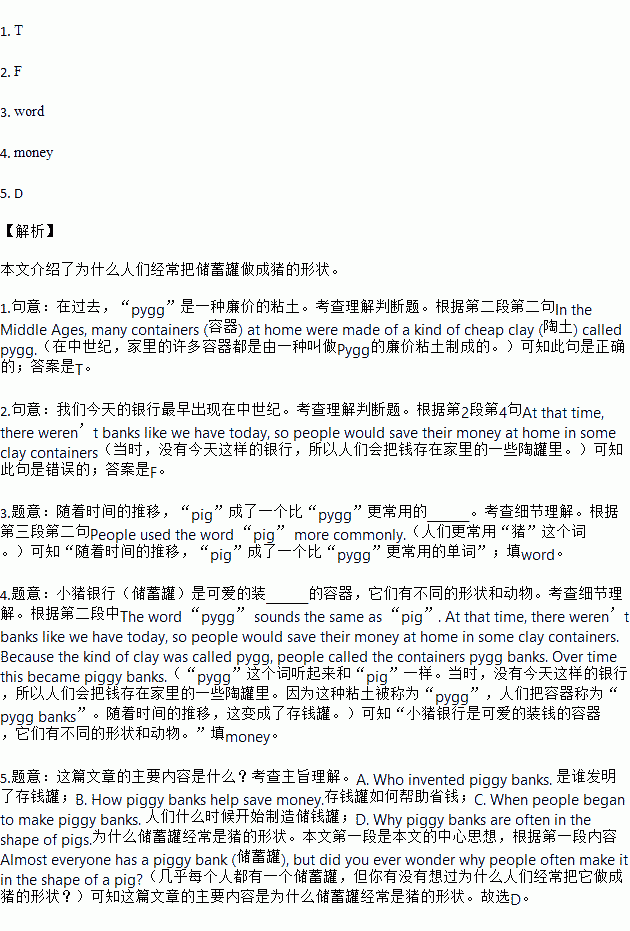
Almost everyone has a piggy bank (储蓄罐), but did you ever wonder why people often make it in the shape of a pig?

Believe it or not, people made the piggy bank in the shape of a pig by mistake. In the Middle Ages, many containers (容器) at home were made of a kind of cheap clay (陶土) called pygg. The word “pygg” sounds the same as “pig”. At that time, there weren’t banks like we have today, so people would save their money at home in some clay containers. Because the kind of clay was called pygg, people called the containers pygg banks. Over time this became piggy banks. After several hundred years, people forgot that the word “pygg” meant a kind of clay.

The English language also changed. People used the word “pig” more commonly. So when English workers were asked to make “piggy banks”, they thought they needed to make containers in the shape of pigs. Surprisingly, the pig-shaped containers were popular.

Today piggy banks are made of all kinds of things, and they also come in different shapes and animals. But people still call those cute containers for money piggy banks.

根据材料内容完成下列任务。

任务一:判断正(T)误(F)。

1.In old times, “pygg” was a kind of cheap clay.

2.The banks we have today first appeared in the Middle Ages.

任务二:完成句子,每空一词。

3.As time went on, “pig” became a more commonly-used ________ than “pygg”.

4.Piggy banks are cute containers for ________ and they come in different shapes and animals.

任务三:选择最佳答案。

5.What’s the passage mainly about?

A. Who invented piggy banks.

B. How piggy banks help save money.

C. When people began to make piggy banks.

D. Why piggy banks are often in the shape of pigs.
练习册系列答案
相关题目

Maybe you think that many parents have a lot to learn about what their children are doing online. According to a recent survey by Symantec Company, which makes many kinds of security(安全)software for home and business computers, there's a "huge difference between parents and their kids".

Parents of children under the age of 18 were asked to estimate(估计)how much time their kids spent online each week. The parents said about three hours a week on average(平均).The kids-ages 8 to 17-who took the survey said they were spending an average of seven hours online each week.

"I really think that's because of the time they spend on their mobile phones and computers, when their parents don't even know they're online," says Symantec's Bill Rosenkrantz. "Remember, cellphones, PDAs and video game machines all make it possible to surf the Internet. You don't have to sit in front of a computer screen."

And what are the kids doing on the Web? "They're doing things, like downloading music, they're going to social networking sites, they're actually shopping online when parents don't think they're doing those kinds of activities," says Rosenkrantz. "They're also, we think, doing some things with research papers and other kinds of activities with homework maybe where they're getting some information online and they really shouldn't be." Nearly a quarter of the kids (23 percent) night do things their parents would not agree.

So how does a modern parent deal with this type of situation? "The first thing we strongly recommend is that parents spend fine with their children online," Rosenkrantz, says. "Sit down with them and understand what they're doing. Secondly, have a dialogue about it. Have a dialogue about what's an acceptable activity, what's an unacceptable activity, and set some ground rules-time online, things you can and can't do. Really have those conversations. That's the most important ." There are a lot of bad people on the Internet. That's why it's so important for parents to know what their kids are doing online.

1.The data(数据)in the second paragraph are used to show .

A. parents don't exactly know kids' online activities

B. time spent online changes with children's ages

C. children always spend too much time online

D. children spend more time online than their parents

2.What can we learn from the passage?

A. Some kids surveyed may go against their parents' rules.

B. Most parents know what their kids are doing online.

C. Special home computers are being made by Symantec.

D. Parents are too busy to pay attention to their kids.

3.In Rosenkrantz's opinion, the key to the situation is that parents should .

A. shorten their kids' time spent online

B. know their kids' online activities

C. use security software in computers

D. have a dialogue with their kids

4.What's the purpose of the passage?

A. To advertise a piece of useful security software.

B. To call parents' attention to kids' online behaviour.

C. To warn children of the risks online activities.

D. To give reasons for kids' bad Internet habits.

Are you looking for something fun and would you like to help others in your free time? Then join us to be a volunteer! We’re a non-profit organization. We have volunteer jobs of all ages. Anyone, from twelve-year-old children to people in their seventies can become a volunteer.

You can help people in many ways. Schools need volunteers to help with taking care of children while parents are working. Hospitals need volunteers to look after children while their parents are seeing a doctor. Animal lovers can help take care of those dogs and cats without homes. There is something for everyone.

“As a volunteer, I don’t want to get anything. Seeing the children’s happy faces, I’m happy, too.” said Carlos Domingo, an old woman of 62. “I often played computer games in my spare time before.

Now I help older people learn how to use computers.” said another volunteer at the age of 18.

If everyone helps out a bit, we’ll have a better world to live in. Interested? Call us at 1-800-555-5756 or visit our website: www.activol.com.

1.When do the volunteers help others?

A. In their free time. B. At weekends. C. On weekdays. D. In the evenings.

2. can be a volunteer.

A. Children B. Old women C. Anyone aged 12-70 D. Young people

3.Volunteers want to get when they help others.

A. money B. computers C. everything D. nothing

4.Carlos Domingo does volunteer work with .

A. animals B. children C. computers D. older people

5.We can read such a passage .

A. in a newspaper B. in a storybook C. in a picture book D. in a textbook

违法和不良信息举报电话:027-86699610 举报邮箱:58377363@163.com

精英家教网
