题目内容

【题目】Understanding Graphics(图表)

When we are reading, we often see one or two graphics in a text. Have you ever thought about these questions: Why are they there? What information do they give? Do they help with our reading and understanding?

Graphics are things like pictures, maps, charts and tables. They give information to readers. Very often, we can see different kinds of graphics in books, magazines and newspapers. Writers use graphics to get the readers'attention and give them some particular(特别的)information. Graphics help to understand the given information in a text. And graphics put the information in a particular order so that it's easy to understand when we take a quick look.

It is not always true that a picture is worth a thousand words. But many things are easier to show than to tell and they may also be easier to understand. Graphics are just the right things that give a great deal of information but it doesn’t take much time to read and understand.

The right way to read and understand a graphic is to look at the picture and the words together. In a graphic, only a few words are used to explain what the picture shows you. Sometimes, numbers and percentages(百分比) are also given to go with the words to explain things.

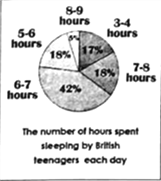
Now look at the graphic on the right. It is how a researcher used a graphic to show the number of hours spent sleeping by British teenagers each day. Can you understand it?
1Which of the following is mentioned as a graphic?

A. A letter.

B. A poem.

C. A map.

D. A name card.

2The writer thinks graphics are important because ____________.

A. less space is taken on a page

B. a picture is worth a thousand words

C. a lot of time can be saved for writers

D. many things are easier to show than to tell

3When we read a graphic, we should ______.

A. find out if there are any tables in it

B. put the information in the right order

C. count how many words there are in it

D. look at the picture and the words together

4The graphic given in the passage tells us that ________.

A. 5 British teenagers sleep for 8-9 hours every day

B. Chinese 18-year-olds spend 5-6 hours sleeping every day

C. 17% of the British teenagers sleep for 3-4 hours each day

D. 42% of the Chinese teenagers spend 6-7 hours sleeping each day

【答案】

1C

2D

3D

4C

【解析】短文介绍了图表的作用以及如何正确使用图表的方法。图表包括图片、地图、图纸和表格之类的东西文本中插入图表能帮助读者更直观快捷地理解相关信息,理解图表的正确方法是把图片和文字一起来阅读

1细节理解题。根据第二段中的句子“Graphics are things like pictures, maps, charts and tables.” 图表是图片、地图、图纸和表格之类的东西地图属于图表,故答案为C。

2细节理解题。根据文中第三段中的句子“But many things are easier to show than to tell and they may also be easier to understand. Graphics are just the right things that give a great deal of information but it doesn’t take much time to read and understand.”很多事情比说出来更容易,而且也更容易理解。图表提供了大量的正确信息阅读和理解并不需要太多的时间。可知作者认为图表是重要的,因为许多东西显示出来比说出来更直观更容易,故答案为D。

3细节理解题。根据短文第4段中的句子“The right way to read and understand a graphic is to look at the picture and the words together.”阅读和理解图表的正确方法是把图片和文字一起看。故答案为D。

4图表理解题。根据图表下面的文字“The number of hours spent sleeping by British teenagers each day.”可知,图表显示的是英国青少年每天睡觉的时间。通过统计表分析,17%的英国青少年每天睡觉3-4小时,故答案为C。


练习册系列答案
相关题目

【题目】阅读短文,根据其内容回答文后各个小题。

What Does a Lifelong Learner Look Like?

Lifelong learners never think of themselves as the greatest expert in anything. They continue-to learn and bring a great deal to the groups they belong to. What does a lifelong learner look like? Here are some of their main characteristics (特征).

They are knowledge seekers. They are always searching for much information on a topic they're interested in and looking for new experience or opportunities to improve their knowledge or skills.

They are social and self-directed learners. They like taking different courses and taking part in discussions around subjects they are interested in. ___________________ they also know their own learning styles, and their strengths and weaknesses. They can plan and organize their own learning.

They are critical(批判性的) thinkers. They always use a lot of ways to analyze (分析) and synthesize(A EX)information. From their research they judge the information to see if it is useful for the question at hand.

They are problem solvers. They will meet different problems while learning. However, they usually see problems as challenges and life experiences and try to stand above them.

1What does the underlined "knowledge seekers" mean?

A. Persons who are looking for knowledge.

B. Persons who are teaching knowledge.

C. Persons whose jobs are inventing knowledge.

D. Persons who are testing knowledge.

2What can be put in the blank(空白处)?

A. They don’t like learning on society.

B. They learn both from and with others.

C. They learn from plants and animals.

D. They invite each other to parties.

3Which of the following most clearly shows you are a critical thinker?

A. You always use a lot of ways to analyse and synthesize information.

B. You believe in the information you get and use them in your study.

C. You correct mistakes someone makes as soon as you find them.

D. You ask others for help when you can’t correct your own mistakes.

4How is the passage organized? (P= Paragraph)

5What is the purpose of the passage?

A. To describe the height, clothes and hairstyle of a lifelong learner.

B. To explain the relationship between common people and lifelong learners.

C. To suggest lifelong learners become experts.

D. To introduce some of the main characteristics lifelong learners have.

【题目】A photo of a boy who arrived at school with a

head full of icicles(冰柱)has drawn widespread

attention to children from poor rural families.

Wearing only a thin jacket, Wang Fuman,10,

had braved -9C weather to travel over an hour

from his village home to reach Zhuanshanbao

Primary School in Zhaotong, Yunnan province.

“After walking more than 4 kilometers through the freezing snow. he arrived with his hair and eyebrows completely frozen, causing laughter among his 16 classmates,” said Fu Heng, the

school’s principal, who uploaded(上传) Wang’s photos on Monday morning. Fu added that his

classrooms do not have heating because of a lack of money.

After hearing Wang's story, the Yunnan China Youth Development Foundation offered a public donation(捐赠) for children from poor families on Tuesday. It has promised to give each needy child 500 yuan ($75) to help them stay warm in winter. By 1:00 p.m. on Wednesday, the provincial foundation bad collected over 300,000 yuan in public donations according to their websites.

Wang, who has been nicknamed “Snowflake Boy”(冰花男孩)by netizen (网友),became

well-known online. By Wednesday morning, his picture had been 'liked" more than 260,000 times on Sina Weibo. “Many children in cities don't have the strong willpower of this boy. I hope all his efforts will be rewarded(回报),” a netizen wrote on Sina Weibo.

The name Fuman translates as “full of happiness”, but Wang does not come from a rich family. He lives in a mud hut(土坯房) with his grandmother and elder sister, and seldom sees his parents

because they are migrant workers in other cities.

“I love school. We can have bread and milk for lunch, and we learn lots of things in class,” Wang said. His village now has electricity and tap water, “and my family is getting help to build a

new house close to the school”, he said. “I think our life will get better.”

1Why did Wang's classmates laugh when he came in?

A. Because they thought Wang was poor.

B. Because they wanted to laugh at him.

C. Because he appeared with a head full of icicles.

D. Because Wang was late for class again.

2What did the netizens do according to the passage?

A. They took photos of Wang Fuman and uploaded them in time.

B. They expressed their support and admiration.

C. They promised to give each needy child 500 yuan.

D. They helped Wang return to school.

3The underlined phrase “a lack of money” can be replaced “

A. being short of money B. losing money

C. plenty of money D. saving money

4What can we know from the passage?

A. the Yunnan China Youth Development Foundation offered a public donation for Wang Fuman on Tuesday.

B. Wang’s village doesn’t have electricity and tap water now.

C. Wang loves school just because he can have bread and milk for lunch.

D. The children got help quickly because of social love and convenient Internet.

【题目】

“Where is the university?” This is a question that many visitors to Cambridge ask. But no one can give them an exact answer, for there is no wall to be found around the university. Theuniversity is the city. You can find classroom buildings, libraries, museums and offices of theuniversity all over the city. And most of its members are the students and teachers of the thirty-one colleges.

Cambridge was already a town long before the first students and teachers arrived 800 years ago. It grew up by the river Cranta, and the river was once called the Cam. A bridge was built over the river as early as 875, So the town got its name “Cambridge”.

In the fourteenth and fifteenth centuries more and more land was for college buildings. The town grew much faster in the nineteenth century after the opening of the railway in 1845. Cambridge became a city in 1951 and now it has a population of over 100,000. Many young students in other countries expect to study at Cambridge. A large number of people from all over the world come to visit the university. It has become a famous place all around the world.

1Visitors to Cambridge can find the following in the university except ____________.

A. libraries B. walls C. offices D. museums

2According to the passage, Cambridge University is made up of____ colleges.

A. 31 B. 15 C. 875 D. 800

3The town got its name from______________.

A. the first students and teachers B. the bridge built over the river Cam

C. the members of the university D. the person who designed the bridge

4Which is the correct order of the events about Cambridge?

a. The railway was opened.

b. Cambridge became a city.

c. More and more land was for college buildings.

d. The first students and teachers arrived at the town.

A. a→c→b→d B. d→a→c→b C. b→c→a→d D. d→c→a→b

5From the passage, we know that_____________.

A. the town grew much faster before 1845

B. the city had a population of 100,000 in 1953

C. many young students dream of studying at Cambridge University

D. the Cambridge University has a history of more than 1,000 years

【题目】How to be a safe and smart SEARCHER

S

everal keywords will help to find better results. Use more than one keyword when you are doing a search. If you want to find out about seagulls, for example, search for and not just ‘seagull’ – because seagull might also be the name of just about anything else, from a hotel to a documentary film.

E

xact references can help you find what you’re looking for. If you are looking for an exact phrase or sentence, e.g. , type it between quotation marks (“”) and only exact matches will be shown. This is useful when you want to find something you’ve already seen but lost.

A

void common words like ‘a’ or ‘the’ in a search. These aren’t always helpful and are usually unnecessary.

R

emove unwanted results by adding a minus symbol (-). For example, would leave out all references to hotels and films.

91 . Make sure that you spell every word in the search box correctly. The smallest typing mistakes can bring unwanted results - especially when the mistyped word exists.

H

ave a filter(过滤程序). It’s a good idea to filter your searches, especially when you are searching for pictures. Ask an adult to help you add a filtering system. There are lots of filtering software options available.

E

xperiment with different search engines until you find the one that’s best for you. Some search engines personalise the results. So check out the option of using a search engine that doesn’t do this and you will get different results.

R

eliability is very important when you are searching on the Internet. Always ask yourself, “Is this reliable?” Don’t make the mistake of believing everything you see. Some websites are unreliable and some information is false. Check your information on other websites before accepting it.

1This is an article written for adults, isn’t it?

______________________________________________________________________.

2If you want to find out about peaches, what keywords may help you find better results?

______________________________________________________________________.

3How can we get exact matches when we are looking for an exact phrase?

______________________________________________________________________.

4What can be filled in the blank?

______________________________________________________________________.

5What is especially important for picture searches?

______________________________________________________________________.

6Write three DON’Ts about safe and smart search.

Don’t _____________________________.

Don’t _____________________________.

Don’t _____________________________.

违法和不良信息举报电话:027-86699610 举报邮箱:58377363@163.com

精英家教网