题目内容

阅读下面短文,根据所读内容,在文章后1-10小题的空格里填入一个最恰当的单词。注意:每个空格只填1个单词。

Some people dislike hiking because they think it is too difficult. However, sometimes it can really be as easy as going out to the park and walking by the river. The places for hiking should be far away from the cars and the noise. Here’s some useful advice for people to go hiking.

First of all, when you choose your first hike, you should be careful. If you choose a too easy one, you’ll still have a nice day outside to enjoy. However, if you choose a too hard one, you may be very tired and can’t have a good time.

Secondly, it’s good for a beginner to join a group. The people in a group can help each other. If you decide to take a hike by yourself, you should prepare as much as possible. You should wear right shoes to make your feet comfortable. Also, take a map with you. If not , you’ll fail to find your way home.

At last, don’t forget to take a mobile phone or a whistle(口哨). When you are in trouble, you can use it to get help. A pleasant hike will give you a sense of freedom(自由) and you will also have a clear mind(头脑) and then return to your studies after it.

Something about hiking

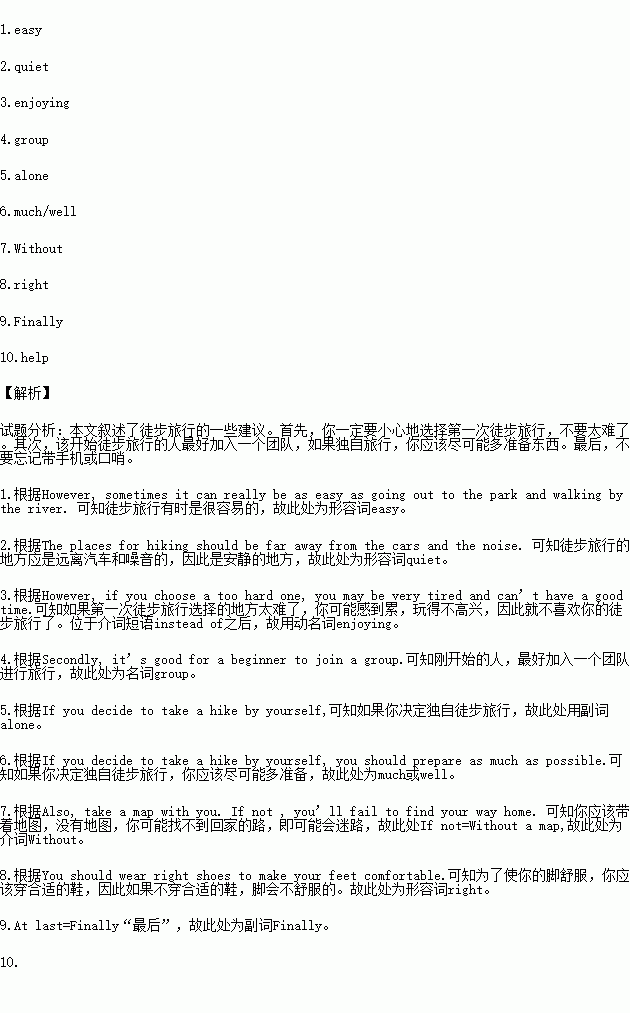
It’s difficult for some people to take a hike, but sometimes it’s 1. to take it. You should take a hike in a far and 2. place.

First of all

You must be careful to choose your first hike. If it’s too hard, you may feel tired instead of 3. your hike.

Secondly

It’s good for a beginner to go hiking with a 4. .

When you decide to take a hike 5. , you should prepare6. .

7. a map, you may lose your way.

If you don’t wear 8. shoes, your feet may feel uncomfortable.

9.

When you are in trouble, a mobile phone or a whistle may 10. others to know where you are. A pleasant hike will be good for your studies.

练习册系列答案
相关题目

When I was a child, I often dreamed of the time when I could leave home and escape to the city. We lived on a farm and, in the winter especially, we were quite cut off from the outside world. As soon as I left school, I packed my bags and moved to the capital. However, I soon discovered that city life has its problems too.

One big disadvantage is money---it costs so much to go out, not to mention basics like food and housing. Another disadvantage is pollution. I suffer from asthma(哮喘), and at times the air is so bad that I am afraid to go outside. Then there is the problem of travelling round. Although I have a car, I seldom use it because of the traffic jams. One choice is to go by bicycle, but that can be quite dangerous.

Of course there are advantages. First, there is so much to do in the city, whatever your tastes in culture or entertainment. Besides, there are wonderful jobs and greater chances of moving to a more important job or position. Finally, if you like shopping, the variety of goods is very surprising---and, what is more, shops are often only a short walk away.

Is life better then, in the city? Perhaps it is, when you are in your teens(十几岁) or twenties. However, as you get older, and especially if you have small children, the peace of the countryside may seem better. I certainly hope to move back there soon.

1.What was the writer always thinking about when he was a child?21*cnjy*com

A. Staying on the farm

B. Moving to the countryside

C. Leaving home for the city

D. Running away from the school

2.Which of the following is true about the writer?

A. He is very old now.

B. He is in good health.

C. He prefers driving a car.

D. He lives in the city now.

3.In the passage, the writer tries to _______.

A. express his opinions about way of life

B. describe his life in the countryside

C. show an interest in the outside world

D. ask the reader to live in the city

4.How is the passage mainly developed?

A. By inferring B. By comparing

C. By listing examples D. By giving explanations2

If you are lucky enough, you may find the hummingbird (蜂鸟), the smallest bird of the animal world, in a south American forest.

Though the hummingbird is no bigger than a bee and weighs only 2 to 3 grams, it can fly as fast as 50 meters in a second. It can fly forwards (向前) as most birds do, and it can fly backwards as well. The strangest thing about it, however, is that it can stay still in the air, just like a helicopter.

Whenever a hummingbird needs food, it will fly slowly towards a flower. It won’t stand on the flower, as bees do, but just hangs to the flower and then begins to sunk (吸吮) the honey from inside the flower with its needle-like beak.

The hummingbird is very particular in building its nest (巢). It takes great trouble to choose materials. It likes soft ones better than hard ones. Its eggs are so small that a common match box can hold as many as one hundred of them.

1.Most of the hummingbirds live in a(n) __________ forest.

A. north American B. south Asian

C. north Asian D. south American

2.A hummingbird can fly as fast as _______ meters in a second.

A. fifty B. five hundred

C. fifteen D. one hundred and fifty

3.The underlined word “helicopter” most probably means _______.

A.轮船 B. 公共汽车 C. 火车 D. 直升飞机

4.When a hummingbird builds a nest, it likes better.

A. soft materials B. hard materials

C. an material D. both

5.Which of the sentences is NOT true?

A. A hummingbird can even fly backwards.

B. You cannot see the wings of a hummingbird move.

C. A hummingbird will fly quickly towards a flower when it’s hungry.

D. A common match box can hold as many as one hundred hummingbird eggs.

Language students often think they have memory problems. They worry because they can’t remember words. In fact, the problem usually isn’t with their memory. The problem is with how they study.

To remember words better, you need to understand how memory works. There are two kinds of memory: short-term and long-term. When you see, hear, or read something, it goes first into short-term memory. But short-term memory lasts for only a few seconds. You will only remember something longer if it goes into long-term memory. Your long-term memory is like a very big library with many, many books. And like a library, it’s organized (有条理的). When you put away a book or memory you can’t just leave it anywhere. You have to choose a place where you can find it again.

How can you do this with vocabulary? The answer is to work with the word and think about the word in new ways. You can do this by writing new sentences that include it. Even better, you can invent a little story about the word, with people or places that you know. Another way is to make a picture in your mind with the word. For example, if the word is height, you can think of the tallest person you know and try to guess his or her height. All of these activities are good ways to think about words. They make the meaning of words stronger in your long-term memory. And they give a way to find a word when you need it.

1.In the writer’s opinion, students can’t remember words because _______.

A. they have memory problems

B. they are too worried

C. they don’t use a proper way

D. they don’t like to study

2.Which is TRUE about memory according to the passage?

A. Short-term memory is seldom used.

B. What we see goes into long-term memory first.

C. We will forget a word soon if it goes into short-term memory.

D. We will never forget a word if it goes into long-term memory.

3.The underlined (划线的) part in Paragraph 2 means long-term memory _______.

A. keeps many books like a large library

B. works like a well-organized library

C. provides any book you want

D. leaves memory anywhere

4.Which is one example of “thinking about the word in new ways” in Paragraph 3?

A. Making sentences with the word.

B. Listening to some familiar stories.

C. Talking with people that you know.

D. Drawing pictures of the word on paper.

5.This passage mainly tells us about _______.

A. language students’ problems in study

B. how to make the meaning of words stronger

C. short-term and long-term memory

D. how to improve ways to remember words

违法和不良信息举报电话:027-86699610 举报邮箱:58377363@163.com

精英家教网