题目内容
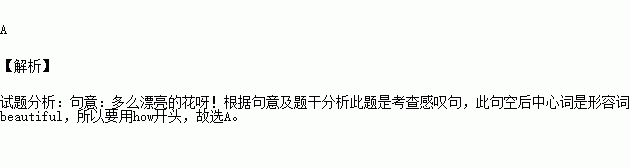
beautiful the flowers are!
A.How B.What C.What a
翻译语篇。阅读下面的短文.将文中划线部分的句子做相应的英、汉互译。
Do you know the pretty girl? Her name is Tian Wei. She was born on April 5,1986. she was from Beijing.她有一双大眼睛and short hair. She was good at Chinese. And she loved writing .
她是不幸的。.When she was in Grade 8, she was ill. Her doctor said she would lose her life anytime. But she wasn’t afraid of death. She kept on studying and writing. She died on August 13,2007,At the end of her life, she was still smiling.
Tian Wei had a great dream. She hoped that people could read her book in the bookshops. In Mrach,2009,her only book Hua Tian Ban Mu(半亩花田) came out. It had more than 5 thousand words. In her book she said, “I’m always aching(疼痛, if possible, I’ll let my right eye weep(哭泣)but the other one smile.”
1.
2.
3.
4.
5.
The judge(法官) thought Geoffrey Payne killed his wife. Now for the first time Payne wrote to a magazine from the prison about what happened on the night of 13 October 1999.
I had to stay late at the hospital that night to do an operation. I finally left at about 11p.m.. I drove home slowly because the wind was blowing and it was raining heavily. I was running into our road when a man suddenly ran in front of my car. I almost hit him but I stopped just in time. I was scared and the man looked scared, too. I got out of the car but he ran away before I could ask if he was all right. It was very strange.
When I got home, the lights were on but it was very quiet. I called to my wife but there was no answer. Then I remembered that she was out at a concert.
I was still very unhappy about what happened on the road, so I made myself a drink. Then I went upstairs to have a bath. I saw that the window in the bedroom was open. This was strange because my wife always locked the doors and windows before she went out. She was afraid of burglars. When I went to close it, I found Ellen. She was lying on the floor. There was blood everywhere. I rushed over for her pulse but she was dead. I was so scared. I sat on the floor beside her body without knowing what to do.
The next thing I knew was that the sky was getting light. I can’t remember a thing about that night. In the morning I phoned the police. They arrived half an hour after I phoned them. But it seemed like hours. During that time I tried hard to remember anything I could about the night before. I couldn’t stop thinking about the man in the road. What was he doing at that time of night in our quiet neighborhood?
1.When Payne got home, he found ______________.
A. a burglar in his house
B. the bedroom window closed
C. Ellen lying on the floor, blood all over
D. Ellen waiting for him in the concert hall
2.After he found Ellen dead, Payne .
A. called out for help
B. called the police at once
C. was too scared to do anything
D. tried to find out the murderer
3.Which of the following is NOT true?
A. Payne called the police the next morning.
B. Payne ran away after his car bumped into the man that night.
C. Payne couldn’t remember clearly what had happened that night.
D. Payne wondered what the man was doing in his neighborhood that night.
4.In this passage Payne tried to .
A. show he was sorry for his wife’s death
B. show he was guilty for murdering his wife
C. tell why his wife was killed that night
D. say the man in the road was probably the murderer
--______ does your father do morning exercises?—Hardly ever.
A. How B. How often C. When D. What time
Bring a map of China because you _______ want to travel around.
A. may B. must C. need D. can
完形填空
A new term has begun. Teachers are worried about the fact that new students are not easy to deal with. They like to bring cell phones and MP3 players to school. What is_____, some students even use cell phones_____out-of-class matters in class, or sometimes just for fun. Some_____students listen to MP3 players when they are having a lesson that they are not interest in.
Are these new students really that____? “Yes.” says Delaney Kirk, a professor at Drake University. ____she adds it’s not their fault. _____, the teachers should be blamed(责备). Mrs Kirk first began thinking about students’ manners six years ago. “I had my first class in which students were sleeping or talking to each other. It seemed that learning well or had nothing to do with them.” she says. “At first, I got worried about this.” But then I said to myself, “You’re giving lessons, and you need to manage this kind of situation. These students need to know more about manners. It’s time to help them develop some good______. They shouldn’t waste time doing nothing when they are young. Sooner or later, they may regret the time they____.”
Mrs Kirk also____a list of suggestions to help teachers better manage their classes. The following are among her suggestions:
●On the first day of class, tell students how they will benefit(受益) by taking the class and the importance of listening carefully in class.
●Do not allow them to bring cell phones or MP3 players to the class at all.
● Tell them how to use cell phones or MP3 players _____.
1.A. bad B. worse C. good D. better
2.A. do B. doing C. to do D. did
3.A. other B. the other C. others D. another
4.A. rude B. polite C. friendly D. boring
5.A. But B. However C. And D. So
6.A. Such as B. For example C. Instead of D. Instead
7.A. ideas B. speeches C. habits D. classes
8.A. had wasted B. waste C. have wasted D. will waste
9.A. makes B. brings C. gets D. takes
10.A. careful B. carefully C. proper D. properly
---Do you want to eat here?
--- No. Just fish and chips to ______, please.
A. get away B. take away
C. send away D. throw away
书面表达
假设TV Guide外文版将刊登文章介绍湖南电视台热播的电视节目“爸爸去哪儿”(Dad, Where Are We Going?),上周五你看过一期。请据此写一篇90词左右的英文观后感。内容提示如下:
1. 节目由5个明星爸爸和他们的孩子主演,深受各年龄段的人喜爱;每周五晚上人们迫不及待的观看这个节目。
2. 节目中爸爸们以前都忙于工作没有时间陪孩子,现在已学会如何悉心照顾孩子;
3. 目的是鼓励亲子双方注意互相交流,这个节目对人们有良好的影响;很多爸爸妈妈们开始思考自己以前是否花足够的时间跟孩子交流。
4. 观后感想。
注意:
1. 观后感须包括所给内容要点,要点语句通顺、意思连贯;
2. 第4要点的内容须用2-3句话展开合理想象,作适当发挥;
3. 观后感的开头已在答题卡上给出,不计入总词数。
The program Dad, Where Are We Going? is one of this year’s hottest TV programs. I saw it last Friday.
____________________________________________________________________
I eat five meals a day. I have _____ 5 pounds.
A. put on B. put up C. put in