题目内容

完形填空。
     April 27th is a special day in Britain. It's called "Take Our Daughters to Work Day". It was   1   to Britain
in 1994 from America. On that day thousands of girls take a day   2   school and go with one of their parents
to their work places. By doing this, it can   3   girls more about the society where they live.
     Now the girls can have a close look at   4   their parents are doing. This may help them to be calmer when
they have to choose a   5  . Mary experienced a day of work at her mother's office. This helped her   6   her
mother's work better. She said that this made her feel more confident about her future.
     Schools and many companies   7   the activity, too. Some schools   8   make the day a necessary part of
school life.
     Experts think that girls with more self-confidence are more likely to be   9   than common girls.  10  parents
can set good examples both at work and at home for them, they will do better than others. Take Our Daughters
to Work Day is surely a step in the right direction.
(     )1. A. sent      
(     )2. A. away      
(     )3. A. talk      
(     )4. A. which     
(     )5. A. place     
(     )6. A. thank     
(     )7. A. hold      
(     )8. A. just      
(     )9. A. successful
(     )10. A. Because  
B. given     
B. at        
B. keep      
B. what      
B. school    
B. understand    
B. refuse    
B. never     
B. polite    
B. If        
C. brought  
C. off      
C. teach    
C. that     
C. job      
C. praise   
C. choose   
C. ever     
C. friendly                       
C. While    
1-5 CCCBC  6-10 BCCAB
练习册系列答案
相关题目
阅读理解。
     (1) Although we may not realize it, when we talk with others we   make ourselves understood not 
just by words. 
 We send messages to the   people around us also by body movements. A smile and 
handshake(握手)show welcome.  Waving one's hand is to say "Goodbye".  Nodding   the head  
means agreement, while shaking it means disagreement. In China and some English-speaking countries,
 these body movements have the same meanings.       
     But not all body languages mean the same things in different countries.  For example,  nodding the head in some Asian countries means not "Yes" but "No".       
     When we speak a foreign language,  (2) to know the meanings of the body movements is important 
in the foreign countries.
  In Russia, France and some of South American countries men kiss (吻) each 
other when they meet.  Men don't kiss each other in China or English-speaking countries. In England, 
older people usually shake hands when they meet someone for the first time. However, young people 
don't shake hands.  (3) In France, people shake hands in the office every morning.  French people kiss
 each other more often than English people when they meet or leave.
1. 将(1)处译成汉语。
    ______________________________________________________
2. 将(2)处改写句子,句意不变。
    ______________________________________________________
3. 将(3)处改为被动语态。
    ______________________________________________________
4. Do all body languages mean the same things in different countries?
    ______________________________________________________
5. Who kiss each other more often when they meet or leave, French people or English people?
    ______________________________________________________
完形填空。
      There are many words in the English language. You will never     1    the meaning of every word in
English. When you read, you will often find many     2    you do not know. You will not have enough time
to    3    reading and try to find every new word in a dictionary. 
      Sometimes you can     4    a new word because you know some of the parts of the new word. For
example, if a word ends     5    the letters "er", that word     6    be the name of a     7    or a thing that does
a certain action (某个动作). A writer is a person who writes.     8    it is not     9    to know the parts of a
new word to understand it,    10    it will help you many times.
(     )1. A. know  
(     )2. A. books  
(     )3. A. stop 
(     )4. A. find  
(     )5. A. in   
(     )6. A. can   
(     )7. A. friend 
(     )8. A. Then  
(     )9. A. helpful 
(     )10. A. but           
B. learn    
B. letters  
B. enjoy    
B. get     
B. off     
B. might (可能)
B. boy     
B. Now      
B. useful            
B. and                  
C. find  
C. stories
C. keep  
C. study 
C. up   
C. should 
C. person 
C. Yet  
C. enough 
C. so                
D. look up      
D. words    
D. start        
D. guess    
D. by         
D. must       
D. girl         
D. Sometimes
D. good       
D. for                      
阅读理解.
                                                                   Letter A
Dear Rose,
     I like your programmes very much. I'm now writing to ask you something about American social
customs (社交习惯). My American friends want me to join them in their dinner party. I am very happy
and have decided to go, but I'm a little worried about it, too. The social customs in my country are very
different from here, so I'm afraid of making mistakes.
     Should I bring a present, such as sweets or flowers? Should I arrive on time or a little late? At the
dinner table, how can I know which fork (叉子) or knife to use? How can I let the family know that I'm
thankful for their kindness?
                                                                                                                                        Wang Lin
    
                                                                  Letter B
Dear Wang Lin,
     It's a good idea to bring a small present when you go to a dinner party. Flowers are always nice, or you may bring a bottle of wine (葡萄酒) if you know that your friends drink it.
     You should arrive on time or five to ten minutes late. Don't get there early. If you're going to be more
than fifteen minutes late, you should call and tell them.
     Try to be free at the dinner table. If you don't know about choosing the right fork or knife, just watch
the other people, and follow them. If you still have no idea of what to do, ask the person next to you.
If you like the food, say so. Of course, you'll thank them for the meal and for their kindness. It's also a
good idea to send a thank-you card the day after.
                                                                                                                                            Rose
1. Wang Lin wants to _____.
    A. make friends with Rose
    B. know some social customs for a dinner party
    C. make her friends happy
    D. give her friends a surprise
2. Rose is possibly _____.
    A. a good housewife
    B. a TV hostess (主持人)
    C. a member of the dinner party
    D. a friend of Wang Lin's
3. If you're asked to a dinner party but not sure about what to bring as a present, it's good to bring _____.
    A. some fruits
    B. a bottle of wine
    C. some flowers
    D. a knife and fork
4. Which of the following is NOT proper (适当的) for joining in a dinner party?
    A. Get there 15 minutes earlier.
    B. Make yourself at home.
    C. Follow others to use forks and knives.
    D. Thank your friends for the meal.
5. From the letters we've learned that it's very _____ to know something about American social customs.
    A. difficult
    B. friendly
    C. enjoyable
    D. helpful
阅读理解。
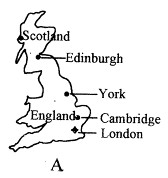
     "The history of York (约克) is the history of England." King George VI (乔治六世) said. York was first
built in A.D. 71, and it has a rich and long history of more than 1, 900 years. Its history makes it one of the
most popular cities for visitors in England. People can hear a lot about England's history and they can see it
and walk in it. Thousands of people from different countries take a walk through 1, 900 years of history on
York's city walls."York is a great city with many special buildings, old city walls and a famous university (大
学)-York University. Besides (此外), it has interesting shops and many fine restaurants. It's both old and
modern. I really love it." said Jack Smith, a visitor from the U.S.A.
     It's really easy to come to York. York is between London and Edinburgh (爱丁堡), the capital of Scotland (苏格兰). You can take a train from London to York. If you have enough time, you can also take a bus from
London to go through Cambridge (剑桥) to York. Come and find out more about York's history!
1. How many years of history does York have?
A. Less than 1, 900 years. ?
B. Only 71 years.
C. Less than 71 years.
D. Over 1, 900 years.
2. Where is York? It's _____.?
A. in Cambridge
B. in Scotland?
C. in England
D. in the U.S.A.
3. What did Jack Smith think of York??
A. Very boring.?
B. Very interesting.
C. There is nothing to see.?
D. A little scary.
4. What does the sentence underlined(下画线) mean??
A. You can learn nothing about the history of England in York.
B. Both York and England have short history.
C. You can learn much about the history of England in York.?
D. York is the only place in England.
5. From the passage, we know that _____ is the right map. 
阅读理解。
     Switzerland (瑞士) is famous for its watches. However, this country didn't invent the watch. It was the
British who did. Here is a story of how the watch was brought to Switzerland.
     Many years ago, an Englishman traveled to Italy. This Englishman traveled in a Carriage. On his way, he
stopped in a small town called Geneva in Switzerland.
     There was a carriage clock in it. This was the earliest kind of watch. A blacksmith's assistant happened
to see the clock. He wanted to know what it was and asked the English man about it. "It is a carriage clock."
said the man. "This machine can tell the time but it isn't working now."
     The blacksmith's assistant wanted to try to repair, so the traveler handed him the clock. The assistant was
a very clever man, so it was easy for him to repair it. He even remembered how it was made. As soon as the
traveler had gone on his way, he made a watch of exactly the same type (样式).
     So the watch-making was started in Switzerland. Today, Swiss watches are sold in countries all over the
world.
1. What is Switzerland famous for?
A. TVs.
B. Pens.
C. Watches.
D. Shoes.
2. What can the carriage clock tell?
A. A story.
B. A joke.
C. The time.
D. A lie.
3. Which of the following is true?
A. The blacksmith's assistant didn't want to have a look.
B. The blacksmith's assistant wanted to wear the clock.
C. The blacksmith's assistant wanted to repair the clock for the man.
D. The blacksmith's assistant repaired the carriage.
4. From the passage, we know that _____.
A. Japan started the watch-making.
B. Swiss watches are sold only in Switzerland.
C. The English traveler was the inventor of the watches.
D. Swiss watches are sold all over the world.

违法和不良信息举报电话:027-86699610 举报邮箱:58377363@163.com

精英家教网