题目内容
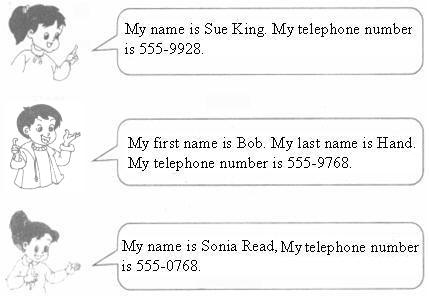
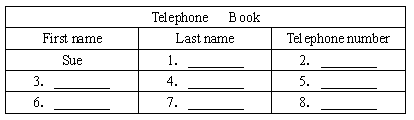
根据图示,完成下列表格。
解析:
|
(1) King (2) 555~9928 由第一幅图内容知。 (3) Bob (4) Hand (5) 555~9768由第二幅图内容知。 (6) Sonia (7) Read (8) 555~0768 由第三幅图内容知。 |

 中考解读考点精练系列答案
 各地期末复习特训卷系列答案
 小博士期末闯关100分系列答案
根据短文内容完成下列表格,并将完整单词写在答题卡对应题号的横线上。(每空一词)
Qian Xuesen was a rocket scientist. He was famous all over the world as the father of China’s space technology. He was born in 1911. On October 31, 2009, he passed away peacefully at the age of 98.
When Qian Xuesen was three years old, his father got a job in the Ministry of Education in Beijing, so he and his family came to Beijing. Qian Xuesen graduated from Shanghai Jiao Tong University in 1934. In 1935, he went to the United States for further study. In 1950, he heard that the new China had been founded, he began to try his best to go back to his motherland. Although the American government tried to stop him from his journey, he succeeded in going back in 1955.
Since 1958, Dr. Qian had devoted all his life to China’s aerospace science and technology (航天技术) and made great achievements. He set up China’s first missile-and-rocket-research institute (导弹、火箭研究机构), which later helped start China’s space program. He retired in 1991,the year before China’s manned space program (载人航天计划) was started. His research formed the basis (基础) of the Long March CZ-2F rocket that carried astronaut Yang Liwei into orbit in 2003.
Qian Xuesen--- the _____1____of China’s space technology
| Personal details | Qian Xuesen was ____2____as a rocket scientist. |
| Career | Qian Xuesen came to Beijing at 3 years old when his father got a job there. In 1934, he graduated from Shanghai Jiao Tong University. In 1935, he went to America for _____3______ study. In 1955, he succeeded in going back to China, although the American government tried to ___4_____ him from his journey. Since 1958, Dr. Qian had devoted all his life to our country and made great achievements. |
| Achievements | He set up China’s first missile-and-rocket-research institute and helped start China’s space ___5_____ . His research formed the basis (基础) of the Long March CZ-2F rocket. |
根据短文内容,完成下列表格,每空一词。
The home of the future won’t be completely different and we will be living in houses and flats as we do today. But people will want to shape their homes to match their dreams. No two homes will be the same. People will be able to buy “house materials” containing moveable walls, doors and windows. They will put together the different parts to create the home they want.
Many jobs that we do today will disappear, others will still be done but will change and new jobs will be created. Skilled workers such as builders, gardeners and electricians won’t disappear because machines can’t take the place of them. We will still have teachers because students need human contact. But they will be using modern technology in class more and students will be working more from home.
Space holidays will develop in the future, but these holidays won’t be for everyone because they won’t be cheap. Short space trips will develop first, then hotels will move around the earth where it will be possible to have a longer vacation. By the end of the next century, there will be holiday centers on the moon with things needed for families.
There will be no paper in the future. Instead, there will be e-paper which people will be able to use over and over again. This will develop in order to protect nature. E-newspapers and e-magazines will take the place of traditional newspapers and magazines and we will download information and news articles from the Internet every day onto our re-useable paper.
As we know, the earth is going to disappear sometime in the future. This isn’t going to happen tomorrow but scientists say that it will happen in five billion years. We will have to find another home. At sometime in the future far away, either we stay on the earth and die with it, or we leave and move to another plant. There won’t be any other choice.
|
Title: Tomorrow’s 1. |
|
|
Things talked about |
Changes described |
|
Houses |
Homes of future will all be 2. from one another. |
|
3. |
Skilled workers will still be 4.. Teachers’ work will change a lot 5. of modern technology. |
|
Vacations |
Space trips and staying in space hotels will still only be for 6. people because they won’t be cheap. Some people can 7. their holidays on the moon. |
|
Information |
E-paper will be used 8. of traditional paper and the 9. of the e-paper will protect nature. |
|
The future |
People will have to 10. to another planet. |
Do you know the pretty girl? Her name is Tian Wei. She was born on April 5, 1986. She was from Beijing. She had two big eyes and short hair. She was good at Chinese. And she loved writing.
She was unlucky. When she was in Grade 8, she was seriously ill. Her doctor said she would lose her life anytime. But she wasn't afraid of death. She kept on studying and writing. She died on August 13, 2007. She smiled till the end of her life.
Tian Wei had a great dream. She hoped that people could read her book in the bookshops. In March, 2009, her only book Hua Tian Ban Mu came out. It had more than 5 thousand words. In her book she said, " I'm always aching (疼痛). If possible, I'll let my right eye weep (哭泣) but the other one smile."
根据短文内容完成下列表格,每空一词。
|
Name |
Tian Wei |
|
Speciality(专长) |
(56) ▲ |
|
(57) ▲ |
Writing |
|
Personality |
(58) ▲ |
|
Suffering when she was a (59) ▲ |
She was seriously ill. |
|
Her (60) ▲ |
People could read her book in the bookshops. |
根据短文内容完成下列表格,并将完整单词写在答题卡对应题号的横线上。(每空一词)
Qian Xuesen was a rocket scientist. He was famous all over the world as the father of China’s space technology. He was born in 1911. On October 31, 2009, he passed away peacefully at the age of 98.
When Qian Xuesen was three years old, his father got a job in the Ministry of Education in Beijing, so he and his family came to Beijing. Qian Xuesen graduated from Shanghai Jiao Tong University in 1934. In 1935, he went to the United States for further study. In 1950, he heard that the new China had been founded, he began to try his best to go back to his motherland. Although the American government tried to stop him from his journey, he succeeded in going back in 1955.
Since 1958, Dr. Qian had devoted all his life to China’s aerospace science and technology (航天技术) and made great achievements. He set up China’s first missile-and-rocket-research institute (导弹、火箭研究机构), which later helped start China’s space program. He retired in 1991,the year before China’s manned space program (载人航天计划) was started. His research formed the basis (基础) of the Long March CZ-2F rocket that carried astronaut Yang Liwei into orbit in 2003.
Qian Xuesen--- the _____1____of China’s space technology
|
Personal details |
Qian Xuesen was ____2____as a rocket scientist. |
|
Career |
Qian Xuesen came to Beijing at 3 years old when his father got a job there. In 1934, he graduated from Shanghai Jiao Tong University. In 1935, he went to America for _____3______ study. In 1955, he succeeded in going back to China, although the American government tried to ___4_____ him from his journey. Since 1958, Dr. Qian had devoted all his life to our country and made great achievements. |
|
Achievements |
He set up China’s first missile-and-rocket-research institute and helped start China’s space ___5_____ . His research formed the basis (基础) of the Long March CZ-2F rocket. |