题目内容
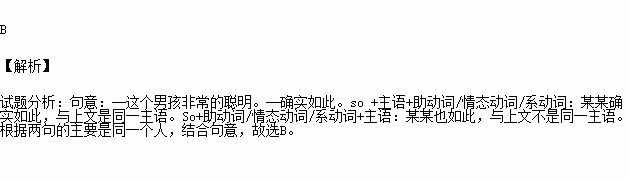
---This boy is very clever.
---_____.
A. So is he B. So he is C. He is so
He ____________his English book at home. He had to share ___________in class yesterday.
A. forgot ; mine B. left ; mine
C. forgot; my D. left ; my
---Sorry, sir. But is this backpack yours?
---Oh, sorry. I just took it _____. It looks like mine.
A. by accident
B. by chance
C. by mistake
Most people want to be happy, but few know how to find happiness. Money and success alone do not bring lasting happiness. Aristotle, a Greek thinker, said,"Happiness depends on ourselves."In other words, we make our own happiness. Here are some opinions to help you be Thappier.
he first opinion of happiness is to enjoy the simple things in life. Too often, we spend so much time thinking about the future ,for example, getting into college or getting a good job —that we can not enjoy the present. You should enjoy life’s simple happiness, such as reading a good book, listening to your favorite music, or spending time with close friends. People who have several close friends often live happier and healthier lives.
Another opinion to living a happy life is to be active and have hobbies. When you are dancing or playing sports, you can forget your problems and time. Many people experience this dancing or playing a sport, such as swimming. You can forget about your problems and only think about the activity.
Finally, many people find happiness in helping others. Studies show that people feel good when they spend their time helping others. If you want to feel happier, do good things for someone. You can help a friend with his or her studies, go shopping to buy food for an elderly person, or simply help out around the house by washing the dishes.
1.The best title of the passage is ________.
A. Money Makes You Happy
B. The Opinions of Happiness
C. Ideas for Helping Other People to Be Happy
2.The second paragraph tells us that ________.
A. the more friends you have, the happier you will be
B. we shouldn’t think about our future
C. happiness is to enjoy the simple things in life
3.The passage gives us ________ pieces of advice on happiness.
A. two B. three C. four
4.The writer thinks that ________.
A. everyone knows how to live a happier life
B. it’s wrong to spend time on work
C. doing good things for someone can make you happier
5.Which of the following is not mentioned(未提及到) in the passage?
A. Reading a good book.
B. Traveling to a foreign country.
C. Playing a sport.
— My parents don’t allow me to watch TV, what should I do?
— ____________
A. You could say sorry to them.
B. Hope things work out.
C. You could sit down and communicate with them.
She looked _________ when she heard the _________ news.
A. surprised; surprised
B. surprising; surprised
C. surprised; surprising
Tom thought up a good plan in order to finish the work early.
A. come up with
B. came up with
C. thought of
-- How many brothers do you have, Jim?
-- I have two brothers. They handsome.
A. all are B. both are C. are both
完型填空
I have studied English for three years. I am to say I am getting on well with it.
To , I thought learning English was only for getting a good . So the problem was how to get the best result in the examination. later on, I found English very interesting. My teacher also told us English was very important and useful. And when he said that, he often that China had joined the WTO and would be the host of the 2008 Olympic Games. I the importance of learning English.
During years of studying English, I made many mistakes. But they have also taught me that we cannot learn English well knowing idiomatic (惯用语的) ways of saying some things. For example, we should say “reading books, newspapers or magazines” “ looking at or seeing them”. I have learned “ring a bell” not“beat a bell ” “have a meeting” not “open a meeting. ” I also find it doesn ’ t if you don ’ t understand every word because you can guess the meaning from the context while reading.
1.A. sad B. glad C. disappointed D. surprised
2.A. begin with B. end up C. sit up D. talk about
3.A. way B. prize C. grade D. chance
4.A. And B. Or C. So D. But
5.A. asked B. added C. talked D. complained
6.A. thought B. improved C. recognized D. realized
7.A. two B. three C. four D. five
8.A. with B. on C. without D. about
9.A. instead B. instead of C. rather D. than
10.A. matter B. mind C. mean D. suggest