题目内容
A. I think so. B. I am afraid I can’t. C. See you.
A. B. C.
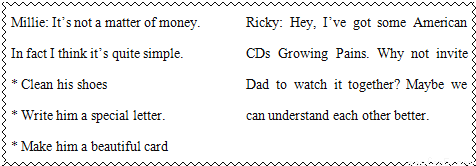
He cleans your house .He repairs your broken toys. He helps you with your homework. Even if you make a lot of trouble at school, he'll never stop loving you. WHO? It's your father, And you could never thank him enough for everything he has done for you. So don't forget to do something nice for him on Father's Day. It's always on the third Sunday in June. This year it's the nineteenth of June. How can we celebrate it and make it a special Father's Day? Here are Millie's and Ricky's ideas:
1.Which day is Father's Day this year?
A. 9th June B. 19th June C. 9th July D. 19th July
2.What will Millie probably NOT do on Father's Day this year?
A. Buy her dad some expensive American CDs.
B. Make her dad a beautiful card.
C. Write her dad a special letter.
D. Clean her dad's shoes.
3.Which sentences should be put in “____________” the article?
A. Sometimes he is lazy.
B. Why not buy him a present?
C. He would do anything for you.
D. Father's Day began a long time ago.
完形填空
Different people have different hobbies. We students also have our own hobbies, such as reading, painting, growing vegetables in our gardens and looking after animals. can make us grow, develop (发展) our interests and help us learn new .
Liu Tao is a student. His hobby is . When he was in senior high school, he wrote a book and published (出版) it in 2007. Many teenagers (青少年) his book. As a result, he becomes a successful young now.
Liu Tao is very lucky his hobby brings him pleasure and success. But he regards writing ________ only one of his many hobbies and interests. He is in many other things. He likes playing football, too. Now he is a member of his school team.
Remember that we spend all our time on our favourite hobby. There are many other interesting things in life, and we should try to do something new or different.
1.A. Hobbies B. Habits C. Life D. Parents
2.A. friends B. skills C. languages D. classmates
3.A. fishing B. swimming C. reading D. writing
4.A. show B. hate C. like D. sell
5.A. writer B. scientist C. reader D. inventor
6.A. because B. when C. however D. whether
7.A. for B. as C. with D. to
8.A. interest B. interests C. interested D. interesting
9.A. must B. can C. should D. shouldn’t
10.A. to do B. doing C. to make D. making
A. Yes, she does. B. No, she doesn’t. C. We don’t know.
第二节 阅读下面的短文,从短文后所给的五个选项中选出能填入短文空白处的最佳选项,使短文通顺、连贯,意思完整。
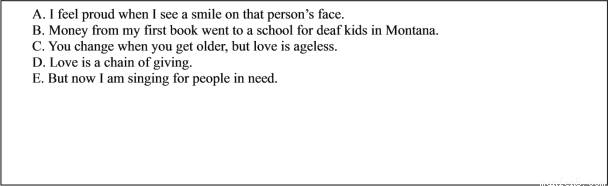
I’ve been singing and performing poetry since I was six years old. I used to sing for my mother’s friends. 1.
I have written three books of poetry and songs. I gave all the money from the books to children’s charities(慈善). 2.
Money from the second book was spent on homeless children in Bosnia.
I visit patients at a local hospital every Saturday morning. I talk and sing for them. I guess that’s really fulfilling (令人满意的) to me, when I sing to someone who is dying, and someone who is really sick and who doesn’t even know what’s happening. 3.
Everyone can give love, and love is what everyone wants. That’s a really important lesson to me.
4.
Making someone happy makes you happy, and they go on and make others happy and it’s like a chain(链).
5.
When you are 7, 13, or 102 years old, love is the same.
The paper _________ wood.
A. made of B. is made from C. is made of
根据短文内容和所给中文提示,在空白处写出单词的正确形式。每空限填一词。
In many English homes people eat 1.(四)meals a day: breakfast, lunch,
tea and dinner. People have breakfast at any time 2.(从)seven to nine in the morning. They have eggs or 3.(面包). English people4.(喝)tea or coffee for breakfast. Lunch comes at one o'clock. Afternoon tea is from four to five in the afternoon. And dinner is about half past seven. First they have5.(汤),and then they have meat or fish with 6.(大量,许多)of vegetables. 7.(在…后)that,they eat some other things, like bananas,8.(苹果)or oranges. 9.(但是,然而)not all English people eat like that. Some of them have 10.(他们的)dinner in the middle of the day. Their meals are breakfast, dinner, tea and supper and these meals are very simple(简单的).
从方框中选择最佳的句子补全对话,使对话内容完整、通顺。
A.No, she isn’t.
B.Good afternoon.
C. He’s my uncle.
D. It’s a picture of my family.
E. Who’s this next to you?
David: Good afternoon, Jenny.
Jenny: 1.
David: What’s this?
Jenny: 2.
David: A picture? Let me see.3.
Jenny: She’s my sister.
David: Is that your sister, too?
Jenny: 4. She’s my cousin.
David: What about this one? Is that your father?
Jenny: No, he isn’t.5.
David: Have a good family.

 B.
B.  C.
C.