题目内容
A lot of inventions are useful to people's life. In 1884, George Eastman invented a kind of film
(胶卷)that fit into a small camera(照相机). Because the new film was easy to use, many people began to buy cameras. When they had used up their film, people returned their cameras to the factory. There, the film was developed, and pictures were printed. Then more film was put into the cameras, which were sent back to the owners, along with their pictures.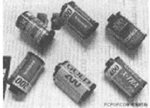
Eastman's camera made it easy to take pictures. Today's cameras are even easier to use, and people can put in their own film.
There are also many new jobs in the field of photography. One of the most important kinds of work is news reporting. Newspapers, magazines, and television all need pictures to tell their stories. Deep-sea divers
(潜水员)take pictures of ocean(海洋)plants and animals. Man finds new uses for the inventions every day.(1
)In 1884, George Eastman changed photo by inventing a new kind of ________.[ ]
|
A .machine |
B .factory |
C .film |
D .camera |
(2
)Long ago, people sent their cameras to a factory because ________.[ ]
A
.they wanted to have their pictures taken by a photographerB
.they wanted their film developedC
.they broke their cameras when taking picturesD
.they wanted to have the cameras cleaned(3
)Why did people begin to buy their own cameras?[ ]
A
.Taking and developing pictures became easier.B
.They did not like to go to photographers.C
.They wanted to see what a camera looked like.D
.They wanted to find a way to make their pictures permanent.(4
)Which of the following statements(陈述)is true?[ ]
A
.Deep-sea divers do not use cameras.B
.Photographers cannot find jobs today.C
.There are different kinds of cameras.D
.Early man found a way to make photographers aid scientists.(5
)Inventions are ________ to people.[ ]
|
A .interesting |
B .expensive |
|
C .useful |
D .strange |

完形填空:
Peter was ten years old. One day his friend Paul said to him.“I'm going to 1 a birthday party on Saturday, Peter. 2 you come?”
Peter asked his mother, and she said, “Yes, you 3 .”
Before Peter went to the Party on Saturday afternoon, his mother said to him, “Now, Peter, don't forget 4 . Don't ask for food. Wait until 5 gives it to you.”
“All right, Mum,” Peter answered, and he went to Paul's house 6 his bicycle.
There were a lot of children 7 the party. They played together for an hour, and then Paul's mother gave them some food, but she forgot to give Peter 8 . He waited politely for a few minutes, and then he held his plate up 9 and said loudly, “Does 10 want a nice clean plate?”
(1) A. hold |
B. take |
C. have |
D. give |
[ ] |
(2) A. Can |
B. May |
C. Need |
D. Much |
[ ] |
(3) A. can come |
B. can't |
C. can go |
D. can't go |
[ ] |
(4) A. be polite |
B. polite |
C. to polite |
D. to be polite |
[ ] |
(5) A. anyone |
B. someone |
C. everyone |
D. on one |
[ ] |
(6) A. on |
B. in |
C. by |
D. with |
[ ] |
(7) A. on |
B. in |
C. by |
D. at |
[ ] |
(8) A. some |
B. any |
C. much |
D. enough |
[ ] |
(9) A. on the air |
B. in the air |
C. out of air |
D. through the air |
[ ] |
(10) A. someone |
B. everyone |
C. anyone |
D. each one |
[ ] |
完形填空:(15分)
通读下面短文,掌握其大意,然后从短文后所给的A、B、C、D四个选项中选一最佳答案.
The word Sandwich(三明治)is 1 English word. Sandwich 2 an Englishman. He 3 about two hundred years 4 . Sandwich had 5 of money. He was very 6 . But he liked 7 play cards for money. He often played 8 day and all night. One time, he played twenty - four hours 9 stopping. He did not 10 the card table to eat. He asked his servant to 11 him some meat and 12 bread. He did not want to stop playing while he ate. He put the meat 13 two pieces 14 bread. In this way he could go on 15 cards.
From the name of this men, Sandwich, we have the word “Sandwich” today.
(1) A. the |
B. a |
C. an |
D. / |
[ ] |
(2) A. is |
B. are |
C. was |
D. were |
[ ] |
(3) A. was |
B. lived |
C. loved |
D. life |
[ ] |
(4) A. ago |
B. before |
C. after |
D. since |
[ ] |
(5) A. much |
B. a lot of |
C. lot |
D. lots |
[ ] |
(6) A. rich |
B. poor |
C. kind |
D. bad |
[ ] |
(7) A. for |
B. with |
C. by |
D. to |
[ ] |
(8) A. both |
B. all |
C. every |
D. only |
[ ] |
(9) A. with |
B. don't |
C. without |
D. not |
[ ] |
(10) A. live |
B. leave |
C. go |
D. come |
[ ] |
(11) A. take |
B. get |
C. fetch |
D. bring |
[ ] |
(12) A. any |
B. some |
C. a piece |
D. a |
[ ] |
(13) A. among |
B. in |
C. between |
D. on |
[ ] |
(14) A. for |
B. of |
C. on |
D. with |
[ ] |
(15) A. playing |
B. to play |
C. played |
D. play |
[ ] |
完形填空
Plants are very important 1 things. Life could not go 2 if there were no plants. This is because plants can make food from air, water and sunlight. But animals and man cannot 3 so. Animals get their food by eating plants and 4 animals. Man gets its food by eating plants and animals too. 5 animals and man 6 plants in order to 7 . This is why we find that there are so many plants around us.
If you look 8 at the plants around you, you will find that there are many types of plants. Some plants are large, 9 others are small. 10 plants are green. There are two sorts(种类)of plants: flowering plants and non-flowering(不开花的)plants.
Flowering plants have roots(根),stems(茎),leaves, flowers and fruits(果子). 11 all the trees around us are flowering plants. Flowering plants 12 make seeds(种子). The sends 13 by the fruits. Some fruits have one seed, some have two, three or four, and some have many seeds. But a few fruits have no seeds 14 . 15 example of a fruit 16 seeds is banana fruit.
Most non-flowering plants do not grow from seeds. They grow from spores(孢子). Spores are small. Some spores are 17 small and 18 that they can float(漂浮) 19 the air. We may say that spores are quite different from seeds. When these spores 20 on wet and shady(阴凉的)places, they usually grow into plants.
1. A.live |
B.lively |
C.living |
D.lived |
[ ] |
2. A.through |
B.over |
C.down |
D.on |
[ ] |
3. A.hope |
B.do |
C.think |
D.make |
[ ] |
4. A.another |
B.the other |
C.other |
D.others |
[ ] |
5. A.Though |
B.And |
C.But |
D.So |
[ ] |
6. A.need |
B.want |
C.find |
D.have |
[ ] |
7. A.grow |
B.live |
C.work |
D.eat |
[ ] |
8. A.careful |
B.clear |
C.carefully |
D.clearly |
[ ] |
9. A.while |
B.when |
C.since |
D.as |
[ ] |
10. A.A great deal of |
B.Lot of |
C.More |
D.Most |
[ ] |
11. A.Between |
B.Except |
C.Almost |
D.Hardly |
[ ] |
12. A.should |
B.can |
C.may |
D.must |
[ ] |
13. A.are born |
B.are hidden |
C.are stored |
D.are kept |
[ ] |
14. A.any longer |
B.any more |
C.at last |
D.at all |
[ ] |
15. A.The |
B.An |
C.A |
D.For |
[ ] |
16. A.without |
B.with |
C.full of |
D.of |
[ ] |
17. A.too |
B.very |
C.so |
D.much |
[ ] |
18. A light |
B.active |
C.little |
D.strong |
[ ] |
19. A.on |
B.in |
C.by |
D.above |
[ ] |
20. A.put |
B.move |
C.place |
D.fall |
[ ] |