题目内容
Come and see the Indian elephants and the new tigers from America. The bears are waiting to meet you, and the monkeys from China are waiting to throw things at you. The lovely dogs from Australia are waiting to laugh at you, and the giraffes from Zambia are waiting to look down on you.
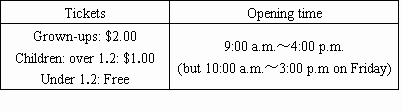
Keep the zoo clean! Do not touch, give food or go near the animals.
根据短文内容,选择正确答案
1.How many kinds of animals are talked about in the passage?
[ ]
2.Now Mr Smith is in the zoo with his two sons, one aged 14 and the other l0, how much are the tickets together?
[ ]
3.Which of the following is the visiting time?
[ ]
4.From the passage, we can guess the animal“giraffe” must be very ________.
[ ]
5.Which of the following can we do in the zoo?
[ ]
A.To give some food to the fish.
B.To touch the monkey on the land.
C.To throw things everywhere.
D.To take a few nice photos.

完形填空
Emily
and Peter have lived next door to each other as long as they can remember. When
they were ___(1)___ children, they ___(2)___ play together. They were good
friends, though they sometimes fought over toys. ___(3)___ they grew older, they
seldom(很少) played with each other. Emily preferred to be with girls and
Peter preferred to play with boys. When they were about fifteen years old, they
almost stopped ___(4)___ to each other, not because they disagreed with each
other, ___(5)___ because they belonged to different groups. Emily began to study
French and also enjoyed watching football games. Peter was only interested in
sports.
___(6)___
was football that brought Emily and Peter back together. One day, after Peter
went home, he looked into the window of Emily’s living room and saw ___(7)___
she was watching a football game on TV. He walked up and knocked at the door.
Emily was ___(8)___ to see him, but asked him to come in and they watched the
___(9)___ of the game together. They are good friends again. They ___(10)___
have different ideas about things
sometimes, but they agree with each other that football is the world’s best
game.
(1)
[ ]
|
A.a
little |
B.little |
|
C.a
few |
D.few |
(2)
[ ]
|
A.often |
B.used
to |
|
C.were used to |
D.themselves |
(3)
[ ]
|
A.When |
B.While |
|
C.So |
D.Because |
(4)
[ ]
|
A.speak |
B.spoke |
|
C.to speak |
D.speaking |
(5) [ ]
|
A.and |
B.but |
|
C.that |
D.so |
(6) [ ]
|
A.It |
B.This |
|
C.That |
D.What |
(7)
[ ]
|
A.what |
B. |
|
C.why |
D.if |
(8)
[ ]
|
A.surprise |
B.surprising |
|
C.surprised |
D.a surprise |
(9)
[ ]
|
A.other |
B.next |
|
C.later |
D.rest |
(10)
[ ]
|
A.yet |
B.also |
|
C.still |
D.too |