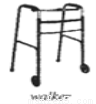
Tina was a seventeen-year-old girl who always wore a bright smile. She had a disease and had to use a walker most of the time. Maybe it was because she looked ______ and people didn’t know how to come near to her. Tina usually broke the ice with people she met with a big “Hi”.

In one class, I gave the students an assignment (作业) to recite (背诵) a poem. I only made the assignment worth a very small part of their total grade since I knew most of my ______ would not do it anyway. In the class, one by one each student _____ to correctly recite the poem. Finally, angry and half joking, I said that the next student who _____ recite the poem had to do three push-ups (俯卧撑). To my _____, Tina was next. She used her walker to move to the front of the class. _____ she recited, she made a mistake. Before I could say a word, she _____ her walker and started doing push-ups. I wanted to say, “Tina, I was just joking!” But she stood up, continued the poem and she finished the rest perfectly.

When she finished, a student asked, “Tina, why did you do that? It’s not an _____ assignment!”

“Because I want to be like you guys! To be normal (正常的),” Tina said.

Silence fell on the whole room when another student cried out, “Tina, we’re not normal! We are

teenagers! We get in ____ all the time.”

“I know,” Tina said as a big smile spread across her face. The rest of the students laughed, too.

Tina got only a few ______ that day, but she got the love and respect of her classmates. To her, that was

worth a lot more than a grade.

1.A. different B. strong C. short D. young

2.A. friends B. students C. teachers D. parents

3.A. started B. planned C. continued D. failed

4.A. shouldn’t B. couldn’t C. needn’t D. wouldn’t

5.A. surprise B. surprised C. excitement D. excited

6.A. Because B. When C. After D. Though

7.A. raised B. changed C. threw D. checked

8.A. active B. useful C. important D. exciting

9.A. attention B. thought C. touch D. trouble

10.A. points B. chances C. mistakes D. successes

Soela Zani is a photographer from Albania. In 1988, a quiet boy lived next door to her. Born with Down's syndrome (唐氏综合征), the boy never spoke and seldom went outside because his parents felt shame to be seen with him.

“It was sad to see that,” Zani said. “Now, people know differently. Children with Down's syndrome are lovely. We need to accept them as they are and give them a chance to succeed in life.”

Zani wanted to do something for those lovely children, so she opened an exhibition (展览) last year at Albania's National Historical Museum. Photos of children with Down's syndrome were shown in the exhibition. In the photos, the children are copying poses (姿势) from famous paintings.

“When we opened the exhibition, the visitors enjoyed all the pictures. Many even started to cry in front of them. I was very touched,” Zani said. “These children are beautiful. They are pieces of art. This is my message.”

In some parts of Albania, having a child with Down's syndrome is still thought to be unlucky or shameful. But Zani has found the beauty of the children, inside and out. “There is no difference between a child with Down's syndrome and a child without it. They are the same,” Zani said. “This exhibition is a present from me to them.” Zani plans to take more photos of children with Down's syndrome and raise money for them this year.

根据材料内容简要回答下列问题。

1.What did Zani's next-door neighbor think of their child?

__________________________________________

2.Who did Zani open the exhibition for?

__________________________________________

3.What could be seen in Zani's exhibition?

__________________________________________

4.Was Zani's exhibition successful?

__________________________________________

5.What's Zani's plan for 2016?

__________________________________________

违法和不良信息举报电话:027-86699610 举报邮箱:58377363@163.com

精英家教网