题目内容
任务型阅读(共5小题;每小题1 分,满分5 分)
阅读下面材料,找出与之匹配的中西方节日。
1.It started several centuries ago in Europe.It began as “Hallow Evening” meaning “holy night”.At that time November 1st was called “All Saints’ Day” and people honored all the saints who did not have their own special day.
2.It happens in a small town Hanoi on the last Wednesday of August every year. During the festival there are all kinds of activities, but the most exciting part is the tomato fight. It takes place at the end of long celebration.
3..On Sunday children wake up to find that the Easter Bunny has left them baskets of candy. He has also hidden the eggs that they decorated earlier that week. Children hunt for the eggs all around the house.
4.Nowadays we play jokes on people on that day. For example, someone might put salt in the sugar container so another person could "accidentally" put it in their coffee. Or someone might change the time on another person's alarm clock so that person would unknowingly wake up earlier or later than planned.
5.The festival dates back 2,000 years ago with a number of legends explaining its origin. The best-known story is about a great patriotic poet named Qu Yuan. The customs vary in different areas of the country. On that day, most families hang a picture of Zhong Kui in their houses.
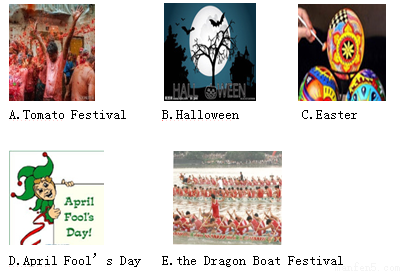
1.B
2.A
3.C
4.D
5.E
【解析】
试题分析:这篇短文主要介绍了五个节日的活动:万圣节,土豆节,复活节,愚人节及中国的龙舟节。
1. began as “Hallow Evening” meaning “holy night”可知是万圣节的来历。故选B
2. the most exciting part is the tomato fight.可知是土豆节,故选A
3.
4.
5.
考点:任务型阅读。

 天天向上一本好卷系列答案
 小学生10分钟应用题系列答案
综合填空, 用以下单词的适当形式填空(10分)
year, next, have , look, America, come, eye, at, class , blond |
Hello! My name is Kangkang. I1.___from China. I’m twelve 2.___old.. Now I’m a student in Beijing International School. I’m in 3.___ Four, Grade Seven. Look 4.___ the photo. The boy 5.___to me is my good friend, Michael. He is from6.___ .He 7.___ big blue8.___and a wide mouth. His hair is 9.___and his nose is big. We don’t 10.__ the same.