题目内容
句型转换。
1.We shouldn’t throw rubbish everywhere.(同义句转换)
We shouldn’t throw rubbish _____ and _____.
2.Hurry up. You will miss the bus.(合为一句)
up, you will miss the bus.
3.The population of China is 1.3 billion. (对画线部分提问)
the population of China?
4.I have already seen the film. (改为一般疑问句)
Have you _____ the film _____?
5.Did your father go to Japan?(改为现在完成时)
_____ your father _____ to Japan?

 期末100分闯关海淀考王系列答案
 小学能力测试卷系列答案
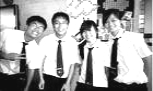
Students in many countries wear school uniforms. Here’s a list of countries below.
| In Brazil, students don’t have to wear uniforms in public schools although they might have one. In general, the uniforms are a pair of blue trousers and a white T-shirt with the school symbol printed on it. |
| School uniforms are used in Cuba. All students wear school uniforms with the color as a symbol of grade level. Children also wear scarves because they are young pioneers. |
| Japan introduced school uniforms in the late 19th century. Today, All students wear school uniforms. Many boys wear white shirts, short pants and caps. Girls’ uniforms might include a gray pleated (褶)skirt and a white blouse. |
| In Singapore, all students must wear uniforms. Though the colors are different from school to school. The uniform for boys is usually shorts or long trousers, with a shirt (often white), while girls wear white pinafores(连衣裙) or skirts. |


1.In Cuba a student wears the scarf as a symbol of _____.
A. grade level B. cold weather
C. public school D. young pioneer
2.Which is true about the students’ uniforms in Singapore?
A. School uniforms are introduced in the late 19th century.
B. Only the students in public schools wear uniforms.
C. Boys’ uniforms are different from girls’ in color.
D. Students usually wear white shirts or skirts.
3.On the school day, a student doesn’t wear the uniform. He probably comes from ______.
A. Brazil B. Cuba C. Japan D. Singapore