题目内容
(题文)There are months in a year. December is in the month.
A. twelve; twelve B. twelfth; twelfth C. twelfth; twelve D. twelve; twelfth
 D
【解析】
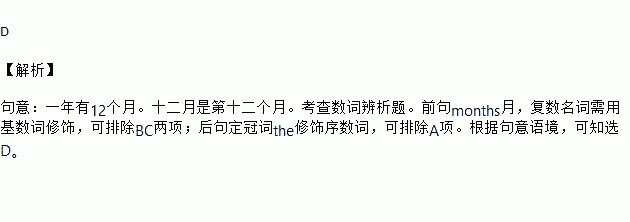
句意:一年有12个月。十二月是第十二个月。考查数词辨析题。前句months月,复数名词需用基数词修饰,可排除BC两项;后句定冠词the修饰序数词,可排除A项。根据句意语境,可知选D。
D
【解析】
句意:一年有12个月。十二月是第十二个月。考查数词辨析题。前句months月,复数名词需用基数词修饰,可排除BC两项;后句定冠词the修饰序数词,可排除A项。根据句意语境,可知选D。

 名校课堂系列答案
I’m Leo. There is a great artist in my family. She is Lisa. Lisa likes drawing a lot. Here are her three drawings.
There is an animal in the first drawing. It has two big eyes, a big mouth and two small ears. It has long arms and long legs. It is black and white. There are some apples in its hands. It looks very happy .What is it? I don’t know, but Lisa says it is a panda.
There is a woman in the second drawing. She is thin. She has straight blonde hair, a small mouth, a big nose and two big eyes. She looks angry. Who is she? Lisa says she is our mum. But Mum has curly blonde hair, small eyes and a small nose.
There is an animal in the third drawing, too. Its head is an apple. Its hair are leaves. It has a long mouth, and it is a banana. Its two legs are carrots. What is it? Lisa says it is a horse, but it doesn’t look like a horse.
Lisa is really a great artist, isn’t she?
1.The animal in the first drawing .
A. looks very happy B. is eating apples
C. has big eyes and big ears
2.Leo’s mum has .
A. a big mouth B. curly blonde hair C. two big eyes
3.From the passage, we can know Lisa is Leo’s .
A. mother B. cousin C. sister
4.The underline word “ it ” in the fourth paragraph means “________”
A. the hair B. the head C. the mouth
5.Which of the following is true according to the passage?
A. Lisa’s horse likes to eat carrots.
B. Leo thinks Lisa’s drawings are not so good. But Lisa loves to draw.
C. Lisa draws an animal and two women.
1.A
2.B
3.C
4.C
5.B
【解析】
本文介绍了利奥的妹妹丽莎画的三幅画。利奥认为她画的不好,但是丽莎喜欢画画。
1.A
细节理解题。根据There is an animal in the first drawing……It looks very happy .可知在第一幅画里的动物看起来非常高兴,故选A。
2.B
细节理解题... 根据句意和英文解释提示,在空白处填入一个适当的单词。(每空一词)
1.There was something _______________ (not right) with her car, so she had to walk there.
2.The _______________ (a kind of fruit we usually eat in summer ) on the plate tastes nice.
3.Your leather coat is _______________ (costing too much money) , but you look smart in it.
4.Young people like wearing _______________ (the sports shoes that are fit for running) .
5.We are often ______________ (needing food) after a long walk.
1. wrong
2. watermelon
3. expensive
4. trainers
5. hungry
【解析】
1.句意:她的车出了毛病,所以她不得不步行去那里。not right,means wrong;根据句意语境和英文提示,可知填wrong。
2.句意:盘子上的西瓜味道很好。a kind of fruit we usually eat ... ---We are going to have a match with Class Eight next Monday ---__________ !
A. Have a good time B. Wish our team good luck C. That’s a good idea D. All right.
B
【解析】
句意:——下星期一我们将和八班进行一场比赛。——祝我们队好运!考查日常交际用语。A. Have a good time玩得愉快;B. Wish our team good luck祝我们队好运;C. That’s a good idea好主意;D. All right.好吧。根据句意语境,可知Wish our team good luck符合语境,故选B。 (题文) ---- _________ TV do you watch every day? ---- Less than an hour.
A. How much B How many C How often D How long
A
【解析】
这里的电视指的是电视节目,为抽象事物,不可数名词,四个选项分别提问不可数名词可数名词,频率和时间长多,故选A,你每天看多少电视? My parents _______ the nice photo.
A. is in B. are in C. is on D. are on
B
【解析】
句意:我的父母在这张漂亮的相片里。my parents复数,所以系动词用are,in在……里,在事物内部;on在……上,指在事物表面。人物是镶嵌在照片内的,故选B。 I’m sure ____ you can help me. But I still doubt ______ I can solve all these problems or not.
A. if, whether B. that, if C. whether, if D. that, whether
D
【解析】句意:我相信你能帮我。但我仍然怀疑我是否能解决所有这些问题。考查宾语从句的引导词。第一个空,I’m sure后面的宾语从句为陈述句,而且不缺少任何成分,所以用连接词that引导,that是从属连词不充当任何成分,排除A、C选项;第二个空doubt后面用if或whether引导宾语从句,但if不能和or not连用,排除B选项;故答案选D。