题目内容
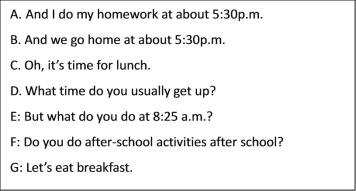
【题目】四.口语运用 运用方框中的句子完成对话,其中有两项是多余的。
Amy:Millie, may I ask you some questions?
Millie: OK, please.
Amy: 1.【1】
Millie: At 6:30 a.m.
Amy: Oh, what time do you go to school then?
Millie: Er…at 7:30a.m.
Amy: I see! 2.【2】
Millie: Let me see...I have lessons.
Amy: And what do you do at 11:50?
Millie: 3.【3】.And we all like the lunchtime.
Amy: 4.【4】
Millie: Of course! We begin at 3:30p.m.
Amy: Do you go home at 4:30p.m.?
Millie: Yes, I do. 5.【5】
【答案】
【1】D
【2】E
【3】C
【4】F
【5】A
【解析】
这段对话只要是Amy咨询Milllie一天活动.
【1】根据后文回答At 6:30 a.m.可知问的是具体的什么时间,故选D。
【2】根据后文回答Let me see...I have lessons可知问的是某个时间点在做什么,故选E。
【3】根据提问And what do you do at 11:50? 可知需回答这个时间点要做什么,故选C。
【4】根据后文回答Of course! We begin at 3:30p.m. 做出了肯定回答,可知此空是一个一般疑问句,故选F。
【5】整个对话是按照时间的顺序进行的。根据前文Do you go home at 4:30p.m.?和Yes, I do.可知下文情节的时间点在4:30之后,故选A。
要求根据上下文选择合适的的句子填空,使句意通顺,前后连贯,表达顺畅,重在考查学生对所学语言的综合运用能力和对文段的理解判断能力。本题有一定难度,但只要联系整篇短文,把握好上下句的意思和关系,正确作答是不成问题的。





【题目】根据表格所提供的信息,选择正确答案。
Here are four, students' habits. Let’s look at them.
Name Activity |
David |
Linda |
Tina |
Jack |
Exercising | Twice a week | Twice a week | Never | Every day |
Drinking milk | Never | Twice a day | Every morning | Three times a day |
Eating fruit and vegetables | Twice a day | Every day | Once a week | Every day |
Eating jun k food | Once a week | Twice a week | Four times a week | Never |
Sleeping | Seven hours a day | Six hours a day | Five hours a day | Eight hours a day |


【1】From the frm, we know________habits may be the best.
A.Tina'sB.David'sC.Jack'sD.Linda's
【2】What does Tina never do?
A.She never exercises.B.She never drinks milk.
C.She never eats vegetables.D.She never eats junk food.
【3】How often does Jack exercise?
A.Never.B.Every day.C.Twice a day.D.Twice a week.
【4】How long does David sleep every day?
A.For five hours.B.For six hours.C.For seven hours.D.For eight hours.
【5】What does Linda do twice a week?
A.She has vegetables and milk.B.She eats junk food and fruit.
C.She exercises and eats healthy food.D.She eats junk food and plays sports.
【题目】阅读下面短文,根据所读内容,在文章后空格里填入一个最恰当的单词,注意:每个空格只填1个单词。
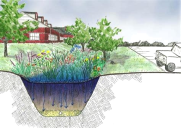
Eco-friendly(环保) rain gardens have beautiful flowers, trees and other plants that beautify the community. They are also healthy for the environment and the people living and working nearby. A rain garden is not very different from a traditional garden, It is just far more eco-friendly. Usually it is built lower than the ground.
Why Eco-friendly Rain Gardens Are Recommended
Rain gardens smartly used rain and storm water by temporarily(暂时) holding water from rain and storms and letting it soak(渗透) slowly into the ground before it runs into streams or enters the public drinking water supply. In this way, a rain garden keeps the water, allowing it to be used as needed by plants in the rain garden, rather than flowing(流) directly into nearby streams and going unused, The water will soak slowly into the ground within a day or two. This creates an advantage that the rain garden does not allow mosquitoes(蚊子) to breed(繁殖). This is a simple, attractive, and eco-friendly “green” way to treat storm water.
What's more, planting a rain garden helps cut down on pollution and make the environment better. The gardens don’t use expensive machinery and chemicals. They remove harmful chemicals in the rainwater and reduce the amount of pollution reaching streams and rivers by up to 30%.
How You Build Your Own Rain Gardens
Native(本地的) plants are recommended for rain gardens because they are more used to the local climate(气候), soil, and water conditions. They may attract local wildlife such as native birds. Water your rain garden right after planting and once a week. Don’t water it if you have had at least an inch of rain during the week. You needn’t take much care of it once the plants have a necessary root system(根系统).
Often, local governments and private businesses develop large rain gardens in their yards and in public parks. However, you can do your own part. You don't need to be an environmental engineer to create a rain garden. Just start by building smaller rain gardens in your yards.
Eco-friendly Rain Gardens | |
Definition(定义) | Eco-friendly rain gardens are far more eco-friendly gardens 【1】 under the ground. |
【2】 of rain gardens | Rain gardens use rain in 【3】 ways. Rain water is held and soaks into the ground before running into streams or 【4】 the drinking water supply. They 【5】 mosquitoes from breeding. |
They help to cut down on pollution and 【6】 the environment. 30% of the pollution is reduced 【7】 using machinery and chemicals. | |
How you build the garden | Use native plants because they are more used and may attract 【8】. Water the garden 【9】 you have had at least an inch of rain during the week. |
Conclusion | To create such a garden, you needn’t be an environmental 【10】. Just start by building small ones in your yards. |