题目内容
The moon looks bigger than the stars at night. But in fact, it`s smaller than any stars. The moon looks big to us, because it is closer to us the stars. The moon goes round the earth. It makes one trip about four weeks. The moon is round and looks beautiful. Now people know quite a lot about the moon. There is no air or water on the moon. So there are not any trees or animals or people on it . The moon gets its light from the sun , but some places on the moon are quite dark. It`s very cold at night .
1. People know quite ______ about the moon now.
A. a lot B. a few C. some
2.The moon is _____ to the earth than the sun.
A. far B. near C. closer
3.The moon makes one trip around the earth is about _________ .
A. a week B. a month C. a year
4. There is (are) ______ on the moon .
A. no air B. no tree or water C.all the above
5.The sun _______ to the moon .
A. get light B. gives light C. gives air

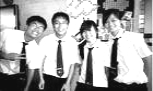
Students in many countries wear school uniforms. Here’s a list of countries below.
| In Brazil, students don’t have to wear uniforms in public schools although they might have one. In general, the uniforms are a pair of blue trousers and a white T-shirt with the school symbol printed on it. |
| School uniforms are used in Cuba. All students wear school uniforms with the color as a symbol of grade level. Children also wear scarves because they are young pioneers. |
| Japan introduced school uniforms in the late 19th century. Today, All students wear school uniforms. Many boys wear white shirts, short pants and caps. Girls’ uniforms might include a gray pleated (褶)skirt and a white blouse. |
| In Singapore, all students must wear uniforms. Though the colors are different from school to school. The uniform for boys is usually shorts or long trousers, with a shirt (often white), while girls wear white pinafores(连衣裙) or skirts. |


1.In Cuba a student wears the scarf as a symbol of _____.
A. grade level B. cold weather
C. public school D. young pioneer
2.Which is true about the students’ uniforms in Singapore?
A. School uniforms are introduced in the late 19th century.
B. Only the students in public schools wear uniforms.
C. Boys’ uniforms are different from girls’ in color.
D. Students usually wear white shirts or skirts.
3.On the school day, a student doesn’t wear the uniform. He probably comes from ______.
A. Brazil B. Cuba C. Japan D. Singapore