题目内容
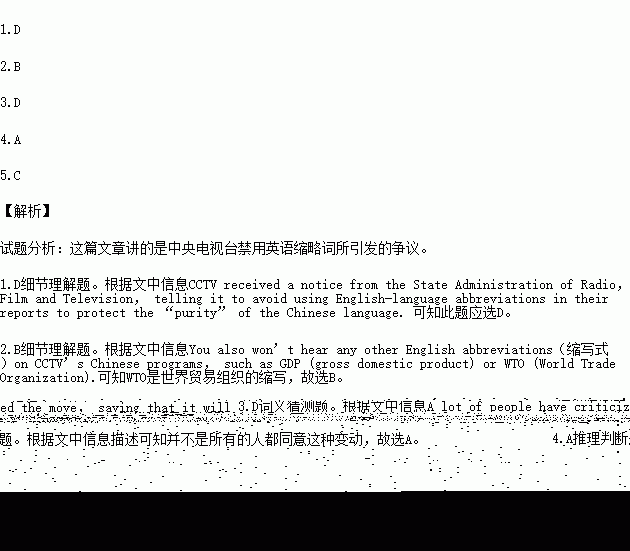
Starting from this month, you won’t be hearing the word “NBA” on sports programs on CCTV. Instead, sport hosts will give the full Chinese name when they refer to the NBA – National Basketball Association. You also won’t hear any other English abbreviations(缩写式)on CCTV’s Chinese programs, such as GDP (gross domestic product) or WTO (World Trade Organization). You will hear their Chinese translations.
CCTV received a notice from the State Administration of Radio, Film and Television, telling it to avoid using English-language abbreviations in their reports to protect the “purity” of the Chinese language. A few other TV stations also received the notice.
Fu Zhenguo, an editor of People’s Daily, is one of the people who proposed(提议)the change. “Using English in a Chinese-speaking environment is against Chinese law,” he said. “Using English on Chinese TV programs is unfair to people who don’t understand English. It will have a bad language influence on kids and teenagers.”
But some experts have a different opinion. Liu Yaoying, a professor at the Communications University of China, said the move shows cultural conservatism(保守主义). “If Western countries can accept some Chinglish(中国式英语)words, why can’t the Chinese language be mixed with English?” Liu said.
A lot of people have criticized the move, saying that it will cause problems for them.
“I understand what CD, VCD and DVD mean when I hear them. But I won’t know what the TV programs are talking about if I hear those products’ full Chinese names,” a person wrote in a BBS post. Following the same post, another person wrote jokingly: “I’m not listening to my MP3 now. I’m listening to my Moving Picture Experts Group-1 Audio Layer 3.
Some people also question why CCTV is keeping its logo, since it is also an English abbreviation.
1. We can’t hear the English abbreviations from this month because___________.
A. no one can say the abbreviations
B. the abbreviations are useless
C. Chinese translations are easier to be understood.
D. the purity of Chinese should be protected
2. Which of the following is an abbreviation of an organization?
A. DVD B. WTO C. GDP D. VCD
3.What is the Chinese meaning of the underlined word “criticized”?
A. 阻止 B. 赞同 C. 表扬 D. 批评
4.From the passage, we know that.
A. Not all the people are satisfied with the move.
B. All the people are pleased with the move.
C. CCTV has given up its logo.
D. The Chinese language can’t be mixed with English .
5. The seventh paragraph shows
A. a bad language influe nce on kids and teenagers
B. it is unfair for our Chinese to use English abbreviations.
C. problems caused by not using the English abbreviations
D. cultural conservatism

 暑假接力赛新疆青少年出版社系列答案
last year more than 40 people died and 900 people injured in traffic accidents in China, because drivers often use their mobile phones. As we know, it is difficult for a driver to put his heart into driving if he talks on their mobile phones.___ 1.______
Some drivers were sending messages while driving. __2.____In other words, the driver watched his mobile phone instead of watching the road ahead during sending a message. How dangerous it was! The driver used a mobile phone and put other people’s lives at risk. Such drivers are selfish and careless. __3._____
Mobile phones are of great fun and useful for us. ___4._____ But you mustn’t use them while driving. If you really have important things to do by phone, please stop your car. Or the next accident may happen to you.
A . We should say no to them and their action. B. They make our life so easy. C. And there were even more serious problems. D It would take a driver several seconds or minutes to edit and send. |
5.Which of the following is NOT TRUE according to the passage.
A. It is dangerous to use mobile phones while driving.
B. The drivers used mobile phones while driving were selfish.
C. We must say no to a driver using the mobile phone when he drives.
D. Mobile phones are the most dangerous for drivers.
情景交际。(有两项多余)。
A: Hello, Bob! How is it going?
B: Hello, Kate! 1. And you?
A: Very well. What’s your plan for the summer?
B: I had a Chinese course last year, and I’d like to go on with it this summer.
A: How was the course? 2.
B: Yes. It seemed that way at first. But after a while it became easier.
A: You were the best in the class, right?
B: I did get an A. Well, could you tell me your summer plan? 3.
A: No, not this summer. 4.
B: That must be very interesting. Can I go with you?
A: 5. Oh, there comes the bus! Good-bye!
B: Bye-bye!
A.I plan to go to Africa next summer. B.Will you travel somewhere interesting? C.Where do you come from? D.Is Chinese very difficult? E.I’m OK. F.Traveling is very expensive. G.No problem. |