题目内容
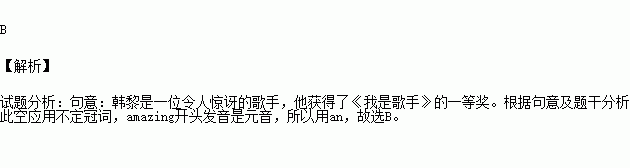
Han Li is amazing singer. He got the first prize of I AM A SINGER.
A. a B. an C. the D. /
根据所给首字母及英、汉语提示,写出单词或短语的正确形式。
1. You can’t i how much I love the dog.
2. They made a _____________ (decide) to climb the mountains.
3. I’m sorry to hear that the old man’s _____________ (死).
4. He ____________ (fall) down last month and hurt his leg.
5. ________________(令她惊讶的是), no one would like to say hello to her.
—What size shoes do you want?
—________.
A. Small shoes B. Size 36
C. 36 size D. Big shoes
—My mother has been to Kunming before.
— ___ . It’s a good place .
A. so have I B. so I have
C. neither have I D. neither I have
The food safety has become one of the problems in our daily life.
A. more expensive B. more important
C. most expensive D. most important
One of the most common forms of public speaking is the ―presentation‖. A presentation is one of the best ways of communicating your message. This article will give you seven of the most important areas to consider when giving any presentation.
◆Preparation Prepare! Prepare! Prepare! Good preparation is very important for any presentation. With good preparation and planning you will be fully confident. This will give you control. With control, you will be ―in charge‖ and your audience (听众) will listen positively to your message.
◆Structure A good presentation has a clear structure, like a good book or film. It usually has a beginning, a middle part and an end.
◆Equipment You may use any of the following pieces of equipment as you want: whiteboard, flipchart, overhead projector, 35 mm slide projector and computer graphics.
Each of these has advantages and disadvantages. The important thing is to know and understand your equipment perfectly, and then you can use it freely and properly.
◆Visual Aids ―A picture is worth 1,000 words.‖ There are many types of visual aids (直观教具) – photographs, maps, tables etc. But you should use them with care. Do not overload your audience with too much information in a short time. A good rule is: use one image to give one message.
◆Signposting When you read a book, you know where you are. You know the title of the book, the end of one chapter, and even the page number. But when you give a presentation, your audience does not know where they are – unless you TELL them! You can use special language called ―signaling‖ or ―signposting‖ to help you. Here are a few examples: Let’s begin by...; Now we’ll move on to...; To start with...later...; To finish up....
◆Audience Relations You need a warm and friendly relationship with your audience. How do you achieve this? Well, enthusiasm is contagious. If you are enthusiastic (热情的), your audience will be enthusiastic too. Try to make eye contact with each member of your audience. Each person should feel that you are speaking to him or her personally.
◆Body Language Your BODY speaks to your audience even before you open your mouth. From your clothes, walk, glasses, haircut and your expression, your listeners form their first impression as you enter the room.
1.How will you be fully confident in a presentation according to the passage?
A. With necessary equipment.
B. With enough visual aids.
C. With proper body language.
D. With careful preparation.
2.The writer may agree that signposting can help ______.
A. speakers to be more enthusiastic
B. the audience catch up with speakers
C. the audience form the first impression
D. speakers avoid using equipment improperly
3.What does the underlined word ―contagious‖ in Paragraph 8 mean?
A. Highly praised. B. Deeply hidden.
C. Clearly expressed. D. Easily spread.
I ______ my English teacher since I left university.
A. didn’t see B. haven’t seen
C. won’t see D. don’t see
I won’t go to Zhang Wei’s birthday party ________ I am invited.
A. unless B. because C. if D. when
She can play _______soccer but she can’t play______violin.
A. the , the B. / , the C. the , / D. a , a