题目内容

词汇运用 (本大题共8分,每小题1分)

(A) 根据句意和汉语注释,写出单词的正确形式。

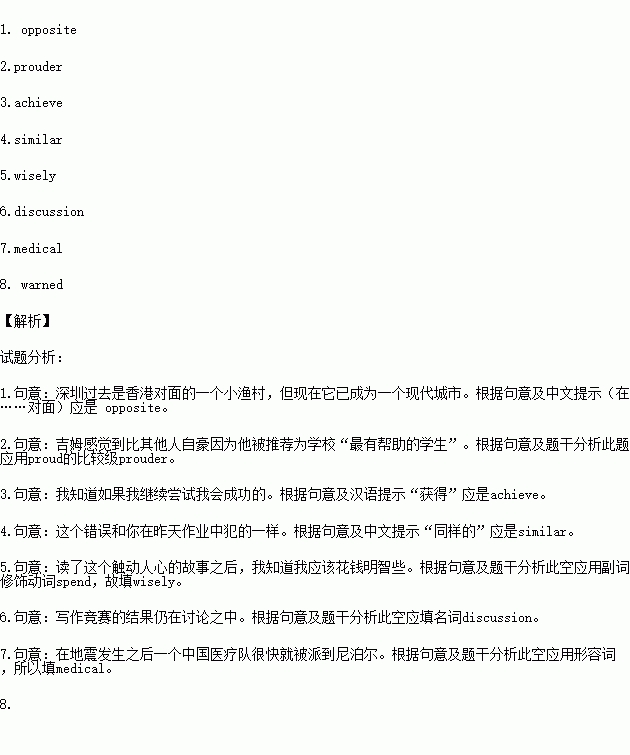
1.Shenzhen used to be a little fish village __________ (在…对面) Hong Kong, but now it has turned into a modern city.

2.Jimmy felt __________ (自豪) than anyone else because he was recommended as “the Most Helpful Student” in our school.

3.I know I can __________ (获得) success if I keep on trying.

4.The mistake is __________ (同样的) to the one that you made in yesterday’s homework.

(B) 根据句意,写出括号内所给单词的适当形式。

5.After reading the touching story, I know I should spend my money __________ (wise).

6.The result of the writing competition is still under __________ (discuss).

7.A Chinese __________ (medicine) team was sent to Nepal soon after the terrible earthquake happened.

8.All the children are often __________ (warn) not to swim alone in the river.
练习册系列答案
相关题目

完形填空(共10小题;每小题1分,满分10分)

阅读下面短文,从短文后所给各题的四个选项(A、B、C和D)中,选出可以填入空白处的最佳选项。

My friends and I had just finished lunch at a hotel when it started to rain heavily. When it became lighter, I decided to get my which was parked at my office three streets away.

My friends that I shouldn’t go, mainly because I was seven months pregnant (怀孕的) then. I promised that I’d be very . One of them wanted to come with me but I insisted that she stayed with another friend who needed help her baby.

I walked out of the hotel and started making my way to the car. At the crossing, a van stopped and a man came out with an umbrella. Before I knew what was happening, he walked right me and told me he’d escort (护送) me. Although I refused, he insisted that he would.

During our walk, he kept telling me to walk slower, as the ground was . When we got to the car-park, I thanked him and he went away. I did not get his name and can recognize (认出) him now. Did he stop for me? I’ll never know.

So how did I pay it forward? I was at home when I noticed two Indian workers in the heavy rain. They were probably on their way to the working place near my home. I went out and passed them my , telling them they should take and keep it. They were surprised by my action. They were very grateful to me, probably why a stranger was offering such kindness. I was so relaxed and happy that day.

1.A. money B.bag C. car D. raincoat

2.A. said B. received C. calmed D. disliked

3.A. brave B. careful C. proud D. helpful

4.A. for B. about C. with D. on

5.A. through B. past C. below D. beside

6.A. wet B. dry C. clean D. dirty

7.A. often B. even C.hardly D. nearly

8.A. fighting B. playing C. working D. walking

9.A. umbrella B. coat C. love D. kindness

10.A. trained B. wondered C. talked D. refused

A 13-year-old American has made a cheap machine that can help blind people read.

The blind can read by using Braille – a system of small bumps (隆起物) that the blind touch to read the letters. The machine that makes these small bumps usually costs at least $2,000. It is called Braille writer. The American schoolboy, Shubham Banerjee, made a new Braille writer from a Lego tool that lets people create robots. Banerjee has called his new machine the Braigo – a combination (组合) of the words Braille and Lego. It costs just $ 350. It works by changing electronic text into Braille and then printing it using a computer or mobile machine.

Banerjee designed (设计) his Braigo last year for a school science exhibition. Since then, he has caught the interest of Silicon Valley in the USA. The big technology company Intel spent money on Banerjee’s machine last November, but they did not say how much money they put in. Banerjee also got $35, 000 from his father to help him start the project. His father works as a computer engineer (工程师) at Intel. He spoke about why he gave so much money to his son, saying:”We as parents started to be interested more, thinking that he’s on to something and this invention has to continue.” Banerjee told the AP News: “My dream would probably be having most of the blind people…using my Braigo.”

1.What is Braile in Line 2?

A. A system of bumps to help the blind read.

B. The name of a new invention.

C. A very cheap machine.

D. A Lego robot.

2.How much will one save if he buys a Braigo instead of a usual Braille writer?

A. Over $2,000. B. Less than $350.

C. Exactly $35,000. D. At least $1,650.

3.What does the Braigo change into Braille?

A. Photocopies. B. Voices.

C. Electronic text. D. Computer languages.

4.Why did Banerjee design his invention?

A. He did it as a hobby.

B. Intel told him to do it.

C. He did it for a school science project.

D. He wanted to get money from his father.

5.Banerjee’s parents wanted him to continue to _______.

A. catch Intel’s interest B. work on his invention

C. be a computer engineer D. use the new Braille writer

违法和不良信息举报电话:027-86699610 举报邮箱:58377363@163.com

精英家教网