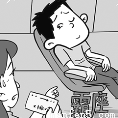
In a video posted on Sina Weibo,we can see a man slouching in a seat on a high-speed train. He is actually a university student .Now he is in the hot seat , because he took a woman’s seat on the high-speed train a few days ago.When the woman asked him to give her seat back, he refused and said, “You have three choices –stand, take my seat or go to the dining coach.”

A worker on the train then came to try to ask him to give the seat back. The man said he wasn’t able to stand on his own and asked for a wheelchair. Left with no other choice, the worker led the woman passenger to another seat.

The video quickly spread online. Many are angry about the man’s behavior. Some people even dug up the man’s name, as well as his education and work history, showing the information online.

The Jinan Public Security Center handed down a punishment for the young man. He was fined 200 yuan and will not be allowed to buy train tickets for some time.

However, many people think it was not strict enough, adding that those who behave similarly on airplanes can be held criminally liable. China News Service noted.

Experts explained that the present laws could be improved to stop train passengers from behaving poorly. And the government in Guangdong has already been on the way.

1.What does the phrase “in the hot seat”probably mean?

A. Being in the center of a room. B. Facing some trouble.

C. Sitting on an uncomfortable seat. D. Becoming popular.

2.What do we know from the video posted on Sina Weibo?

A. The man stole a passenger’s purse.

B. The man was sitting in someone else’s seat.

C. The man was asking a woman to dinner.

D. The man wanted to sit in a wheelchair.

3.What did other people think of the young man’s behavior?

A. They showed their understanding. B. They started to take others’ seats too.

C. They felt angry about what he did. D. They gave their seats to him.

4.What can we infer from the story?

A. The man’s legs were seriously hurt.

B. It’s alright to put others’ information online.

C. Bad behavior on planes is not punished.

D. Laws that punish bad behavior on trains are not as strict as those for planes.

Most people need to hear those “three little words”-I love you.Once in a while, they hear them just in time.I _________ Connie the day she was sent to the hospital, where I worked as a woman volunteer.Her husband, Bill, stood _________ nearby as she was transferred to the hospital bed.Although Connie was in the final stages of her fight against cancer, she was _________.As we became familiar(熟悉), she said how frustrating(沮丧) it was to be married 32 years to a man who often called her “a silly woman”. She looked out of the window at the trees in the courtyard. “I’d give anything if he’d say I love you, it’s just not in his _________.”

Bill visited Connie every day.In the beginning, he sat next to the bed _________ she watched the soaps.Later, when she began sleeping more, he paced up and down the hallway outside her room.Soon, when she no longer watched television and had fewer _________ moments, I began spending more of my _________ time with Bill.

One day, over coffee I got him on the _________ of women and how we need romance in our lives. “Do you tell Connie you love her?” I asked(knowing his answer), and he looked at me as if I was _________. “I don't have to,” he said.“She knows I do!” “I'm sure she knows,” I said, “but she needs to hear what she has __________ to you all the years.”

We walked back to Connie's room.Bill __________ inside, and I left to visit another patient.The date was February 12.

Two days later when Bill saw me, he allowed himself to come into my __________ for a long time.His face was __________ with tears.Finally, he leaned back against the wall and __________ a deep breath.“I have to say something,” he said.“I have to say how good I feel about telling her.”He stopped to __________ his nose.“This morning I told her how much I loved her…and loved being married to her.You should have seen her smile!”

1.A. looked B. met C. watched D. saw

2.A. nervously B. carefully C. happily D. carelessly

3.A. excited B. upset C. cheerful D. mad

4.A. eyes B. heart C. brain D. nature

5.A. after B. while C. before D. where

6.A. sleepy B. reading C. waking D. standing

7.A. difficult B. lonely C. happy D. volunteer

8.A. subject B. idea C. lesson D. event

9.A. crazy B. bored C. surprised D. ill

10.A. loved B. meant C. given D. done

11.A. disappeared B. appeared C. fell D. ran

12.A. hands B. arms C. face D. feet

13.A. red B. black C. wet D. felt

14.A. held B. took C. lost D. felt

15.A. wash B. keep C. run D. blow

Different cultures make different families. For example, there are differences in the way Chinese and Americans raise children.

First, Chinese and American families have different attitudes towards independence. Each Chinese child has been considered to be the apple of parents’ eyes. It is not surprising to see Chinese parents always helping their children with getting dressed, having meals, bathing, and other things. American parents, on the other hand, teach their children how to do things alone from childhood.

Second, most Chinese parents often make their children have extra classes, such as piano, drawing, or singing lessons. Parents want their children to develop in an all-round way and be better students than other children. The problem is that their children may not be interested in these classes. American parents try to respect their children’s interests and usually don’t make them do what they don’t like.

Third, there is a difference in the way parents in China and American treat mistakes that children make. Many Chinese people believe in the saying, “Spare the rod, spoil the child.” When Chinese parents see their children make mistakes, they often get very angry, some even hit them instead of making them realize their mistakes. This affects the children’s growth and the forming of their character, and also makes the generations gap wide. American parents think it is common for people to make mistakes because mistakes are a part of life. They often say, “It’s OK to make mistakes. Making mistakes helps you learn.” They help their children deal with mistakes by giving them ideas about how to turn mistakes into learning opportunities.

Families in China and America are quite different, and one way may seem better than the other, but it is better to think about whether the parents fit the family or not instead of talking about which one is wrong or right.

Comparisons

Differences

Different attitudes

Towards independence

Chinese parents always try to do almost 1. for their children.

American parents try to let their children 2. with things on their own from childhood.

Different ways of treating children’s 3..

Chinese children are often made to go to 4.classes.

American children are usually encouraged to do what they 5..

Different ways of treating children’s mistakes

Chinese parents are 6. about children’s mistakes and often 7. them.

American parents think everyone can make

Mistakes and they are a good 8. to learn.

The author’s 9.

Parenting styles should depend on what is 10. for the family.

违法和不良信息举报电话:027-86699610 举报邮箱:58377363@163.com

精英家教网