题目内容
We can all improve our English_______practicing more.
A.for B.in C.with D.by
--- Some schools have used smart uniforms. I wonder .
--- They can tell parents where their children are.
A.who invented them B.what they are used for C.when students wear them
请阅读下面的材料,然后从A—F中选出与材料相匹配的图片,并在答题卡上将该项涂黑。其中有一项是多余的。
A. B. C.
D. E. F.
1. Koby: I’d like to have a relaxing day on Sunday. The weather report says it will be sunny. So I want to have a picnic with my family. We can enjoy nice food in the open air.
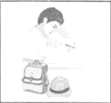
2. Colin: I really want to play or chat with my friends. But I can’t. I have to study hard for the coming exams. If I get good grades in all the subjects, my parents will be happy.
3.Molly: The coming weekend must be interesting for me. My parents say they will take me to Sanya. I’ve never seen the sea. I think it must be wonderful to swim in the sea and walk along the beaches.
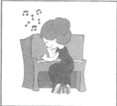
4.Pear: Swimming is my favorite sport. But I’m afraid I can’t do it this weekend. My mother has asked a piano teacher to teach me at home.
5.Kelly: I have many things to do this weekend. But most of them are not important. Only one thing I have to do is that I’ll take part in Lisa’s birthday party.
In your dreams, you may clearly see something or hear someone talking. But what about smells? Can you ever remember smells from your dreams?
A study published in 1896 looked at different sensory experiences in dreams. It found that visual(视觉的)experience mainly controls one's dreams. It takes up about 85 percent, while auditory(听觉的)experience makes up 69 percent and smell only 7 percent.
But why? Scientists from the University of Illinois, US, have a theory based on what is know about the brain.
In our brain, there is a special part called the cerebral cortex(大脑皮层). It is linked to our feelings. As much as two-thirds of the cerebral cortex works in vision(视觉). So vision appears often in dreams. Auditory experience is closely tied to , language, and language is processed entirely in the cerebral cortex.
Smell, on the other hand, has little to do with the cerebral cortex. It connects directly to the memory and emotional systems. That is why a smell can sometimes bring back a distant memory.
Another possibility is that perhaps smell is not easily affected by our imagination. For example, close your eyes and imagine your favorite dish. What do you get? It is easy to think about what it looks like. But it is not as easy to imagine its smell.
The vision and auditory senses arc part of a complex process inside the brain. But smell is a direct measurement of chemicals in the air. There is less imagination involved in smell. Therefore,smell might be less influenced by the brain activity that happens while dreaming. It is similar to taste and touch. That is why you don’t usually have the experience of taste and touch in your dreams.
1.Which experience mainly controls one's dreams, according to the 1896 study?
A.Smell. B.Vision. C.Hearing. D.Taste and touch.
2.Which of the following is TRUE about the US scientists’ brain theory?
A.Less than half of the cerebral cortex works in vision.
B.Auditory experience is not tied to language.
C.Smell has almost nothing to do with the cerebral cortex.
D.It’s difficult to imagine what things in your dreams look like.
3.According to paragraph 6 and 7, it’s easier to imagine a dish’s______.
A.look than its smell B.smell than its look C.taste than its smell D.smell than its taste
4.Why can we hear someone talking in our dreams?
A.Because auditory experience is closely tied to language which is processed entirely in the cerebral cortex.
B.Because auditory experience makes up 85 percent in controlling one’s dream.
C.Because auditory experience has little to do with the cerebral cortex.
D.Because auditory is not part of a complex process inside the brain.
5.What is the best tile for the story?
A.How does the cerebral cortex work B.Why can’t you smell in your dreams.
C.What experience happens most often in dreams. D.Why can’t you remember smells from your dreams.
— Can I park my car here, sir?
—_______.You see, there's much traffic here.
A.Never mind B.Of course C.You’d better not D.Yes, please
阅读下面短文,在空白处填入括号中单词的正确形式。
I couldn't wait to go to Europe to see some cities I 1.(real) wanted to visit. It was great because I could choose what I enjoyed 2.(do) in each city.
The train trip was fast and the views of the countryside were 3.(interest). Now I was in Salzburg, Austria. The quiet hills of Austria are great places 4.(relax). We saw the movie The Sound of Music. Mozart, the famous 5.(music), was born in Austria. I listened to some of his classical music.
The train ride to Amsterdam was a long one. Amsterdam is a fun city, full of 6.(friend) locals and many tourists. I spent the whole day 7.(visit) the art museums there. The museum about the famous Dutch artist Van Gogh is filled with history and beautiful art. I took a boat ride and saw local people in 8.(tradition) dresses. I even got to taste some delicious Dutch cheese.
Copenhagen, Denmark, is one of the safest 9.(place) in the world. I spent a busy and nice day at the Tivoli Amusement Park. It is a huge park which even has concerts and dance shows. Hans Christian Andersen, a famous writer of 10.(child) books, was born in this city. I found a lovely bookshop and bought two of his fairy tale books, The Little Mermaid and The Ugly Duckling.
What an interesting trip it is! I love it.
Did you enjoy ________ at the beach last weekend?
A.you B.your
C.yours D.yourself
Where does the woman want to go?
A.To the bookstore. B.To the zoo. C.To the bank.
I went________ last Sunday.
A.fishing B.fish
C.fished D.to fish


 春雨教育同步作文系列答案春雨教育同步作文系列答案
 B.
B. C.
C.
 E.
E.  F.
F.