题目内容

C

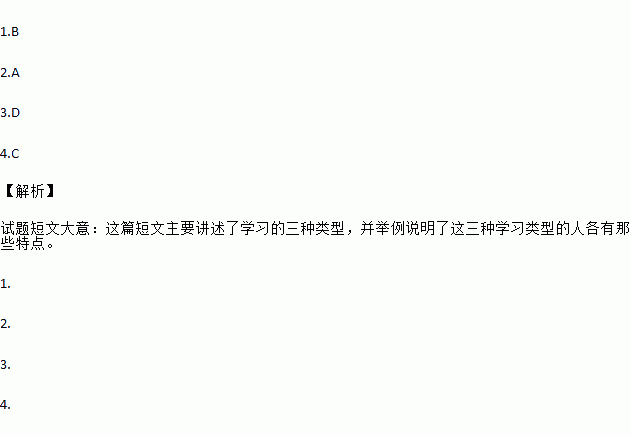
Why are you study habits different from those of your friends? Why do you seem to learn faster in some classes while more slowly in others? One reason you may not know is that people have different types. Scientists say there are three different learning types: Visual(视觉型),Auditory(听觉型),and Kinesthetic (动觉型)。

Visual learners learn best by seeing. If you seem to easily remember information from pictures, graphs(图表),and videos, you are probably a visual learner. You’re not good at copying down what the teacher says in class. Never mind. You can draw graphs or pictures instead, if you find that works better for you.

Auditory learners learn best by hearing. If you seem to easily remember things by hearing them, then you are probably an auditory learner. You must listen carefully while the teacher is speaking because it’s the easiest way for you to learn . Sometimes you may find that taking notes tops you from listening carefully. After class, you can write down what you remember or borrow your friend’s notes to copy.

Kinesthetic learners learn best by doing. If you seem to learn best by working with your hands, you are probably a kinesthetic learner. Taking notes by writing can make you pay close attention to information as you receive it. Of course, you can learn best by making full use of labs or other class activities.

Hope you learn better by knowing what your personal learning type is.

1.There are____________ different learning types according to the passage.

A. two B. three C. four D. five

2.Jude can remember the words of a song quickly by listening to it once or twice. She might be a /an ____________ according to the passage.

A. auditory learner B. visual learner

C. strange leaner D. usual learner

3.Kinesthetic learners learn best by ____________

A. Remembering information from videos B. listening teachers in class

C. drawing graphs or pictures D. doing things with their hands

4.The best title of this passage may be “____________”

A. Study Habits B. Ways to study

C. Learning types D. Reasons to learn
练习册系列答案
相关题目

Ray Charles, a black singer and pianist of the USA. He had won 12 Grammy Awards (格莱美奖) and performed at 10,000 concerts around the world. Many musicians called him simply “the Genius” (天才).

Ray Charles was born into a poor family, without a father. When he was 5 years old, his younger brother died, and around the same time, Charles started to lose his sight. By the age of 7 he was completely blind. He had already been learning the piano for a year, and when he went blind, his mother knew this would be the only way he would make any money in the future. All his life, Charles remembered her saying: “Do it right, or don’t do it at all.”

Later he went to a school for blind and deaf children. There the teachers also encouraged him to study music. Sadly, while he was still at school, his mother died. He left school and in the early 1950s Charles organized a group of players. He sang, played the piano and wrote music.

He made many classical CDs wit h famous artists such as Elton John and the Beatles.

In 2003 a film of his life Ray was made. The part of Charles was played by a younger actor and musician called Jamie Foxx. The film director brought Foxx to meet Charles. After they had been playing together for two hours, Charles, then aged 73, jumped up and said: “He’s the one ... he can do it.” A year later Charles died aged 74. The film of his life has been as popular as his songs and means that the memory of Charles’ music will live on.

1. What can we learn from Ray’s childhood story?

A. His father died when he was 5 years old.

B. He started to go blind at the age of 7.

C. He was born in a rich musician family.

D. He started to learn the piano at the age of 6.

2.Ray Charles’ mother encouraged him to play music because .

A. his father was a musician as well

B. because it would help him get used to being blind

C. it was a good way for a blind person to get money

D. his teacher thought he was a genius

3.Ray Charles went to a school for .

A. normal children B. deaf and blind children

C. talented children only D. children without parents

4.Ray Charles thought that Jamie Foxx .

A. was the right person to play him in the film

B. was a good film maker

C. was the wrong person to play him in the film

D. was a good director

5.What is the main idea of the last paragraph?

A. Becoming a musician. B. Childhood story.

C. The film of Ray’s life. D. Master of many styles.

Students learn their lessons in class. In class teachers teach them. Students sit in the classroom listening to the _________. This is a way of _________. Is this the _________ way for students to learn something? Of course not. There is _________ way to learn. That is students can teach themselves. For example, if you can’t remember something _________ you are doing your homework, you can look at your book to find the_________ .This is a way to teach yourself. And it is not a(an) ___________thing. We can do this at any place and at any time.

How do you teach yourself? The first thing you must do is _________. Read something you are ___________ in, or you have to read .The second is that you must ask yourself questions. The question is something you don’t understand, __________you want to know more about. You can write down these questions. A____________ student is usually good at asking questions. The __________is to answer the question yourself by thinking hard ,by reading the text of other books, and______________ by asking other people .This is the way of teaching yourself .And you must do this all by yourself. If you keep ____________ like this for a long time, you are__________ to succeed in your study.

1.A. friends B. teachers C. workers D. parents

2.A. learning B. teaching C. playing D. thinking

3.A. first B. second C. last D. only

4.A. another B. the other C. others D. other

5.A. before B. after C. when D. because

6.A. words B. sentences C. answers D. pictures

7.A. easy B. difficult C. boring D. interesting

8.A. writing B. speaking C. listening D. reading

9.A. interested B. excited C. interesting D. exciting

10.A. and B. but C. so D. or

11.A. dishonest B. clever C. lazy D. kind

12.A. first B. second C. third D. fourth

13.A. sometimes B. only C. never D. seldom

14.A. to do B. doing C. do D. to doing

15.A. sure B. afraid C. surely D. worried

违法和不良信息举报电话:027-86699610 举报邮箱:58377363@163.com

精英家教网