题目内容

转换句型,每空一词。

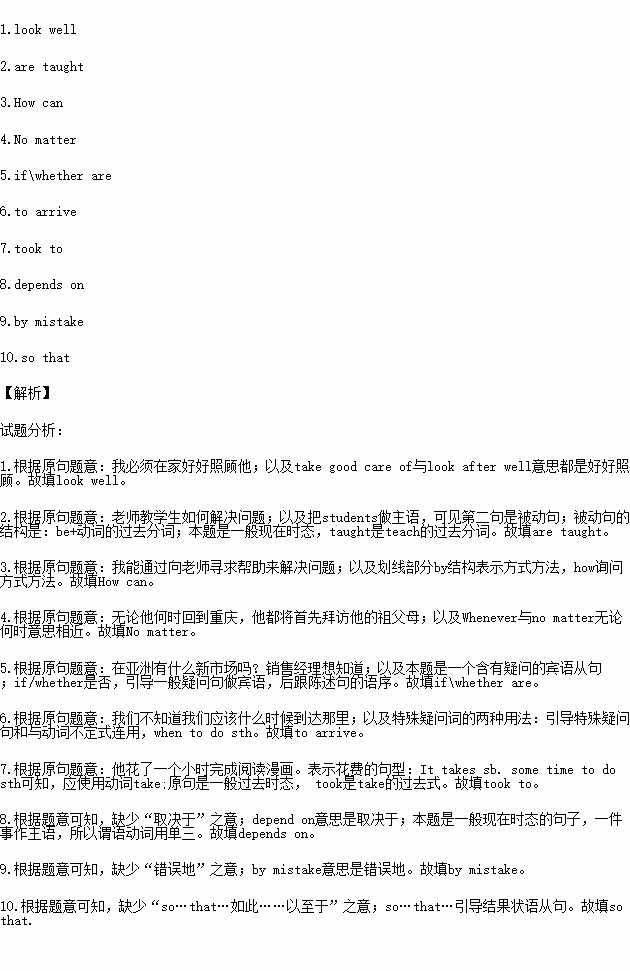
1.My brother is ill. I must take good care of her at home.(改为同义句)

My brother is ill. I must after her at home.

2.Teachers teach students how to solve problems.(改写同义句 )

Students how to solve problems by teachers

3.I can deal with it by asking the teacher for help.(对划线部分提问)

you deal with it?

4.Whenever he comes back to Chongqing , he will visit his grandparents first .(同义句转换)

________ _______ when he comes back to Chongqing , he will visit his grandparents first .

5.Are there any new markets in Asia? The sales manager wants to know.(合并为一句)

The sales manager wants to know _________ there ___________ some new markets in Asia.

6.We don’t know when we should arrive there. (保持句意基本不变)

We don’t know when __________ __________ there.

7.He spent an hour in finishing reading the comics.( 改为同义句)

It______ him an hour _______ finish reading the comics.

8.能否把这做好取决于你的学习习惯。(完成译句)

Whether or not you can do this well __________ __________ your learning habits .

9.昨天我错拿了Lisa的雨伞。

I took Lisa’s umbrella __________ __________ .

10.乡下的环境如此好以致于我都想搬去那儿住。(完成译句)

The environment of the countryside is __________ good __________ I want to move there .
练习册系列答案
相关题目

Almost every Chinese person can recite the two lines of the famous poem, “Every grain on the plate comes from hard work (谁知盘中餐,粒粒皆辛苦).” But sadly, many of us don’t actually get the real meaning of these lines: Don’t waste food.

A CCTV program, News One Plus One, reported that the food Chinese people throw away every year is much enough to feed 200 million people for a year.

Do we have too much food? Of course not. According to the UN World Food Program, there were 925 million hungry people around the world in 2013, especially in developing countries. Six million children die of hunger every year.

Chinese people are famous for being hospitable(好客的) and generous. Many even feel that they lose face if their guests have eaten all the food on the table.

Luckily, a number of people have got to know the importance of saving food. Last November, Li Hong, a waitress in a restaurant in Nanjing, got fired(解雇) because she took some leftover(剩余的) food home for her son. Many people stood by her and criticized(批评) the waste of food.

What should we do in our daily lives to waste less food? Here are some tips:

1. Do not order too much in a restaurant. Only order as much as you want to eat. If you cannot eat all the food you ordered, take the rest of it home.

2. Don’t be too picky(挑剔的) about food. Some food may not taste great, but your body needs it.

3. Keep an eye on what food you have at home. Don’t buy too much, especially for vegetables and fruit.

1.How many people were hungry around the world in 2013 according to the UN World Food Program?

A. 200 million. B. 6 million.

C. 925 million. D. 952 million.

2.What does the writer want to show us through Li Hong’s story?

A. Many Chinese restaurants waste a lot of food.

B. Many Chinese people are kind and ready to help the weak.

C. Chinese people feel that they lose face if their guests eat all the food.

D. Many Chinese people don’t agree with the behavior(行为) of wasting food.

3. According to the article, we shouldn’t waste food because .

A. food comes from hard work

B. Chinese are hospitable and generous

C. there is enough food to feed all the people

D. six million children die of hunger every day

4.Which of the following is a good way to save food?

A. Taking restaurant leftover food home.

B. Not eating the healthy food you don’t like.

C.Ordering more than you need at a restaurant.

D. Not knowing what you already have at home when shopping.

违法和不良信息举报电话:027-86699610 举报邮箱:58377363@163.com

精英家教网