题目内容

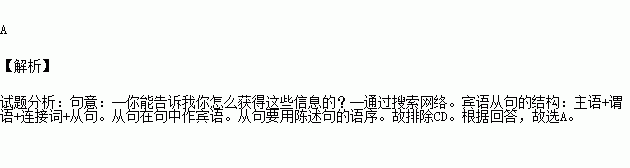
---Could you tell me ______? _______ --- By searching the Internet.

A. how you got the information

B. why you got the information

C. how did you get the information

D. why did you get the information
练习册系列答案
相关题目

Did you know that about 55% of communication is unspoken, so in fact, our bodies are actually saying more than our words. I find that the key to a successful conversation in any language is to speak to people not only in their spoken language but also with the body language they know best.

Britain, along with much of Northern Europe, has a non-touch culture, so personal space is very important. In a formal(正式的) situation, we would usually greet each other with a handshake. Informally, but not so often, my British friends and I would greet with a hug. Hardly ever would we greet with a kiss on the cheek, let alone a hug and two kisses on the cheek!

Here in the south of Italy, and in many different parts of the world, both men and women greet with two kisses on the cheek, use a lot of hand signs and often touch each other. In other words, little personal space is left between people when communicating.

At university, I have learnt to successfully communicate in spoken Italian. And since I moved to live with the local people, I have also started to pick up their body language. Sometimes, I find myself not knowing what hand signs to use when expressing myself. However, what I know for sure is that I would miss the opportunity to fully put myself in the Italian culture if I keep my personal space unbroken.

Here are 5 body language tips in Italy;

● Use different signs; head, arms and hands.

● Use facial expressions. Always smile at people! It is said that smiling is the most powerful unspoken way to communicate friendliness.

● Use eye contact , because "the eyes are the window to the soul."

● Don't worry about personal space. Italians are a people who like to use the sense of touch, so moving away or keeping your distance may be considered as being unfriendly.

● Touch. When meeting and leaving, always shake hands.

1. In Britain, people usually greet each other with .

A. a warm hug B. a handshake

C. a kiss on the cheek D. two kisses on the cheek

2. The writer uses Britain and Italy as examples to show .

A. men and women greet in the same way

B. Italians are more friendly than the British people

C. keeping personal space is very important in any country

D. people in different countries use different body language

3. From Paragraph 3, we can learn that the writer .

A. likes to keep his personal space

B. tries to learn Italian body language

C. knows little about Italian hand signs

D. keeps using British body language in Italy

4.What is the most powerful unspoken way to show friendliness in Italy?

A. Hand signs. B. Smiling. C. Eye contact. D. Touch.

阅读理解。

I would like to talk to you about one of the most beautiful places I’ve ever seen. I was born and raised there and now I visit it from time to time. My family moved to the city, so I only go back to see friends or to camp and fish.

I grew up in a small town called Antonito Co. It is surrounded by mountains. So camping is a big source of happiness in the valley(山谷). There are so many beautiful places to hike.

The town itself is very small. It is said that if you blink (眨眼) when you’re going through it, you’ll miss it. This has some truth in it considering the size of the town. We have one grocery store (杂货店), a tiny post office , and a tiny bank. There are also a few gas stations, bars, some excellent restaurants, a small hospital and of course several schools. However, for clothing and shoes, you have to drive thirty miles to Alamosa to shop there.

Everyone in the town is nice and we all know each other. The crime rate (犯罪率) is zero unless you count some weekend fights that break out because some people drink too much. The classes in school are small, so you get a lot of attention from the teacher.

You’re probably wondering why I don’t live there. Well, I can’t get a job there. A lot of the businesses are family-owned. And they never fire (解雇) their employees (雇工). So the employees work there usually until they retire (退休). Most people have to go to other places to get a job.

1.What is this passage mainly about?

A. A travel guide of the writer’s hometown.

B. An introduction to the writer’s hometown.

C. The history of the writer’s hometown.

D. The scenery of the writer’s hometown.

2.By the underlined part in paragraph 3, the writer wants to show that the town is ___________.

A. beautiful B. small

C. exciting D. safe

3.What can you find in the writer’s hometown?

a. bank

b. a post office

c. some gas stations and bars

d. a clothing store

e. a shoe shop

f. some restaurants and a hospital

A. abce B. bdef

C. abcf D. cdef

4.Which of the following statements is TRUE?

A. Teachers pay more attention to the students because they work hard.

B. It is great fun for the writer to go camping in the valley.

C. It’s common to see some drunken people in the writer’s hometown.

D. The writer moved to the city because he didn’t like his hometown.

5.We can learn from the last paragraph that in the writer’s hometown ___________ .

A. not many job chances are provided

B. employees don’t make much money

C. most people live a very hard life

D. only the old still live there

违法和不良信息举报电话:027-86699610 举报邮箱:58377363@163.com

精英家教网