Thousands of years ago, people didn’t know that the Earth moved. They thought the sun really moved across the sky. The Greek god Helios was said to drive the sun around the sky with his chariot (战车). But now, these ideas have all changed. Nowadays, it is the sun that drives our “chariot” around the sky.

So what does all this mean? Well, quite simply, there is now a plane (or “chariot”) that is powered by the sun. It has special parts in its wings. These parts absorb power from the sun. They absorb so much power that they can carry on flying at night. In the Greek myths, Helios had to take a break at night. It seems we’re finally even more efficient (效率高) than the gods themselves.

This plane is called Solar Impulse (太阳驱动号). It will fly across the US in May. This is very important for the future of the world.

So why is solar energy so good for us? Well, other kinds of energy cause a few problems. If you live in China, you’ve probably noticed the pollution. This is caused by burning coal or gas to make energy. The heat and chemicals (化学制品) from this make things work. But if we use the heat from the sun, we don’t have to burn anything, and there’s no pollution.

Solar energy is not all there yet. It needs to be improved. But the best thing about it is that, unlike coal and gas, it doesn’t run out. Solar Impulse could keep flying forever. Well, actually, the sun will run out too, one day, but not for another 5 billion years. That’s a pretty long flight.

1. What does “chariot” really refer to (指的是) in the last sentence of Paragraph 1?

A. The Earth.                 B. The Greek god.               C. The plane.               D. Birds.

2. Which of the following is TRUE about Solar Impulse?

A. It can only fly at night.                                  B. It is powered by the sun.

C. It has already flown across the US.                 D. It needs gas to work.

3. In the passage, what is mentioned as the cause of pollution in China?

A. Overpopulation.                                            B. Heavy traffic.

C. Using solar energy.                                        D. Burning coal or gas.

4. What does the writer mean by “that’s a pretty long flight”?

A. Solar Impulse moves very slowly.

B. Solar Impulse will be in use for a very long time.

C. It takes a lot of time to get Solar Impulse going.

D. Solar Impulse has a long way to go to take the place of the sun.


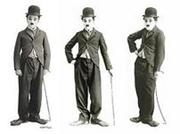
Perhaps the most famous name in the world of silent movies is Charlie Chaplin. It was in 1889 that both moving pictures and Charlie Chaplin were born. Sadly, Charlie’s father died when Charlie was five, and his mother was sent to mental (精神的) hospital. This left young Charlie homeless and living on the streets.

Things seemed bad for Charlie, but he had a bright, nice character. He was pleasant and easy to like. So he managed to get small parts in performances around London. Then, he moved to the USA in 1906, and his life took a major change for the better. He got a part in a show performing there. Seven years after his arrival in the USA, he got his first major part in a film. Charlie was a great success in the movie theaters. His silent, highly visual (视觉的) form of comedy was perfect for the silent films of the time. By 1915, he was making over $1,250 a week, which was a huge amount of money at that time. Charlie knew what he was good at, and he stuck to it. Even when sound could be used for movies in 1923, he continued to make silent pictures. Charlie knew that the silence was an essential part of what made his movies so funny. Charlie continued to make silent films well into the 1940s, when almost everyone else had changed to sound. Charlie, however, still remained one of the world’s greatest film stars.

1. When did Charlie get his first major part in a film?

   A. In 1889.              B. In 1906.                   C. In 1913.           D. In 1923.

2. The underlined word “essential” in Paragraph 2 probably means _____________.

   A. very boring         B. very correct                     C. very difficult      D. very important

3. From the passage we know that Charlie ___________.

   A. was easy to get along with                       B. stopped making movies in 1923

   C. was born and brought up in America         D. didn’t produce silent films in America

4. Which could be the best title of the passage?

   A. A Great Man of Silent Movies.                  B. The Major Change for an Actor.

   C. The Beginning of Silent Movies.               D. The Hard Life for A Movie Maker.


Last month, Yang Xuelan, 18, was preparing for the college entrance examination, just like every Senior 3 student. However, a terrible earthquake hit her hometown, Ya’an, Sichuan on April 20.

Yang ran to the playground. She was safe. But all her study materials were buried (被埋) in the classroom. A university in Chengdu lent a helping hand. Now Yang and her classmates are studying there.

The earthquake killed at least 196 and injured more than 12,000. Soldiers and experts arrived at the quake zone (震区) immediately. They helped rescue people and rebuild homes. Tens of thousands of people have donated money and materials to help.

There is little we can do to stop natural disasters such as earthquakes from happening. But we can try to make ourselves better prepared for these disasters.

Japan is considered to be one of the best countries at dealing with earthquakes. From a young age, the Japanese are taught how to keep safe in earthquakes. Schools in Japan often take earthquake drills (演练).

Almost every Japanese family has a survival kit (救生包), which has a flashlight, a radio, water and enough food for several days. This helps people to stay alive after an earthquake.

What can we do when an earthquake happens? Some methods can reduce the harm they cause. The American Red Cross introduced the “Drop, Cover & Hold on” method.

*Drop down onto your hands and knees. This position protects you from falling.

*Cover your head and neck under a strong table or desk. If there is no shelter nearby, you can also stay along a wall, and cover your head and neck with your arms and hands.

*Hold on to your shelter until the shaking stops. Be prepared to move with your shelter if the shaking shifts it around.

1. We can tell from the first two paragraphs that _________.

A. an earthquake hit Yang’s hometown

B. Yang hasn’t been to school after the quake

C. the earthquake made Yang a college student

D. Yang and her classmates were buried in the classroom

2. Why are Yang and her classmates studying at a university in Chengdu at present?

A. Because they have got a chance to go to college.

B. Because they got help from soldiers and experts.

C. Because they don’t want to study in their school any more.

D. Because their school buildings were destroyed by the earthquake.

3. What did soldiers and experts mainly do in the quake zone?

A. They built classrooms for students.

B. They donated a lot of money and materials.

C. They helped save people and rebuild their homes.

D. They tried to prevent more earthquakes from happening.

4. Which of the following should you do when an earthquake happens?

A. Stay there and don’t move.              

B. Stand straight on a table or desk.

C. Drop down onto your hands and knees.

D. Lie down on the ground and face the ceiling. 


完形填空

请认真阅读下面短文,从短文后各题所给的A、B、C、D四个选项中,选出最佳选项。

On 26th December, 2004, a young girl called Tilly Smith was on holiday with her family in Phuket, Thailand. No one 1 what was going to happen —a tsunami (海啸) that would 2 about 200,000 people. Tilly had studied tsunamis in her 3 class and had seen a video of a tsunami.

“My mum didn’t 4 what was happening,” said Tilly. But Tilly did. “I saw this bubbling on the water, at the edge; the water and the foam (气泡) looked as if they were boiling, and were making a 5 noise. The water was coming in, but it wasn’t going out 6 . It was coming in, and in, towards the hotel.”

She turned to her mother and sister and told them that it was a tsunami. 7 they did not believe her. She was only 10 years old. Maybe she was just hoping to see a tsunami 8 she had studied it?

Tilly’s father went back to the hotel with her sister. They told the people who worked in the hotel what Tilly had said. Tilly 9 out to the beach, to warn the people there. The hotel workers 10 Tilly. They began to get people off the 11 . Only a few minutes later a huge wave 12 over the beach. This beach was one of the few beaches in Phuket where no one was killed or seriously 13 . This was all because of 10-year-old Tilly Smith. She and all her 14 escaped (撤离). She 15 them.

1. A. forgot B. thought C. found D. knew

2. A. wash B. take C. kill D. surprise

3. A. physics B. geography C. History D. chemistry

4. A. realize B. understand C. see D. study

5. A. small B. common C. strange D. peaceful

6. A. more B. again C. then D. soon

7. A. As usual B. At once C. At first D. In fact

8. A. before B. if C. though D. because

9. A. walked B. ran C. drove D. jogged

10. A. believed B. doubted C. asked D. educated

11. A. hotel B. school C. road D. beach

12. A. swept B. flew C. ran D. went

13. A. worried B. disturbed C. carried D. hurt

14. A. group B. friends C. family D. school

15. A. left B. saved C. thanked D. moved

 0  91094  91102  91108  91112  91118  91120  91124  91130  91132  91138  91144  91148  91150  91154  91160  91162  91168  91172  91174  91178  91180  91184  91186  91188  91189  91190  91192  91193  91194  91196  91198  91202  91204  91208  91210  91214  91220  91222  91228  91232  91234  91238  91244  91250  91252  91258  91262  91264  91270  91274  91280  91288  159627 

违法和不良信息举报电话:027-86699610 举报邮箱:58377363@163.com

精英家教网