网址:http://m.1010jiajiao.com/timu_id_2210076[举报]
| 根据对话内容,将方框内符合对话情境的句子抄写在对话空白处,使对话恢复完整。选项中有两项是多余的。 | |
| A: Hello! Could I speak to Mary, please? B: Certainly. 1 C: Hello, Mary here. A: Hi, Mary. 2 I'm going to have a party tomorrow. Can you come? C: 3 But I'm afraid I'm not very well. A: I'm sorry to hear that. 4 C: Don't worry. I'Il take good care of myself. I hope you will have a good time at the party. A: 5 Goodbye! C: Goodbye!
| |
| 1. __________ 2. __________ 3. __________ 4. __________ 5. __________ |
口语运用
A、根据对话及方框中的选项补全对话。
| A. We can watch a video. B. Our house is across from the supermarket. C. What are you doing? D. It’s on Bridge Street . E. There’s a new hotel on the corner. |
Michael: Hey, John.
John: Hi, Michael.
Michael: 1
John: Reading a book.
Michael: Do you want to come over to my house? 2
John: OK. Where is your house?
Michael: 3 It’s a quiet street off Fifth Avenue.
John: Oh, OK. I know where that is. 4
Michael: Yes. There’s a small supermarket on the street. 5
John: OK, I’ll see you at two-thirty.
1-5 ___________________
B、对话排序 (5分)
你在这个城市,但对此城市不太熟悉,一天你一个人想去公园玩,但你又必须先到旅馆去看一位你的好朋友,然后出来后再去银行取一些钱,最后才去公园。对话中的A表示你,B是警察,请根据下列图示及句子,把下列句子排列成一段通顺的对话。
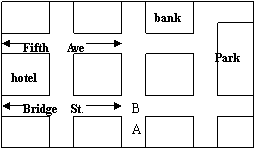
1. A: Excuse me. Can you tell me the way to the park?
2. B: Oh, I see. You can go straight and turn right on the first crossing, you’ll find a white building(建筑物). That’s the hotel.
3. A: How can I get to the bank after I go out of the hotel?
4. B: Oh, it is in the east(东面)of the city. You can go …
5. A: I’m sorry, I may tell you that before(在…..以前)I get to the park, I’ll have to go to the hotel to see my good friend, and then I’ll go to the bank to get some money.
6. B: That’s not difficult. After walking out of the hotel, please turn left and walk about 100 m. You will get to Fifth Avenue. Then turn right and the bank is on the right.
7: A: OK. Thanks a lot.
8. B: No, very near. Going out of the bank, you go back to the Fifth Avenue. Turn left and go straight, there is a park on the left.
9. A: Is the bank far(远) from the park?
正确顺序:___ 4___ ___ ___ ___ ___ ___ ___
查看习题详情和答案>>They are part of a new addiction (瘾) called Internet addiction. Internet addicts spend at least thirty to
forty hours online every week. The use of the Internet can be an addiction like drug (毒品) use. People
lose control (控制) of the time they spend on the Internet.
For example, one college student was missing for several days. His friends were worried, and they
called the police. The police found the student in the computer lab. He was surfing the net for several days
straight.
Studies show that about 6 to 10% of Internet users become addicted. And people worry about the teens
because the Internet is changing the playing field for some of them. They spend more time in cyberspace
than in the real world of friends and family.
Is "surfing the net" a hobby or an addiction for you? You may have a problem if you have these
symptoms (症状):
·You do not go to important family activities or you do not school work because you like to spend hours
on the Internet.
·You can't wait for your next online time.
·You plan to spend a short time online, but then you spend several hours.
·You go out with your friends less and less.
B.What an Internet addict usually does.
C.Where to find an Internet addict.
D.Why to write this passage.
B.It is a way of producing drugs.
C.It is like taking drugs.
D.It is terrible to imagine.
B.They used to work on the Internet.
C.The playing field of the teens will disappear.
D.More and more of the teens will become addicted to the Internet.
B.Internet addicts usually stay in the computer lab without sleep
C.Some of the Internet users have already been seriously addicted
D.The police often help to find those Internet addicts
B.You feel uncomfortable without the online time.
C.You like doing your homework very much.
D.The time flies when you are online.
B.Go to family activities more often.
C.Do things as you have planned.
D.Stay with your parents as often as possible.
1. Stay inside and duck and cover. Get under a desk or table, or stand in a corner or under a
doorway. Cover your head and neck with your arms.
2. Move against a wall if in a high building with no protective desk or table nearby. Cover your head
and neck with your arms.
3. Try to get into an open area away from trees, buildings, walls, and power lines (电杆) if outdoors.
4. Pull over (停靠)to the side of the road away from overpasses (天桥) and power lines if driving.
Stay in your car until the shaking ends.
5. Get away from shelves or other areas where objects may fall if in a crowded store or public area.
Do not run for the door. Lower your body close to the ground and cover your head and neck with your
hands and arms.
6. Stay in your seat if in a cinema or a theater. Get below the level of the back of the seat and cover
your head and neck with your arms.
7. If you take cover (躲避) under a strong piece of furniture (家具), hold on to it and be prepared
to move with it.
8. Try to stay away from kitchens, where there are often many objects that might fall or get burnt.
B. Covering your head and neck with your arms can protect you in an earthquake
C. Advice for dangerous situations
D. How to stay calm (保持镇静) in an earthquake
B. some kind of meat for eating
C. walk like a duck
D. lower your head or body very quickly
B. Drive your car quickly through the overpass and get out of it.
C. When you stay under a strong piece of furniture, you should hold on to it and be prepared to move
with it.
D. Climb over the back of the seat and cover your head and neck with your arms.
B. Your arms
C. Your neck and arms
D. Your head and neck
B. outside a building
C. in your house
D. in a store