摘要: A. sign B. train C. picture D. line

网址:http://m.1010jiajiao.com/timu3_id_3206077[举报]

There are some of the signs that you see on the roads. Number one is a sign with the number thirty on it. When drivers see this sign they must not go at more than 30 kms an hour. We see this sign when we get to parts of the country where there are many houses and other buildings. For example, when we are getting near a town, 30 kms an hour is the speed limit.

Number two is the sign for end of the speed limit. We are out of the town now and may go at more than 30 kms an hour.
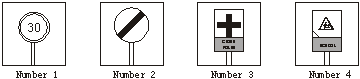
Number three is a sign that we are near a cross-roads, that is, a place where two roads cross. We must drive carefully.

Number four has the word SCHOOL on it. This is a sign that there is school at the side of the street or road. Perhaps there are children going to school or leaving school. So drivers must look carefully and go slowly until they are past the school building.

1. When a driver sees a sign with the number thirty on it in front of him,  he________________.

A. must stop at once

B. needs to drive his car over 30 meters

C. has to run at 30 km or less than 30 km an hour

D. needs another 30 km fast

2. A sign with the number 30 kms on it is set up________________.

A. in the villages

B. in the countryside

C. at the side of road near the houses or buildings

D. at the crossing

3. If the driver sees sign Number 2 in front of him, he________________.

A. can drive his car as fast as possible                       

B. can go through the crossing

C. can drive his car over 30 km an hour                         

D. can’t go through the road

4. When a driver sees sign Number 3, he mustn’t drive his car________________.

A. 30 km an hour      B. carefully           C. slowly         D. carelessly

5. Among the four signs which has something to do with children?

A. Sign Number 1.                            B. Sign Number 2.           

C. Sign Number 3.                              D. Sign Number 4.


查看习题详情和答案>>

My ears are recently full of joyous remarks from my friends such as, “Oh, Beckham is so handsome, so cool, that I can’t help falling in love with him!” or “What perfect skills he has!” Yeah, I agree  1 some degree, though I sometimes do want to ask them how much they 2  Beckham, apart from his appearance and how much they know about football  3 scoring goals. It seems funny that we are crazy about things, with which we are  4 or about which we are uncertain, but we all, my friends  5 I, consider this one of life’s  6 .

We need these pleasures to brighten up our lives. But that doesn't amount to craziness 7 nonsense. As an old saying  8 , “Don't judge a book by its cover.” We should not judge 9 from its appearance. We should all know, it is one’s good character and great contribution that  10 one a star and unforgettable. Therefore, we’d better say  11 about Beckham’s good looks.

If we close our eyes,  12 into deep thought, we can find that the things that  13 us to be happy or sad  14 a clear meaning. If we don't go deeper and are just satisfied with superficial(表面的) things,  15 we will find that we have not really gained anything 16 our first impression has blinded and misled us, and we’ll not know the facts we ought to know unless we  17 that and make some changes.

It is believed that thinking and going deeper than before is a sign of great  18 . If one day we are willing to go deeper into everything, no matter how much it  19 us, we will finally prove how much we have grown up, how much more sensible, mature, and intelligent we have

20 .

1.A.to             B.on            C.in            D.at

2.A.learn from       B.hear about      C.get from       D.know about

3.A.rather than      B.except for      C.more than      D.besides

4.A.unknown       B.unhappy       C.unfamiliar      D.unlucky

5.A.not            B.as well as      C.rather than      D.but

6.A.pleasures        B.hopes         C.sorrows       D.regrets

7.A.but            B.and           C.or            D.or else

8.A.speaks         B.goes          C.talks          D.tells

9.A.something       B.nothing        C.everything      D.anything

10.A.make         B.cause         C.build          D.create

11.A.more          B.much         C.less           D.worse

12.A.burying        B.falling         C.losing         D.absorbing

13.A.move         B.take          C.have          D.force

14.A.lack          B.have          C.include        D.cover

15.A.in fact         B.indeed         C.in a while      D.sooner or later

16.A.so            B.even though     C.because        D.although

17.A.realize         B.refuse         C.search         D.supply

18.A.joy           B.progress       C.effort         D.work

19.A.cares         B.pains          C.affects        D.minds

20.A.come         B.felt           C.had           D.become

查看习题详情和答案>>

阅读理解

  For many years, no one could communicate with people who had been born without hearing.These deaf people were not able to use a spoken language.

  But, beginning in the 1700s, the deaf were taught a special language.Using this language, they could share thoughts and ideas with others.The language they used was a language without sound.It was a sign language.

  How did this sign language work? The deaf were taught to make certain movements using their hands, faces, and bodies.These movements stood for things and ideas.People might move their forefingers across their lips.This meant, “You are not telling the truth.” They might tap their chins with three fingers.This meant “my uncle.”

  The deaf were also taught to use a finger alphabet.They used their fingers to make the letters of the alphabet.In this way, they spelled out words.Some deaf people could spell out words at a speed of 130 words per minute.

  Sign language and finger spelling are not used as much as they once were.Today, the deaf are taught to understand others by watching their lips.They are also taught how to speak.

(1)

The deaf “talked” to other people ________.

[  ]

A.

by moving their hands, faces and bodies

B.

by shouting and singing

C.

without using any letters

D.

without using any language

(2)

The deaf could spell out words ________.

[  ]

A.

by reading them aloud

B.

by going here and there

C.

by expressing the letters with their fingers

D.

by watching others

(3)

Now, the deaf are trained to ________.

[  ]

A.

write sentences quickly

B.

understand others by lip-reading

C.

be good at mind-reading

D.

keep alone happily

(4)

The story as a whole is about ________.

[  ]

A.

learning to spell

B.

teaching the deaf to speak

C.

how the deaf communicate

D.

understanding Indian sign language

查看习题详情和答案>>

阅读理解

  What exactly is a lie?Is it anything we say which we know is untrue?Or is it something more than that?For example, suppose a friend wants to borrow some money from you.You say “I wish I could help you, but I am short of money myself.” In fact, you are not short of money but your friend is in the habit of not paying his debts and you don't want to hurt his feelings by reminding him of this.Is this really a lie?

  Professor Jerald Jellison of the University of southern California has made a scientific study of lying.According to him, women are better lies than men, particularly when telling a “white lie”, such as when a woman at a party tells another woman that she likes her dress when she really thinks it's terrible.However, this is only one side of the story.Other researchers say that men are more likely to tell more serious lies, such as making a promise that they have no intention of carrying out.This is the kind of lie politicians and businessmen are supposed to be particularly skilled at:the lie from which the liar hopes to profit or gain in some way.

  Research has been done into the way people's behavior changes in a number of small, unimportant ways when they lie.It has been found that if they are sitting down at the time, they tend to move about in their chairs more than usual.To the trained observer they are saying “I wish I were somewhere else now”.They also tend to touch certain parts of the face, particularly the nose.One explanation of this may be that lying causes a slight increase in blood pressure.The tip of the nose is very sensitive to changes and the increased pressure makes it itch.

  Another gesture that gives liars away is what the writer Decmond Morris in his book Man Watching calls the “mouth cover”.He says that there are several typical forms of this, such as covering part of the mouth with the fingers, touch the upper lip or putting a finger of the hand at one side off the mouth.Such a gesture can be understood as an unconscious(未察觉的)attempt on the part of the liar to stop himself from lying.

  Of course, such gestures as rubbing the nose or covering the mouth, moving about in a chair can not be taken as proof that the speaker is lying.They simply tend to happen more often in this situation.It is one gesture alone that gives the liar away but a whole number of things, and in particular the context(上下文)which the lie is told.

(1)

According to the passage, a white lie seems to be a lie ________.

[  ]

A.

that other people believe

B.

that other people don't believe

C.

told in order not to hurt someone's feelings

D.

told in order to take advantage of someone

(2)

Research suggests that women ________.

[  ]

A.

are better at telling less serious lies than men

B.

generally lie for more than men do

C.

often make promises they intend to break

D.

lie at parties more often than men do

(3)

Researchers find that when a person tells lies ________.

[  ]

A.

his blood pressure increases measurably

B.

he looks very serious

C.

he is likely to make some small changes in his behavior

D.

he uses his unconscious mind

(4)

The writer of the passage ________.

[  ]

A.

hates lying

B.

enjoys lying

C.

often tells a lie

D.

tries to study about lying

(5)

Which of the following is not mentioned in the passage as a sign of lying?

[  ]

A.

Touching one's ears

B.

Rubbing the nose

C.

Moving in a chair

D.

Covering the mouth

查看习题详情和答案>>

违法和不良信息举报电话:027-86699610 举报邮箱:58377363@163.com

精英家教网