网址:http://m.1010jiajiao.com/timu3_id_3195180[举报]
任务型阅读 (共10小题,每小题1分,满分10分)
认真阅读下列短文,并根据所读内容在文章后表格中的横线上填入最恰当的单词。
注意:每空只填一个单词。
Maybe you are an average student. You probably think you will never be a top student. This is not necessary so, however. Anyone can become a better student if he or she wants to. Here is how.
1). Plan your time carefully. When you plan your week, you should make a list of things that you can have to do. After making the list, you should make a schedule of your time. First time for eating, sleeping, dressing, etc. Then decide a good, regular time for studying. Don’t forget to set aside enough time fro entertainment. A weekly schedule may not solve all your problems, but it will force you to realize what is happening to your time.
2). Find a good place to study. Look around the house for a good study area. Keep this space, which may be a desk or simply a corner of your room. Free from everything but study materials. No games, radios, or television. When you sit down to study, concentrate on the subject.
3). Make good use of your time in class. Take advantage of class time to listen to everything the teachers say. Really listening in class means less work later. Taking notes will help you remember what your teachers say.
4). Study regularly. When you get home from school, go over your notes. Review the important points that your teachers mentioned in class. If you want to know what your teacher is going to discuss the next day, read the material in advance. This will help you understand the next class. If you do these things regularly, the material will become more meaningful, and you will remember it longer.
5). Develop a good attitude about tests. The purpose of a test is to show what you have learned about a subject. They help you remember your new knowledge. The world won’t end if you don’t pass a test, so don’t be overly worried.
There are other methods that might help you with your studying. You will probably discover many others after you have tried these.
How to Become a Better Student?
| General methods | How to | Advantages |
| plan you time carefully | ● make a list ● make a 1 | force you to realize 2 is happening to your time |
| find a good place to study | free of everything but study 3 | you can 4 on the subjects |
| make good use of your time in class | ●listen to everything the teachers say ●take 5 | really listening in class means 6 work later. |
| study regularly | ● go over your notes ● 7 _ new materials | Help you 8 it better, remember it longer |
| develop a good attitude about tests | don’t overly 9 about it | remember your new 10 |
Taxis
Taxis are in the streets 24 hours a day.Simply raise your hand, and a taxi will appear in no time.They are usually red, and they display the price per kilometre on the window.You should check whether the cab has a business permit, and make sure you ask for a receipt.
Buses and trolleybuses
Public transport provides a cheap way to get around in Beijing.There are 20,000 buses and trolleybuses in Beijing, but they can get very crowded.It’s a good idea to avoid public transport during the rush hour(6∶30 a.m.~8∶00 a.m.and 5∶00 p.m.~6∶30 p.m.).Fares are cheap, starting at 1 yuan.Air-conditioned buses cost more.Buses numbered 1 to 100 are limited to travel within the city centre.Higher numbers have destinations in the suburbs.Tourists shouldn’t miss the 103 bus which offers one of the most impressive routes, past the Forbidden City and the White Pagoda in Beihai Park.If you get on a double-decker bus, make sure you sit upstairs.You’ll have a good view of the rapidly changing city.
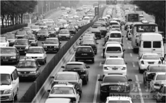
Most buses run from about 5∶00 a.m.to midnight.However, there is also a night bus service, provided by buses with a number in the 200s.
Minibuses
Minibuses with seats for 12 passengers offer an alternative to expensive taxis and crowded public transport in some areas.They run regular services and follow the same routes as large public buses.And in a minibus you always get a seat even in rush hours.
Underground
There are four underground lines in Beijing, and several lines are under construction.Trains are fast and convenient, but rush hours can be terrible.A oneway trip costs 3 yuan.Station names are marked in pinyin.The underground is open from 5∶00 a.m.to 11∶00 p.m..
Pedicabs
Tourists like these human-pedalled“tricycle taxis”, but they can be expensive.You should talk to the driver, and make sure you know the price before you begin the journey.For example, if it is per person, single or return.Tricycles are worth using if you want to explore the narrow alleys(hutong)of old Beijing.
Questions:
1.What’s the problem with buses?
2.What are the advantages of the underground?
3.What can you visit in a pedicab?
All children in the United States have to receive an education, but not all children go to school. A number of parents 36 not to send their children to school. Such children are known 37 “home-schoolers”. Some parents prefer teaching their children at home 38 they do not believe schools teach the correct religious (宗教的) 39 ; others believe they can provide a better educational 40 for their children by doing so. 41 , results show home-schooled children often do better than 42 on national tests in reading and math.
David teaches his three children at home. He 43 that his children learn very differently from children in school. Learning starts with the children’s 44 and questions. For example, when there is snowfall on a winter day, it may 45 a discussion about climate, snow removal 46 , Alaska, etc. Or a spring evening when the family is out 47 the stars is a good time to ask questions about the sky. If the Brazilian rain forests are on TV, it 48 be a perfect time to talk about how rain forests influence the climate, how deserts are 49 and how the polar ice caps 50 ocean levels.
Home schooling is often more interesting than 51 schools, but critics (批评家) say home-schoolers might be uncomfortable 52 with other people in adult life. Critics also say that most parents are not 53 to teach their children. However, most parents don’t have the time or the 54 to teach their children at home, so schools will continue to be 55 most children get their formal education.
| 【小题1】 |
|
| 【小题2】 |
|
| 【小题3】 |
|
| 【小题4】 |
|
| 【小题5】 |
|
| 【小题6】 |
|
| 【小题7】 |
|
| 【小题8】 |
|
| 【小题9】 |
|
| 【小题10】 |
|
| 【小题11】 |
|
| 【小题12】 |
|
| 【小题13】 |
|
| 【小题14】 |
|
| 【小题15】 |
|
| 【小题16】 |
|
| 【小题17】 |
|
| 【小题18】 |
|
| 【小题19】 |
|
| 【小题20】 |
|
It was not until 1936 basketball became a regular part of the Olympic Games.
|
A.that |
B.when |
C.which |
D.then |
查看习题详情和答案>>
It was not until 1920 ______ regular radio broadcasts began.
|
A.while |
B.which |
C.that |
D.since |
查看习题详情和答案>>