网址:http://m.1010jiajiao.com/timu3_id_3144497[举报]
When we think of leadership, we often think of strength and power. But what are these really, and how do they operate?
Leadership today is not about forcing others to do things. If this is even possible, it is short-term, and tends to backfire. If you order someone to do something against their will, they may do it because they feel they must, but the anger they feel will do more harm in the long-term. They will also experience fear.
Fear causes the thinking brain to shut down, making the person unable to function at his or her best. If they associate you with this emotion of fear, they will become less functional around you, and you will have succeeded in not only shooting yourself in the foot, but possibly making a very good employee or partner unable to perform effectively. Fear has no place in leadership.
The way we influence people in a lasting way is by our own character, and our understanding and use of emotion. We can order someone to do something, which may be part of the work day; or we can employ them at the emotional level, so they became fully devoted to the projects and provide some of their own motivation(积极性). Today’s work place is all about relationships.
Anyone works harder in a positive environment in which they’re recognized and valued as a human being as well as a worker. Everyone produces just a bit more for someone they like. Leaders understand the way things work. They know the pay check is not the single most motivating factor (因素) in the work life of most people.
The true strength of leadership is an inner strength that comes from the confidence of emotional intelligence---knowing your own emotions, and how to handle them, and those of others. Developing your emotional intelligence is the single best thing you can do if you want to develop your relationships with people around you, which is the key to the leadership skills.
1.An employee may have a feeling of fear in the work place when___.
|
A.he is forced to do things |
|
B.be cannot work at his best |
|
C.he feels his brain shut down |
|
D.he thinks of his work as too heavy |
2.Which of the following is TRUE according to the passage?
|
A.People tend to associate leadership with fear |
|
B.Working conditions affect people’s physical health |
|
C.Good relationship is the key to business success |
|
D.Smart people are more functional in the work place |
3.To positively influence employees a leader should first of all __.
|
A.provide better suggestions |
|
B.develop his own personality |
|
C.give his employees a pay raise |
|
D.hide his own emotion of fear |
4.A good leadership is mainly seen in a leader’s ability to___
|
A.provide a variety of project for employees |
|
B.help raise employee’s living standards |
|
C.give employees specific instructions |
|
D.deal wisely with employees’ emotions |
查看习题详情和答案>>
In Britain today, is it possible to tell a person’s class just by looking at him? Physical details alone tell us about health, diet and the type of work a person does. A hundred years ago the working class often looked unhealthy, small and they were either too thin or too fat. The upper classes were often tall, sporting types who were used to a good diet and looked healthy. Today living and working conditions have improved, and such descriptions are no longer true. People are taller now than a hundred years ago. Everyone in Britain today is able to have free medicine, a good diet, acceptable working conditions and enough rest and leisure.
The clothes people choose to wear, however, do provide information about their backgrounds. Expensive clothes look expensive and show their wearer is rich. Clothes can provide other clues as well. The upper classes appear to be less interested in fashion and wear good quality clothes in non-bright colours, made of natural material like wool, leather and cotton. Lower working-class people often choose clothes in bright colours, made of man-made materials. A sociological explanation for this would be that colour and interest are missing from their lives, and therefore any opportunity to produce this is taken.
Clothes are available at a price within most people’s reach. New clothes make the wearer feel good and show some degree of wealth to the outside world. Today it is the younger people who spend most money on clothes. Fashion is no longer for the upper classes and the rich. Young people from all social classes spend a lot of money on clothes. Some new fashions are started by working—class people who want to look different and feel important. They want people to look at them.
1. In the past, a person’s appearance could not tell other people about his ________.
A. health B. diet C. occupation D. habits
2. The clothes people choose to wear tell us about their ________.
A. education B. richness C. backgrounds D. hobby
3. A working—class person may start a new fashion because ________.
A. she wants to draw the attention of other people
B. she wants to look different and healthy
C. she wants to show their wealth
D. she wants to show their taste
4. Which of the following statements is NOT true?
A. Expensive clothes look expensive and show the wearer is rich.
B. Working—class people prefer clothes in bright colours because they lack colour in their lives.
C. Today, it is still the upper class people who spend most money on clothes.
D. Today, fashion is no longer for the upper classes and the rich.
查看习题详情和答案>>
任务型阅读 (共10小题; 每小题1分,满分10分)
请认真阅读下列短文,并根据短文的内容要点完成文章后的表格列单。
注意:补全填空应符合语法和搭配要求,每格只填一个单词。
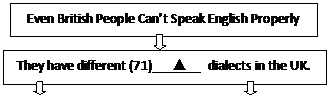
Even British People Can’t Speak English Properly
There are different regional accents across the UK, and a number of regions have several different dialects, that is, they have their own unique vocabulary and grammatical phrases. There were at least six different accents born to London the last time I counted.
Worse than that, it is not just where a person is born in the UK that decides their accent. For example, a language and its accents often vary across class or level of education. Another example is how language can differ among age groups in the UK. The words and pronunciations used by young people in the UK can be radically different compared with those used by adults.
Yoof culture
The word ‘yoof’ is a slang spelling of ‘youth’. Some people consider ‘yoof’ to be a negative term, since its pronunciation is easier and lazier than ‘youth’. Other people see the term as positive, because it describes how young people are creating their own language, concepts and identity. When people find it difficult to understand their children, the children can say more things than without censorship(审查,检查) of their parents. In this way, young people are starting to find freedom, independence and self-expression. They are creating a ‘yoof culture’.
It is not possible to come up with a complete list of words used by yoof. By the time the list was completed, it would be out of date. New words come and go like fashions. However, a few features of the yoof style of language are as follows:
◆instead of saying something like ‘That’s good!’ or ‘I understand’, yoof will use a single adjective like ‘Safe!’, ‘Sorted!’, ‘Sound!’, ‘Cool!’ or ‘Wicked!’.
◆instead of ‘He then said no!’, yoof will say ‘She was like: no!’
◆Instead of ‘She’s attractive!’, yoof will say ‘She’s fine!’ or ‘She’s fit!’
◆Instead of ‘I don’t care!’, a yoof will say ‘Whatever!’.
New social and political language
Certain groups of society feel threatened by ‘yoof culture’ or by the British working classes having more social freedom. As a result, a negative term now commonly used in the UK is ‘chav’. It is insult and is meant to describe someone who is uneducated and anti-social (e.g. ‘He’s a chav!’). A young person who wears a jacket with a hood(风帽,头巾) (after all, it rains a lot in the UK) is sometimes called a ‘hoodie’. It is a negative term and suggests that the young person is interested in committing crime.
Where does that leave us?
Learners of English often feel that the best test of their English is how well they can talk to a native speaker. Yet learners should not worry about communicating with native speakers so much. Research conducted by the British Council shows that 94 per cent of the English spoken in the world today is spoken between non-native speakers of the language. In fact, when we think about ‘international English’, there is no such thing as native or non-native speakers. The UK no longer owns the English language.
 |