网址:http://m.1010jiajiao.com/timu3_id_3142741[举报]
Why are medical dramas so popular?
Why are we so fascinated by medical dramas? From the high drama of Casualty and ER to the squeamish reality of Embarrassing Bodies and One Born Every Minute, it is hard to look away. Books with a medical or health theme are equally popular on best-selling lists.
When it comes to how our bodies function and malfunction, we are hooked. Without doubt, medical science is a rich source of stories. The popularity of all forms of medical-based drama suggests that we love to watch and read about people dealing with pain and discomfort, facing problems we fear we might face too at some point in our lives. Prof George Ikkos, president of the Royal Society of Medicine’s psychiatry section, says it is more to do with learning about ourselves from other people. The integrity of our body is extremely important. We should be concerned about our own body and that lies at the heart of it. Programmes like Casualty are dramatic and exciting—they involve a lot of ordinary people we can relate to directly. "It’s not like watching something about nuclear physics or stamp collecting."
Prof Ikkos says: "Well-informed programmes can be helpful but people engage at different levels, from the highbrow to the lowbrow, depending on how people relate to what they are watching." There is, of course, no research to confirm whether these dramas improve our understanding of medical matters or change our knowledge of health issues. Some fly-on-the-wall medical shows may simply be a popular form of voyeurism(窥探者). "But they do give information that is helpful. I would not want to discourage them," Prof Ikkos adds.
The themes of health, medicine and science are also at the heart of many works of popular fiction and non-fiction. Best-selling novels such as Before I Go To Sleep by SJ Watson and Me Before You by Jojo Moyes tackle the subjects of long-term memory loss and life as a paraplegic(高位截瘫的人). Thomas Wright, whose new book Circulation—a biography of the 17th Century physician William Harvey—won the Wellcome Trust Book Prize this week, does not need to be convinced about the power of medical history. He was attracted to the story behind Harvey’s discovery that the heart was the principal organ of the body, pumping blood through veins and arteries with an incredible force. During an experiment, Wright says, Harvey cut the aorta(主动脉) of an animal and the blood dashed out with such force and quantity that it splattered the room. "It was so shocking to people who thought blood flowed slowly around the body. It’s an image that stayed in my mind."That dramatic scene opens Wright’s book and he returns to it at the end too. Back then, people did not have much faith in physicians and many did not believe that medicine would be able to help or cure them, if they could afford to go to them in the first place. As a result, Harvey had a tough time convincing people of his theories.
Wright says how we view doctors and their methods has changed greatly since then and that could explain the popularity of medical dramas."Now we look to doctors and scientists for answers—we hope that they can overcome illness and death. We put them on a pedestal. Just the act of going to a doctor makes me feel better, but that builds expectations and pressure too."Wright hopes his book will appeal to the same audience who watch the blood-stained medical dramas on TV.
63. People like to watch and read medical drama because________.
A. they want to form of medical-based drama
B. they want to read a rich source of stories.
C. they want to deal with pain and discomfort
D. they might face the similar situation in their life
64. According to prof Ikkos, which statement is right?
A. We can cure ourselves from dramas.
B. Pro Ikkos will improve medical drama show.
C. Different people can learn from the medical dramas.
D. There is no specific research to confirm medical matters.
65. Harvey’s experiment of cutting the aorta tells us_________.
A. the heart was the principal organ of the body
B. the heart in the animal can press the blood dash
C. in the 17th century, medical knowledge was convinced
D. in the 17th century, animal was used in medical operation
66. Which of the following shows the structure of the passage?
A. 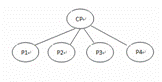 B.
B. 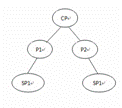
C. 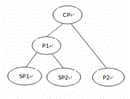 D.
D. 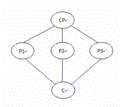
CP: central Point P: Point SP: Sun-point (次要点) C: Conslusion
查看习题详情和答案>>阅读下面短文,从短文后所给各题的四个选项(A、B、C和D)中,选出可以填入空白处的最佳选项,并在答题卡上将该项涂黑。
My parents operated a small restaurant in Seattle.It was open twenty-four hours a day, six days a week.And my first real job,when I was six years old,was 21 the diners’ shoes.My father had done it when he was young,so he taught me 22 to do it efficiently,telling me to 23 to reshine the shoes if the customer wasn’t 24 .
Working in the restaurant was a cause of great 25 because I was also working for the good of the family.But my father 26 that I had to meet certain standards to be part of the team.I 27 to be punctual,hard-working,and polite to the 28 .
I was 29 paid for the work I did at the restaurant.One day I made the mistake of advising Dad that he 30 give me $10 a week.He said,“OK.How about you paying me for three meals a day you have here? And 31 the times you bring in your friends for free soft drinks?” He 32 I owed him about $40 a week.
I remember returning to Seattle after being 33 in the US Army for about two years.I had just been promoted to Captain at that time.And full of pride,I walked into my parents’ restaurant,but the 34 thing Dad said was,“How about your 35 up tonight?” I couldn’t 36 my ears! I am an officer in the Army! But it didn’t 37 as far as Dad was concerned,I was just 38 member of the team.I reached for the mop(拖把).Working for Dad has taught me the devotion to a 39 is above all.It has nothing to do with 40 that team is involved in a family restaurant or the US Army.w.w.*w.k.&s.5*u.c.om
A. cleaning B. shining C. removing D. keeping
A. why B. what C. when D. how
A. offer B. refuse C. love D. learn
A. interested B. annoyed C. relaxed D. satisfied
A. fun B. pride C. trouble D. effort
A. got it right B. kept it a rule C. made it clear D. took it for granted
A. had B. tended C. hated D. managed
A. family B. workers C. customers D. friends
A. never B. always C. seldom D. ever
A. must B. should C. might D. could
A. at B. before C. around D. for
A. worked out B. found out C. put out D. thought out
A. alone B. away C. outside D. off
A. usual B. last C. next D. first
A. washing w.w.*w.k.&s.5*u.c.om B. taking C. cleaning D. moving
A. ignore B. follow C. believe D. understand
A. happen B. care C. go D. matter
A. no B. other C. some D. another
A. team B. family C. leader D. restaurant
A. why B. whether C. when D. How
查看习题详情和答案>>阅读下面短文,从短文后所给各题的四个选项(A、B、C和D)中,选出可以填入空白处的最佳选项,并在答题卡上将该项涂黑。
My parents operated a small restaurant in Seattle.It was open twenty-four hours a day, six days a week.And my first real job,when I was six years old,was 21 the diners’ shoes.My father had done it when he was young,so he taught me 22 to do it efficiently,telling me to 23 to reshine the shoes if the customer wasn’t 24 .
Working in the restaurant was a cause of great 25 because I was also working for the good of the family.But my father 26 that I had to meet certain standards to be part of the team.I 27 to be punctual,hard-working,and polite to the 28 .
I was 29 paid for the work I did at the restaurant.One day I made the mistake of advising Dad that he 30 give me $10 a week.He said,“OK.How about you paying me for three meals a day you have here? And 31 the times you bring in your friends for free soft drinks?” He 32 I owed him about $40 a week.
I remember returning to Seattle after being 33 in the US Army for about two years.I had just been promoted to Captain at that time.And full of pride,I walked into my parents’ restaurant,but the 34 thing Dad said was,“How about your 35 up tonight?” I couldn’t 36 my ears! I am an officer in the Army! But it didn’t 37 as far as Dad was concerned,I was just 38 member of the team.I reached for the mop(拖把).Working for Dad has taught me the devotion to a 39 is above all.It has nothing to do with 40 that team is involved in a family restaurant or the US Army.
1.A. cleaning B. shining C. removing D. keeping
2.A. why B. what C. when D. how
3.A. offer B. refuse C. love D. learn
4.A. interested B. annoyed C. relaxed D. satisfied
5.A. fun B. pride C. trouble D. effort
6.A. got it right B. kept it a rule C. made it clear D. took it for granted
7.A. had B. tended C. hated D. managed
8.A. family B. workers C. customers D. friends
9.A. never B. always C. seldom D. ever
10.A. must B. should C. might D. could
11.A. at B. before C. around D. for
12.A. worked out B. found out C. put out D. thought out
13.A. alone B. away C. outside D. off
14.A. usual B. last C. next D. first
15.A. washing B. taking C. cleaning D. moving
16.A. ignore B. follow C. believe D. understand
17.A. happen B. care C. go D. matter
18.A. no B. other C. some D. another
19.A. team B. family C. leader D. restaurant
20.A. why B. whether C. when D. How
查看习题详情和答案>>
and so was time. Often one of the children would want something that cost too much, and I would say, "Do
you see a money tree outside? Money doesn't grow on trees, you know. "Finally, when all five had gotten
through high school and college, and had started having their own families, I started thinking again about having a garden. However, I knew gardens cost money.
Then, one spring morning on Mother's Day, as I was working in my kitchen, I heard cars drive by and
looked out of the window to see a new tree planted in my yard. I couldn't believe my eyes: it was a money
tree! Dollar bills were stuck all over that tree, and there was a note which read: "I owe you eight hours of
digging time. Love, Marvin."
Marvin, my first son, kept his promise. He dug up a nice ten-by-fifteen-foot bed (花坛,花圃) for me. My
other children bought me tools, a sunflower stepping stone (踏脚石) and gardening books. We built a garden
together.
That was three years ago. My garden is now very pretty, and just what I'd always wanted. When I go out
to weed or tend my flowers, I don't seem to miss my children as much as I once did. It feels as if they were
right there with me. When I think about what my children have done for me, I get tears in my eyes every time. I'm still not sure whether money grows on trees. But I know love does!
B. Because she didn't have enough time and money.
C. Because her children wanted expensive things.
D. Because her children were going to high school and college.
B. Her first son.
C. Her husband.
D. Her five children.
B. Because she has a very pretty garden.
C. Because she feels the love of her children in the garden.
D. Because she is busy weeding or tending her flowers.
B. The author built a pretty garden after her children had graduated from school.
C. The author actually wanted to have money grow on trees.
D.The children loved their mother so much that they helped her realize her dream.
B. the story of pretty garden
C. the story of a money tree
D. a story of the love between a mother and her children
第三节 完形填空(共20小题;每小题1.5分,满分30分)
阅读下面短文,从短文后所给各题的四个选项(A、B、C和D)中,选出可以填入空白处的最佳选项,并在答题卡上将该项涂黑。
My parents operated a small restaurant in Seattle.It was open twenty-four hours a day, six days a week.And my first real job,when I was six years old,was 21 the diners’ shoes.My father had done it when he was young,so he taught me 22 to do it efficiently,telling me to 23 to reshine the shoes if the customer wasn’t 24 .
Working in the restaurant was a cause of great 25 because I was also working for the good of the family.But my father 26 that I had to meet certain standards to be part of the team.I 27 to be punctual,hard-working,and polite to the 28 .
I was 29 paid for the work I did at the restaurant.One day I made the mistake of advising Dad that he 30 give me $10 a week.He said,“OK.How about you paying me for three meals a day you have here? And 31 the times you bring in your friends for free soft drinks?” He 32 I owed him about $40 a week.
I remember returning to Seattle after being 33 in the US Army for about two years.I had just been promoted to Captain at that time.And full of pride,I walked into my parents’ restaurant,but the 34 thing Dad said was,“How about your 35 up tonight?” I couldn’t 36 my ears! I am an officer in the Army! But it didn’t 37 as far as Dad was concerned,I was just 38 member of the team.I reached for the mop(拖把).Working for Dad has taught me the devotion to a 39 is above all.It has nothing to do with 40 that team is involved in a family restaurant or the US Army.
21. A. cleaning B. shining C. removing D. keeping
22. A. why B. what C. when D. how
23. A. offer B. refuse C. love D. learn
24. A. interested B. annoyed C. relaxed D. satisfied
25. A. fun B. pride C. trouble D. effort
26. A. got it right B. kept it a rule C. made it clear D. took it for granted
27. A. had B. tended C. hated D. managed
28. A. family B. workers C. customers D. friends
29. A. never B. always C. seldom D. ever
30. A. must B. should C. might D. could
31. A. at B. before C. around D. for
32. A. worked out B. found out C. put out D. thought out
33. A. alone B. away C. outside D. off
34. A. usual B. last C. next D. first
35. A. washing B. taking C. cleaning D. moving
36. A. ignore B. follow C. believe D. understand
37. A. happen B. care C. go D. matter
38. A. no B. other C. some D. another
39. A. team B. family C. leader D. restaurant
40. A. why B. whether C. when D. How
查看习题详情和答案>>