网址:http://m.1010jiajiao.com/timu3_id_3140119[举报]
Anna lived on the side of a valley.One summer, there was a very big , and a lot of houses down below Anna's were washed away.Anna's house was enough to escape the flood, so when the water had and the other houses were there with no roof and no walls and all covered with mud(泥), her house was just all right.
Her house was quite small, her husband was dead, and she had four children, Anna took in one of the families that had lost in the flood and she her home with them until it was for them to rebuild their house.
Anna's friends were when they saw Anna do this.They could not understand why Anna wanted to give so much more work and trouble when she already had quite a few children to .
“Well,” Anna her friends, “at the end of the First World War, a woman in the town where I then lived found herself very , because her husband had been killed in the and she had a lot of children I have now.The day before Christmas, this woman said to her children, ‘We won’t be able to have much for Christmas this year, so I’m going to only one present to all of us.Now I’ll go and get it.’ She came back with a who was even poorer than they, and who had no parents.‘Here’s our ,she said to her children.
The children were and happy to get such a present.They the little girl, and she grew up as their sister.Such was that Christmas present.”
1.A.accident B.flood C.fire D.earthquake
2.A.below B.big C.high D.small
3.A.reduced B.come C.disappeared D.appeared
4.A.rising B.standing C.flowing D.falling
5.A.so B.for C.but D.since
6.A.nothing B.anything C.something D.everything
7.A.gave B.shared C.found D.built
8.A.necessary B.important C.obvious D.possible
9.A.worried B.disappointed C.satisfied D.puzzled
10.A.them B.him C.herself D.us
11.A.supply B.grow C.support D.educate
12.A.asked for B.talked with C.turned up D.explained to
13.A.sad B.rich C.poor D.happy
14.A.storm B.rain C.war D.flood
15.A.because B.which C.that D.as
16.A.get B.make C.send D.buy
17.A.boy B.student C.teacher D.girl
18.A.child B.daughter C.present D.sister
19.A.angry B.lovely C.excited D.sorry
20.A.disliked B.gained C.led D.welcomed
查看习题详情和答案>>
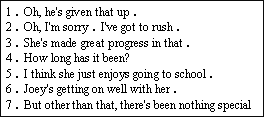
根据对话内容,从对话后的选项中选出能填入空白处的最佳选项,选项中有两项多余选项.
-Well, Bob, what a surprise! It's nice to see you again!
-Hello, Ann!________ 61 ________ Wasn't it a year ago, the last time we saw you?
-You know, I think you are right.How are your wife and the children?
-Oh, they're fine.Billy fell down and broke his leg a few months ago.________ 62 ________
-Wasn't Joey learning to play the violin? Seems to me I remember something about that.
-________ 63 ________ He's all excited about sports now.
①And your wife, what is she doing these days?
②She is going to a night school on Mondays and Thursdays.She's studying French now.But last year she studied typing and sewing.________ 64 ________ Next it'll probably be cooking.
③How nice for her!________ 65 ________ But say hello to Mrs James for me, will you?
④Sure I will, and remember me to your husband.Gookbye.
If you want to teach your children how to say sorry, you must be good at saying it yourself, especially to your own children. But how you say it can be quite tricky.
If you say to your children “I’m sorry I got angry with you, but …” what follows that “but” can render the apology ineffective: “I had a bad day” or “your noise was giving me a headache ” leaves the person who has been injured feeling that he should be apologizing for his bad behavior in expecting an apology.
Another method by which people appear to apologize without actually doing so is to say “I’m sorry you’re upset”; this suggests that you are somehow at fault for allowing yourself to get upset by what the other person has done.
Then there is the general, all covering apology, which avoids the necessity of identifying a specific act that was particularly hurtful or insulting, and which the person who is apologizing should promise never to do again. Saying “I’m useless as a parent” does not commit a person to any specific improvement.
These pseudo-apologies are used by people who believe saying sorry shows weakness. Parents who wish to teach their children to apologize should see it as a sign of strength, and therefore not resort to these pseudo-apologies.
But even when presented with examples of genuine contrition, children still need help to become aware of the complexities of saying sorry. A three-year-old might need help in understanding that other children feel pain just as he does, and that hitting a playmate over the head with a heavy toy requires an apology. A six-year-old might need reminding that spoiling other children’s expectations can require an apology. A 12-year-old might need to be shown that raiding the biscuit tin without asking permission is acceptable, but that borrowing a parent’s clothes without permission is not.
【小题1】According to the author, saying “I’m sorry you’re upset” most probably means “_______”.
| A.You have good reason to get upset |
| B.I’m aware you’re upset, but I’m not to blame |
| C.I apologize for hurting your feelings |
| D.I’m at fault for making you upset |
| A.the complexities involved should be ignored |
| B.their ages should be taken into account |
| C.parents need to set them a good example |
| D.parents should be patient and tolerant |
| A.a social issue calling for immediate attention |
| B.not necessary among family members |
| C.a sign of social progress |
| D.not as simple as it seems |
阅读理解
As I travel across China, I hope to learn as much as I can about the Chinese people, your history, and your dreams for the future and I hope to help the Chinese people understand more of America's history, the lessons the American people have drawn from it, and the dreams we hold for the 21st century.
I believe both Chinese and Americans aspire(立志,有愿望) to many of the same things--to provide for our families, to teach our children, to build our communities, to protect our earth, to shape our own futures, and pass brighter possibilities on to our children.
There may be those here and back in America who wonder whether closer ties and deeper friendship between America and China are good. Clearly, the answer is yes. We have a powerful ability to help each other grow. We can learn much from each other. And as two great nations, we have a special responsibility to the future of the world. The steps we take over the next week can lead to far greater strides for our people in the years ahead.
Here in this city of your magnificent history, we must always remember that we, too, are ancestors(祖先). Someday our children and their children will ask if we did all we could to build just societies and a more peaceful world. Let our monument be their judgment that we did that. Let our progress include all people, with all their differences, moving toward a common destiny.
Let us give new meaning to the words written in the ancient Book of Rites, what you call the Li Shi: When the great way is followed, all under heaven will be equal.
1.It becomes clear from the passage that _____.
[ ]
A.both China and America are the most powerful countries in the world
B.both China and America should do something for the future of the world
C.both China and America are great countries with a long history
D.both China and America can provide their children with good education
2.Which of the following statements is NOT mentioned in the passage?
[ ]
A.America will encourage their children to learn the Chinese history.
B.The speaker is in the city with the magnificent Chinese history.
C.Both Chinese and Americans share some desires and interests.
D.The speaker wants Chinese to understand more of American history.
3.The underlined word“here”used in Paragraph 3 refers to“_____”.
[ ]
A.in the city B.on the platform
C.at the ceremony(仪式) D.in China
4.It can be inferred that the person who made the speech is a _____.
[ ]
A.scientist B.statesman
C.businessman D.professor
查看习题详情和答案>>When I was 16 years old, I made my first visit to Disneyland in America. It wasn’t the first time I had been 36 . Like most English children I learned French 37 school and I had often been to France, so I 38 speaking a foreign language to people who didn’t understand 39 . But 40 I went to America, I was really looking forward to__41_ a nice easy holiday without any 42 problems.
__43__wrong I was! The misunderstanding began 44 the airport. I was looking for a 45__telephone to give my friend Danny a 46 and tell her I had arrived. A 47 old man saw me looking lost and asked 48 __ he could help me.
“Yes.” I said,“I was to give my friend a ring. ”“Well, that’s nice,” he said. “Are you getting 49 ? But aren’t you a bit young?”“ 50 is talking about marriage?” I replied. “I just want to give my friend a ring to tell her I’ve arrived. Can you tell me 51 there’s a phone box?”“Oh!” he said, “there’s phone downstairs.”
When at last we did meet up, Danny explained the misunderstanding to me. “Don’t worry,”she said to me, “I had so many 52 at first. There are lots of words which the Americans 53 differently in meaning from us British. You’ll soon get used to 54 funny things they say. Most of the 55 , British and American people understand each other!”
| 【小题1】 |
|
| 【小题2】 |
|
| 【小题3】 |
|
| 【小题4】 |
|
| 【小题5】 |
|
| 【小题6】 |
|
| 【小题7】 |
|
| 【小题8】 |
|
| 【小题9】 |
|
| 【小题10】 |
|
| 【小题11】 |
|
| 【小题12】 |
|
| 【小题13】 |
|
| 【小题14】 |
|
| 【小题15】 |
|
| 【小题16】 |
|
| 【小题17】 |
|
| 【小题18】 |
|
| 【小题19】 |
|
| 【小题20】 |
|