网址:http://m.1010jiajiao.com/timu3_id_3130957[举报]
Today our lives are changing faster than at any time in history. Here we report on three important changes that will have a big impact on our everyday lives in the future.
The cashless society
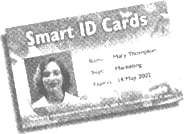
Cash and bank-notes will disappear almost completely. They will be replaced by smart cards, namely plastic cards: microchip(微芯片)processors(处理器)loaded with some money. When we pay for goods,the shop assistant will put our smart card into a payment terminal(终端)and money will come into his card from our card. When all the money is used up,we will be able to reloadit by putting it into a telephone,dialing our bank account and money will be put into the card from the account.
Interactive telephones
Talking computers will play an important part. They will recognize speech, ask us what information we need, look through a database,and put the information into speech.If we want to book a flight or pay a bill by phone, we will interact with a talking computer to do so. Human telephone operators will be used only for more complex operations such as dealing with complaints or solving special problems.
Traffic jams in cities will be reduced because drivers will use electronic route maps to find the quickest route to their destination. Electronic systems will start changing motorists for driving in cities.As soon as motorists have to pay to drive in cities, they will stop using their cars and use public transport instead. Speed control systems will be built into cars. These systems will automatically(自动地)regulate the speed of the car to take account of traffic and weather conditions and prevent accidents. It will be many years before these changes bring results but when they do,there will be a titanic improvement in road safety.
With the development of science and technology, more and more advanced things will be invented or created. Life in the future is undoubtedly different from that at the present.
【小题1】Cash and bank-note will disappear because .
| A.they will be out of use sooner or later |
| B.they will be replaced by plastic cards convenient to use |
| C.we can load money from the bank |
| D.they will be rejected by payment terminals |
| A.Go to the bank to deposit some money. |
| B.Put the card into a telephone and dial the bank account. |
| C.Buy a new card. |
| D.We don’t know. |
| A.Future cars | B.Speed control systems | C.Intelligent cars | D.Traffic jams |
| A.When we buy tickets for flying somewhere else, we can have a talk with the computer. |
| B.If you make a complaint, you can use human telephone operation. |
| C.Drivers will stop using their cars and use public transport in order to prevent accidents. |
| D.The help of electronic route maps will decrease traffic jams. |
| A.huge and great | B.the name of a ship | C.slight | D.increasing |
| |||||||||||||||||||||||||||||||||||||||||||||||||||||||||||
Cities alarmed by deaths and injuries of pedestrians are taking efforts to make crosswalks safer for people on foot, especially seniors and children who need more time to cross streets.
A pedestrian is killed in a traffic accident in the USA every 110 minutes; one is injured every nine minutes, according to official data. Crosswalks can be especially dangerous for the elderly. Among people 70 and older, 36% of pedestrian deaths in 2006 occurred in crosswalks, compared with 21% of those younger than 70, according to the Insurance Institute for Highway Safety.
The Federal Highway Administration (FHWA) advises that next year States increase by nearly 15% the amount of time traffic lights provide for pedestrians to cross the street after the flashing orange hand appears.
FHWA spokesman Doug Hecox says reasons for the change include an aging population that needs more time to cross, health conscious Americans walking more, children encouraged to walk to prevent getting overweight and high gas prices pushing people to walk instead of drive.
Pedestrian deaths went down by 12% from 5, 449 in 1996 to 4,784 in 2006,.But among those in 2006,471 were killed in crosswalks, down slightly from 488 ten years earlier, the National Highway Traffic Safety Administration (NHTSA) says.
Which of the following is true according to the text?
A. Among 100 pedestrian deaths there were 21 people younger than 70.
B. Old people are more likely to meet with accidents in crosswalks.
C. Traffic accidents killed more old people than young people.
D. About seven traffic accidents happened per hour.
What is FHWA’s suggestion to States?
A. Fixing more traffic lights.
B. Providing more crosswalks.
C. Giving pedestrians more time to cross streets.
D. Increasing the time before the orange lights appear.
What’s the cause of the crosswalk safety problem according to the text?
A. There’re many cars and buses on the road. B. Pedestrians are careless.
C. Crosswalks are more crowded than before. D. Drivers don’t give way.
The report from NHTSA suggests that .
A. fewer people were injured in crosswalks
B. crosswalk safety has greatly improved
C. much has been done to reduce traffic accidents
D. pedestrian deaths in crosswalks remain a serious problem
查看习题详情和答案>>Cities alarmed by deaths and injuries of pedestrians are taking efforts to make crosswalks safer for people on foot, especially seniors and children who need more time to cross streets.
A pedestrian is killed in a traffic accident in the USA every 110 minutes;one is injured every nine minutes, according to official date. Crosswalk can be especially dangerous for the elderly. Among people 70 and older, 36% of pedestrian deaths in 2006 occurred in crosswalks, compared with 21% of those younger than 70, according to the Insurance Institute for Highway Safety.
The Federal Highway Administration(FHWA)advises that next year states increase by nearly 15% the amount of time traffic lights provide for pedestrians to cross the street after the flashing orange hand appears .
FHWA spokesman Doug Hecox says reasons for the change include an aging population that needs more time to cross, health-conscious Americans walking more, children encouraged to walk to prevent getting overweight and high gas prices pushing people to walk instead of drive.
Pedestrian deaths went down by 12% from 5,449 in 1996 to 4,784 in 2006. But among those in 2006, 471 were killed in crosswalks, down slightly from 488 ten years earlier, the National Highway Traffic Safety Administration (NHTSA) says.
Which of the following is true according to the text?
A. Among 100 pedestrian deaths there were 21 people younger than 70.
B. Old people are more likely to meet with accidents in crosswalks.
C. Traffic accidents killed more old people than young people.
D. About seven traffic accidents happened per hour.
What is FHWA’s suggestion to states?
A. Fixing more traffic lights.
B. Providing more crosswalks.
C. Giving pedestrians more time to cross streets.
D. Increasing the time before the orange lights appear.
What’s the cause of the crosswalk safety problem according to the test?
A. There’re many cars and buses on the road.
B. Pedestrians are careless.
C. Crosswalks are crowded.
D. Drivers don’t give way.
The report from NHTSA suggests that
A. fewer people were injured in crosswalks
B. crosswalk safety has been greatly improved
C. much has been done to reduce traffic accidents
D. pedestrian deaths in crosswalk remain a serious problem
查看习题详情和答案>>Cities alarmed by deaths and injuries of pedestrians are taking efforts to make crosswalks safer for people on foot, especially seniors and children who need more time to cross streets.
A pedestrian is killed in a traffic accident in the USA every 110 minutes;one is injured every nine minutes, according to official date. Crosswalk can be especially dangerous for the elderly. Among people 70 and older, 36% of pedestrian deaths in 2006 occurred in crosswalks, compared with 21% of those younger than 70, according to the Insurance Institute for Highway Safety.
The Federal Highway Administration(FHWA)advises that next year states increase by nearly 15% the amount of time traffic lights provide for pedestrians to cross the street after the flashing orange hand appears .
FHWA spokesman Doug Hecox says reasons for the change include an aging population that needs more time to cross, health-conscious Americans walking more, children encouraged to walk to prevent getting overweight and high gas prices pushing people to walk instead of drive.
Pedestrian deaths went down by 12% from 5,449 in 1996 to 4,784 in 2006. But among those in 2006, 471 were killed in crosswalks, down slightly from 488 ten years earlier, the National Highway Traffic Safety Administration (NHTSA) says.
- 1.
Which of the following is true according to the text?
- A.Among 100 pedestrian deaths there were 21 people younger than 70.
- B.Old people are more likely to meet with accidents in crosswalks.
- C.Traffic accidents killed more old people than young people.
- D.About seven traffic accidents happened per hour.
- A.
- 2.
What is FHWA’s suggestion to states?
- A.Fixing more traffic lights.
- B.Providing more crosswalks.
- C.Giving pedestrians more time to cross streets.
- D.Increasing the time before the orange lights appear.
- A.
- 3.
What’s the cause of the crosswalk safety problem according to the test?
- A.There’re many cars and buses on the road.
- B.Pedestrians are careless.
- C.Crosswalks are crowded.
- D.Drivers don’t give way.
- A.
- 4.
The report from NHTSA suggests that
- A.fewer people were injured in crosswalks
- B.crosswalk safety has been greatly improved
- C.much has been done to reduce traffic accidents
- D.pedestrian deaths in crosswalk remain a serious problem
- A.