网址:http://m.1010jiajiao.com/timu3_id_3098091[举报]
Listening comprehension(30 marks)
Section A(22.5 marks)
Directions:In this section, you will hear six conversations between two speakers.For each conversation, there are several questions and each question is followed by three choices marked A, B, and C.Listen carefully and choose the best answer for each question.You will hear each conversation TWICE.
Example:
When will the magazine probably arrive?
A.Wednesday
B.Thursday
C.Friday
The answer is B.
Conversation 1
1.What is the woman going to do tomorrow?
A.To prepare for an interview
B.To attend an interview.
C.To give a lecture
2.How is the woman feeling now?
A.excited
B.worried
C.disappointed
Conversation 2
3.Why has the woman been exercising recently?
A.To keep fit.
B.To train for a race.
C.To lose weight.
4.How does the woman feel after running?
A.Tired.
B.Energetic.
C.Sick.
Conversation 3
5.Why can’t the woman eat the ice-cream?
A.Because she doesn’t like the kind.
B.Because she’s on a diet.
C.Because she’s eating something else.
6.Which of the following best describes Judy?
A.strong- willed
B.bad-tempered.
C.simple-minded.
Conversation 4
7.What will the speakers do next week?
A.Have a physics lesson.
B.Have a get-together.
C.Have an exam.
8.Why does Jennie call Martin?
A.To see if he’s fine.
B.To invite him to her house.
C.To borrow his physics book.
9.What does Martin advise Jennie to do?
A.To ask for help from Helen.
B.To prepare for the physics exam together.
C.To meet his brother.
Conversation 5
10.What does the man come for?
A.Joining a tour to Liverpool
B.Booking a ticket
C.Asking for information about the trains to Liverpool
11.Which train will the man take?
A.8:10
B.10:20
C.12:30
12.How much is the commission charge(委托手续费)?
A.2 pounds
B.10 pounds
C.20 pounds
Conversation 6
13.Where is Jack calling from?
A.The Grand Hotel.
B.The airport in Chicago.
C.The airport in Los Angeles.
14.Why doesn't Jack visit Dorothy at once?
A.Because he doesn't want to see Dorothy's parents.
B.Because he has to go to the representative's office this afternoon.
C.Because he prefers to stay at the airport now.
15.What will Jack do tonight?
A.Work in the hotel.
B.Visit some friends.
C.Have dinner with Dorothy's family.
Section B(7.5 marks)
Directions:In this section, you will hear a short passage.Listen carefully and then fill in the numbered blanks with the information you have heard.Fill in each blank with no more than three words.

Listening Comprehension
Section A(22.5 marks)
Directions:In this section you'll hear six conversations between two speakers.For each conversation, there are several questions and each question is followed by 3 choices marked A, B and C.Listen carefully and then choose the best answer for each question.
You will hear each conversation TWICE.
Example:
When will the magazine probably arrive?
A.Wednesday.
B.Thursday.
C.Friday.
The answer is B.
Conversation 1
1.What will the speakers have to do this evening?
A.Attend a party.
B.Watch TV.
C.Go to the cinema.
2.When does the man hope the movie starts?
A.At 5∶30.
B.At 7∶30
C.At 8∶00
Conversation 2
3.When did the man book a room last?
A.The week before last.
B.Last week.
C.This week.
4.Which floor will the man stay?
A.On the 7th floor.
B.On the 8th floor.
C.On the 87th floor.
Conversation 3
5.How long does the man want to work per week?
A.Only 10 hours.
B.10 to 20 hours.
C.Over 20 hours.
6.What can we learn about the man?
A.He wants a job to get some experience.
B.He is a student.
C.He doesn't want to work on weekends.
Conversation 4
7.Why does the man keep empty cans?
A.He wants to use them again.
B.His mother collects them as a hobby.
C.He wants to sell them to the dustman.
8.Where are the speakers?
A.In America.
B.In China.
C.In Britain.
9.Who is the woman?
A.The man's friend.
B.The man's mother.
C.The man's sister.
Conversation 5
10.Which of the following is true about the man?
A.He gets up early.
B.He has to go to work.
C.He usually goes shopping in the mornings.
11.How does the man go to the supermarket?
A.On foot.
B.By car.
C.By bus.
12.What will the man do in summer evenings if he has time?
A.Play sports.
B.Watch TV.
C.Join in cultural events.
Conversation 6
13.What is the relationship between the speakers?
A.Husband and wife.
B.New neighbors.
C.Old friends.
14.What can we learn from the conversation?
A.There are safety guards on duty 24 hours a day in the neighborhood.
B.There is no big supermarket near the neighborhood.
C.A house was broken into twice in the neighborhood.
15.What does the woman hope the man can do the day after tomorrow?
A.Give her a gift.
B.Go shopping with her.
C.Attend a party in the community.
Section B(7.5 marks)
Directions:In this section, you will hear a short passage.Listen carefully and then fill in the numbered blanks with the information you've heard.Fill in each blank with NO MORE THAN THREE WORDS.
You will hear the short passage TWICE.

PART FOUR WRITING SECTION A
Directions: Read the following passage. Fill in the numbered blanks by using the information from the passage. Write NO MORE THAN 3 WORDS for each blank.
The Chilean earthquake, measuring 8.8 – magnitude, which struck early Saturday morning, released 500 times the energy of the 7.0 – magnitude quake that hit Haiti last month, a geophysicist told CBS’ “The Early Show. ” Tsunami warnings were issued for much of the Pacific, including Hawaii, following the quake that struck near the Chilean coast.
“When the earthquake occurred, it moved the land and then it moved the water causing the tsunami,” said U.S. Geological Survey geophysicist Jessica Sigala. “And the coastal areas of Chile have already noticed the wave heights up to about 7 feet.”
Sigala said Hawaiians can expect to see the waves from this tsunami around 11:20 a.m. local time (about 4:20 p.m. ET). “So we have to wait and see how big the waves will be.”
“It's not so much the height [of the wave] but it's the width, it's how long the duration, and then it's also the speed at which it's traveling,” said co-anchor Kelly Cobiella “Correct me if I'm wrong, but these waves are traveling at the speed of a jetliner, about 500 miles per hour?”
“That's correct. It's a big block of water coming onto the land,” Sigala said.
Chile has already experienced several aftershocks following the quake.
“Aftershocks are definitely a concern,” said Sigala. "We always see aftershocks with a large quake and a shallow quake, which this one was. And as of right now, we've located about maybe 15 aftershocks and those are of the larger kind. I'm sure they felt much more than that.”
“A shallow earthquake just means that it happened pretty close to the surface,” said Sigala. “And because of that the energy is really close to the surface, where all the buildings and people are.”
50 deaths caused by aftershocks have been reported, according to the national emergency agency, adding the estimate casualties to 960.
Title: Concerns after 1.
I. Tsunami:
● 2.: much of the Pacific, including Hawaii
●Cause: the earthquake moved 3.
●Wave Heights: about 4.
● 5.___ : about 500 mph
II. 6.:
●Reason: the Chilean Earthquake was a 7.__ and a 8.earthquake, which always have them after the major one
●Number: at least 9.
●Loss: 10.
SECTION B
Directions: Read the following passage. Answer the questions according to the information given in the passage and required words limit. Write your answers on your answer sheet
From bankers to factory staff, employees in the west face the bleak prospect of losing their jobs as a global recession starts to bite. For colleagues in the East the pain is more likely to come through a pay cut.
Human resource experts say cultural differences explain why Asian firms try harder to keep jobs in difficult times, which will stop unemployment and may help keep Asian economies afloat at a time of slowing exports.
The East Asian attitude may also make it easier for firms to recover quickly from the economic downturn since they will not need to rehire or train new staff, leaving some experts predicting Western shift to Eastern flexibility.
“In the Confucian attitude, the right thing to do is to share the burden. There is the sense of collective responsibility whereas in the west, it’s more about the individual survival,” said Michael Benotlel, associate professor of organizational behavior at Singapore Management University.
Steven Pang, Asian Regional director for Aquent, a headhunting firm, said in many East Asian companies there was an responsibility “ to take care of the members of the family and go through the pain together” even if that meant causing losses.
Us firms from General Motors to Goldman Sachs plan to lay off workers by the thousands. But at the Asian units of Western multinationals, jobs cuts will probably less severe.
Japan’s jobless rate was 4 percent in September, up from 3.8 percent in January, while Hong Kong’s was flat at 3.4 percent. But US unemployment is expected to have jumped to 6.3 percent last month from below 5 percent in January.
Experts say that while there are noticeable differences in labor practices in East and West, the gap will narrow as more firms become more multinational and competition forces firms to adopt the best practices of rivals from abroad.
11.According to the passage, what does “to share the burden” mean?
(no more than 6 words)
____________________________________________________________________
12.Why would firms in the west lay off workers when facing a bleak prospect?
( no more than 5 words)
____________________________________________________________________
13.Why is it easier for the East Asian firms to recover quickly from the economic downturn? (no more than 12 words)
____________________________________________________________________
14.What’s the passage talking about? (no more than 15 words)
____________________________________________________________________
查看习题详情和答案>>
Listening Comprehension
Section A Short conversations
Directions:In section A, you will hear ten short conversations between speakers.At the end of each conversation, a question will be asked about what was said.The conversations and the questions will be spoken only once.After you hear a conversation and the question about it, read the four possible answers on your paper, and decide which one is the best answer to the question you have heard.
1.A.10∶00
B.10∶10
C.10∶20
D.10∶30
2.A.A cook.
B.A waitress.
C.An airhostess.
D.A customer.
3.A.On the bus.
B.In the theatre.
C.In the classroom.
D.In a cafeteria.
4.A.It will probably rain this afternoon.
B.She likes to watch the rain come down
C.She will play even if it rains.
D.It has rained a lot lately.
5.A.Stop worrying.
B.Go out more.
C.Talk to a friend.
D.Get counseling.
6.A.She thought it was extremely difficult.
B.She thought it was okay even though she usually dislikes essay exams.
C.She thinks essay exams are boring and especially this one.
D.She thinks she will fail this test.
7.A.She wasn’t able to attend the reception.
B.She is an honor student.
C.She likes flowers very much.
D.She is a teacher.
8.A.Because she has walked a long distance.
B.Because she is tired out.
C.Because she is all wet.
D.Because she is careless.
9.A.Bob has been married for a long time.
B.He plans to go to the wedding.
C.He hasn’t been to California for a long time.
D.The woman should go to California.
10.A.Make the woman another lunch.
B.Get the woman a coffee.
C.Buy the woman a lunch.
D.Help look for the woman’s lunch box.
Section B passages,
Directions:In part B, you will hear two short passages, and you will be asked three questions on each of the passages.The passages will be read twice, but the questions will be spoken only once.When you hear a question, read the four possible answers on your paper and decide which one would be the best answer to the question you have heard.
Questions 11 through 13 are based on the following passage.
11.A.Basic health.
B.Special training.
C.Nothing.
D.Special skill.
12.A.Steadily
B.Gently.
C.As long as possible
D.Fast
13.A.When you have any health worries.
B.When you decide to jog.
C.When you require more information.
D.When you decide to jog alone.
Questions 14 through 16 are based on the following news.
14.A.Her mother doesn’t love her as much as her grandfather did.
B.Her mother was the subject of talks with her grandfather.
C.Her mother will misunderstand her problems.
D.She missed her grandfather.
15.A.Co-workers cannot be your close friends.
B.People will be pleased if you call them at 2∶00 a. m..
C.You can’t discuss your problems with a distant family member.
D.The one you can call at 2∶00 a. m. is someone close to you in spirit.
16.A.Parents should understand their kids.
B.The earth is an inhabited garden if you have close friends.
C.There are many ways to make friends.
D.There is a difference between a lonely desert and an inhabited garden.
Section C longer conversations.
Directions:In part C, you will hear two longer conversations.The conversations will be read twice.After you hear each conversation, you are required to fill in the numbered blanks with the information you have heard.Write your answers on your answer sheet.
Blanks 17 through 20 are based on the following conversation:

Complete the form.Write ONE WORD for each answer.
Blanks 21 through 24 are based on the following conversation:

Complete the form.Write NO MORE THAN THREE WORDS for each blank.
Listening Comprehension
Section A Short conversations
Directions:In section A, you will hear ten short conversations between speakers.At the end of each conversation, a question will be asked about what was said.The conversations and the questions will be spoken only once.After you hear a conversation and the question about it, read the four possible answers on your paper, and decide which one is the best answer to the question you have heard.
1.A.3∶40
B.4∶00
C.4∶20
D.3∶20
2.A.He wants to get a new position.
B.He is asking the woman for help.
C.He has left the woman a good impression.
D.He enjoys letter writing.
3.A.At a newsstand.
B.At a car dealer’s.
C.At a newspaper office.
D.At a publishing house.
4.A.The weather forecast says it will be fine.
B.The weather doesn’t count in their plan
C.They will not do as planned in case of rain.
D.They will postphone their programme if it rains.
5.A.He’s not used to city life.
B.He is very tall and thin.
C.It's hard to find him there.
D.He’s always holding a needle.
6.A.His computer doesn’t work well.
B.He isn’t getting along with his stuff.
C.He didn’t register for a proper course.
D.He can’t apply the theory to his program.
7.A.He lent her his extra pen.
B.He was afraid of losing his pen.
C.He offered her a pencil.
D.He said he didn’t have any extra ink.
8.A.Neither of the watches keeps good time.
B.The woman’s watch stopped three hours ago.
C.The man’s watch goes too fast.
D.It’s too dark for the woman to read her watch.
9.A.By going on a diet.
B.By having fewer meals.
C.By doing physical exercise.
D.By eating fruits and vegetables.
10.A.The plane’s departure time remains unknown.
B.The man went to a wrong check-in counter.
C.The man has just missed the flight.
D.The plane will leave at 9∶14.
Section B passages,
Directions:In part B, you will hear two short passages, and you will be asked three questions on each of the passages.The passages will be read twice, but the questions will be spoken only once.When you hear a question, read the four possible answers on your paper and decide which one would be the best answer to the question you have heard.
Questions 11 through 13 are based on the following passage.
11.A.100million.
B.50 to 100 million.
C.15 million.
D.500 million.
12.A.Aristotle
B.A Russian.
C.Nobel
D.Dolly
13.A.Animal testing is unnecessary and a poor scientific practice.
B.Animals have played an important part in many scientific researches.
C.Many Nobel Prize winners are interested in animal testing.
D.Animal research was carried out in every medical advance of the last century.
Questions 14 through 16 are based on the following news.
14.A.Product name.
B.Features.
C.Target customer.
D.Price.
15.A.Affordable; latest.
B.incredible; fastest; smallest.
C.Best deal; best choice.
D.Perfect; right choice.
16.A.The advertisement for Star 5000 emphasizes its users and the status it brings
B.The Brand E-Brain from Diamond Computer offers you the perfect tool.
C.The advertisement for FX435 focuses on computing power.
D.The three brands are among the best sellers on the market.
Section C longer conversations.
Directions:In part C, you will hear two longer conversations.The conversations will be read twice.After you hear each conversation, you are required to fill in the numbered blanks with the information you have heard.Write your answers on your answer sheet.
Blanks 17 through 20 are based on the following conversation:
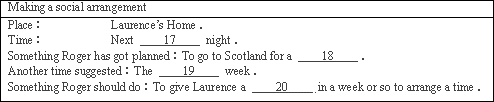
Complete the form.Write ONE WORD for each answer.
Blanks 21 through 24 are based on the following conversation:
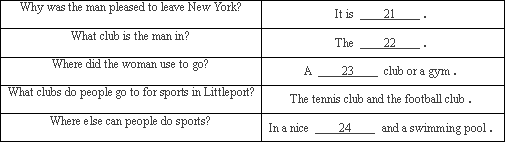
Complete the form.Write NO MORE THAN THREE WORDS for each blank.