摘要:附加题:完形 改错

网址:http://m.1010jiajiao.com/timu3_id_3097624[举报]

完形填空(Cloze Test)


阅读下面短文,掌握其大意,然后从各题所给的四个选项(A、B、C和D)中,选出最佳选项。
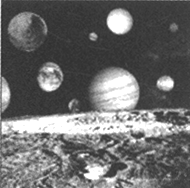
  Since mankind ___1___, people have looked to the stars, ___2___ them to be Gods. Some called them the“Wanderers”, and invested a complex mythology(神话)in them. Many ___3___ worshipped(敬神)them through song, praise, prayer(祈祷). For thousands of years people thought the planets, moons and Sun ___4___ the Earth, and that the Earth was the ___5___ of the universe. When telescopes were ___6___ in the seventeenth century, people began to think that the Earth wasn't the center of the universe, and that the planets did not revolve around the Earth, but ___7___ the Sun. This concept was called heliocentrism. People started ___8___ of the planets as worlds very much like our own, and not the mythological Gods people thought they were. People started to think that other civilizations(文明)___9___ on other planets which were too far to see. As ___10___ were improved, more planets were found. Uranus, Neptune and Pluto. There may even be other planets ___11___ Pluto, but only time will ___12___ the answer to that question.

  Our solar system has 9 planets that orbit a big star called the Sun. (An orbit is the path that a planet moves through. )All the planets orbit the Sun in elliptical (椭圆的)paths.

  All the planets ___13___ different amounts of time to get all the way round the Sun. ___14___ takes a year to make one complete orbit. In fact, that's how we decided ___15___ a year should be--it's the length of time it takes us to get all the way around the Sun!

(1) A.rose
B.arose
C.began
D.raised
(2) A.believed
B.to believe
C.believing
D.had believed
(3) A.cultures
B.groups
C.citizens
D.mankind
(4) A.traveled
B.went
C.circled
D.moved
(5) A.planet
B.system
C.satellite
D.centre
(6) A.invented
B.found
C.discovered
D.produced
(7) A.instead
B.in place of
C.rather than
D.rather
(8) A.considereding
B.regarding
C.thinking
D.taking
(9) A.existed
B.survived
C.appeared
D.happened
(10)A.telephones
B.televisions
   C.cameras
D.telescopes
(11)A.through
B.across
   C.beyond(越过)
D.outside
(12)A.have
B.solve
C.supply
D.enable
(13)A.spend
B.take
C.waste
D.cost
(14)A.Uranus
B.Neptune
C.Pluto
D.the earth
(15)A.how long
B.how far
   C.how soon
D.how often
查看习题详情和答案>>

完形填空(Cloze Test)


阅读下面短文,掌握其大意,然后从各题所给的四个选项(A、B、C和D)中,选出最佳选项。
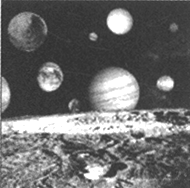
  Since mankind ___1___, people have looked to the stars, ___2___ them to be Gods. Some called them the“Wanderers”, and invested a complex mythology(神话)in them. Many ___3___ worshipped(敬神)them through song, praise, prayer(祈祷). For thousands of years people thought the planets, moons and Sun ___4___ the Earth, and that the Earth was the ___5___ of the universe. When telescopes were ___6___ in the seventeenth century, people began to think that the Earth wasn't the center of the universe, and that the planets did not revolve around the Earth, but ___7___ the Sun. This concept was called heliocentrism. People started ___8___ of the planets as worlds very much like our own, and not the mythological Gods people thought they were. People started to think that other civilizations(文明)___9___ on other planets which were too far to see. As ___10___ were improved, more planets were found. Uranus, Neptune and Pluto. There may even be other planets ___11___ Pluto, but only time will ___12___ the answer to that question.

  Our solar system has 9 planets that orbit a big star called the Sun. (An orbit is the path that a planet moves through. )All the planets orbit the Sun in elliptical (椭圆的)paths.

  All the planets ___13___ different amounts of time to get all the way round the Sun. ___14___ takes a year to make one complete orbit. In fact, that's how we decided ___15___ a year should be--it's the length of time it takes us to get all the way around the Sun!

(1) A.rose
B.arose
C.began
D.raised
(2) A.believed
B.to believe
C.believing
D.had believed
(3) A.cultures
B.groups
C.citizens
D.mankind
(4) A.traveled
B.went
C.circled
D.moved
(5) A.planet
B.system
C.satellite
D.centre
(6) A.invented
B.found
C.discovered
D.produced
(7) A.instead
B.in place of
C.rather than
D.rather
(8) A.considereding
B.regarding
C.thinking
D.taking
(9) A.existed
B.survived
C.appeared
D.happened
(10)A.telephones
B.televisions
   C.cameras
D.telescopes
(11)A.through
B.across
   C.beyond(越过)
D.outside
(12)A.have
B.solve
C.supply
D.enable
(13)A.spend
B.take
C.waste
D.cost
(14)A.Uranus
B.Neptune
C.Pluto
D.the earth
(15)A.how long
B.how far
   C.how soon
D.how often
查看习题详情和答案>>

完形填空

The Brick


  About ten years ago, a young and very successful manager named Josh was travelling down a Chicago neighborhood street. He was going a bit fast in his 1 car.

  He was watching for kids rushing out from between parked cars. 2 his car passed, no child rushed out, but a brick did and WHUMP! It 3 his shiny black side door! Josh 4 out of his car, grabbed the kid and pushed him up 5 a parked car. He shouted at the kid,“ 6 was that all about and who are you? Just what are you doing?”He went on with 7 “That's my new Jaguar, that brick you threw is going to cost you a lot of money. Why did you throw it?”

  “Please, mister, please…I'm 8 ! I didn't know what else to do!” 9 the youngster.“I threw the brick 10 no one else would stop!”Tears were dripping down the boy's chin as he 11 around the parked car.“It's my brother, mister,”he said.“He rolled 12 the sidewalk and fell out of his wheelchair and I can't 13 him up.”Sobbing, the boy asked the manager,“Would you please help me get him 14 into his wheelchair? He's hurt and he's too heavy for me.”

15   beyond words, he lifted the young man back into the wheelchair and took out his handkerchief 16 wiped the cuts, checking to see that everything was going to be OK. He then 17 the younger brother push him down the sidewalk toward their home.


  It was a long and slow walk back to his expensive car. Josh 18 did fix the side door of his Jaguar. He kept the damage to 19 him not to go through life so fast that someone has to throw a brick at him to get his attention. Pay 20 to the bricks of life coming at to you.


(1) Aold


Bexpensive


Csecondhand


Dslow


(2) ASince


BAfter


CAs


DSo  long as


(3) Astruck


Bdestroyed


Cwiped


Dharmed


(4) Aclimbed


Bstepped


Cgot


Djumped


(5) Aagainst


Bon


Cwith


Dtoward


(6) AHow


BWhy

  
CWhen   

DWhat


(7) Aeagerness


Banger

  
Cpunishment  

Ddispleasure


(8) Adiscouraged


Bdisappointed

  
Csorry  

Dhopeless


(9) AExplained


BCried

  
CShouted  

DAdded


(10) Auntil


Bif


Cbefore


Dbecause


(11) Ahid


Bpointed


Cran


Dsearched


(12) Afar


Baway


Coff


Donto


(13) Alift


Braise


Chold


Dpick


(14) Aover


Bup


Cdown


Dback


(15AEncouraged


BMoved

  
CExcited  

DFrightened


(16) Aso


Bbut


Cand


Dor


(17) Awatched


Bnoticed


Csaw


Dobserved


(18) Aever


Bseldom


Chardly


Dnever


(19) Arequire


Bremind


Cwarn


Dkeep


(20) Alove


Bturn


Cattention


Drespect


查看习题详情和答案>>

完形填空(Cloze Test)

  News analysts(分析家),reporters, and correspondents(通讯记者)play a   1   role in our society.They gather information, prepare stories, and make broadcasts that inform us about local, state, national, and international   2   ; present points of view on current issues; and report on the actions of public officials.

  Journalists spend much of their time out and about   3   information, interviewing people and attending events and press conferences.They make notes or   4   interviews on tape.Then, back in the office, they   5   the“copy”on a word processor.Journalists also do a lot of work on the phone,   6   and checking out facts.Large newspapers and radio and television   7   assign reporters to gather news about specific   8   such as crime or education.Some reporters specialize in fields such as health, politics, foreign affairs, sports, theater, consumer affairs, social events, science, business, or religion.Reporters on small publications   9   all aspects of the news.They take   10   , write headlines, lay out pages, edit wire service stories, and write editorials.It can get pretty frantic(狂乱的)as   11   draw near, so you need to be able to work   12   and under pressure.

  Journalists must be able to write clearly and concisely(简明的).They need to   13 a story interesting-and getting it the right   14   is quite a skill!You need to be   15 in people and have a(an)“   16   ”for a good story.

  This is certainly not a nine to five   17  .After all, newsworthy events happen 24 hours a day, seven days a week.  18   can be long, especially when there are deadlines to   19  .On the other hand, you get to talk to lots of interesting people, see all kinds of places and   20   the excitement of being right where it's all happening.

(1)

[  ]

A.

lead

B.

supportive

C.

important

D.

key

(2)

[  ]

A.

events

B.

incidents

C.

accidents

D.

news

(3)

[  ]

A.

to gather

B.

gathering

C.

reporting

D.

to report

(4)

[  ]

A.

record

B.

make

C.

have

D.

give

(5)

[  ]

A.

print

B.

approve

C.

write up

D.

read

(6)

[  ]

A.

talking

B.

interviewing

C.

polishing

D.

proving

(7)

[  ]

A.

stations

B.

organizations

C.

institutes

D.

companies

(8)

[  ]

A.

titles

B.

topics

C.

headlines

D.

ideas

(9)

[  ]

A.

concltude

B.

include

C.

broadcast

D.

cover

(10)

[  ]

A.

actions

B.

photographs

C.

materials

D.

interviews

(11)

[  ]

A.

deadlines

B.

publishings

C.

days

D.

nights

(12)

[  ]

A.

carefully

B.

clearly

C.

quickly

D.

happily

(13)

[  ]

A.

make

B.

make up

C.

write

D.

tell

(14)

[  ]

A.

words

B.

way

C.

size

D.

length

(15)

[  ]

A.

worried

B.

curious

C.

interested

D.

concerned

(16)

[  ]

A.

nose

B.

mind

C.

head

D.

eye

(17)

[  ]

A.

thing

B.

work

C.

job

D.

timetable

(18)

[  ]

A.

Days

B.

Hours

C.

Weeks

D.

Years

(19)

[  ]

A.

arrive

B.

draw

C.

hurry

D.

meet

(20)

[  ]

A.

experience

B.

feel

C.

face

D.

get

查看习题详情和答案>>

完形填空(Cloze Test)

  Many of our traditional medicines come from plants that grow wild throughout the world.Folk medicine keeps the health of the body by using medicines taken from surrounding plants since   1   for making medicine can be   2   everywhere, one can   3   folk medicine in any place of the world.They provide the basic ingredients(成分)that were used in the preparation of medicines and remedies(治疗方法).

  The practice of folk medicine   4   all the way back to the time of early man when both man and animal used plants in order to   5   healthy.It is not   6  , for example, to see an animal suck the sap of some plant after being   7   by a poisonous snake.  8   animals seem to have their   9   gift for knowing which plant will   10   what illness, man probably learned how to   11   for himself by animal watching.

  Man   12   learned other things from animals.He observed that wild animals when sick remained quiet and rest, depending upon nature's remedies(治疗方法)for   13   well-the medicine in plants and pure air.He saw that an animal with a   14   could often be   15   resting in a cool place, eating nothing and often drinking a lot until the fever was gone.

(1)

[  ]

A.

material

B.

liquids

C.

chemistry

D.

vapour

(2)

[  ]

A.

uncovered

B.

made

C.

found

D.

produced

(3)

[  ]

A.

do

B.

get

C.

complete

D.

practice

(4)

[  ]

A.

comes

B.

goes

C.

reaches

D.

keeps

(5)

[  ]

A.

have

B.

remain

C.

keep up

D.

continue with

(6)

[  ]

A.

usual

B.

uncommon

C.

comfortable

D.

easy

(7)

[  ]

A.

hurt

B.

wounded

C.

eaten

D.

damaged

(8)

[  ]

A.

Unless

B.

However

C.

Even though

D.

Because

(9)

[  ]

A.

native

B.

national

C.

natural

D.

nation

(10)

[  ]

A.

cure

B.

develop

C.

raise

D.

cause

(11)

[  ]

A.

wait

B.

think

C.

long

D.

care

(12)

[  ]

A.

almost

B.

mainly

C.

also

D.

hardly

(13)

[  ]

A.

growing

B.

getting

C.

turning

D.

becoming

(14)

[  ]

A.

disease

B.

wound

C.

fever

D.

cold

(15)

[  ]

A.

watched

B.

found

C.

stared

D.

uncovered

查看习题详情和答案>>

违法和不良信息举报电话:027-86699610 举报邮箱:58377363@163.com

精英家教网