网址:http://m.1010jiajiao.com/timu3_id_3092978[举报]
Nothing is more refreshing on a warm summer day than watching someone else work.
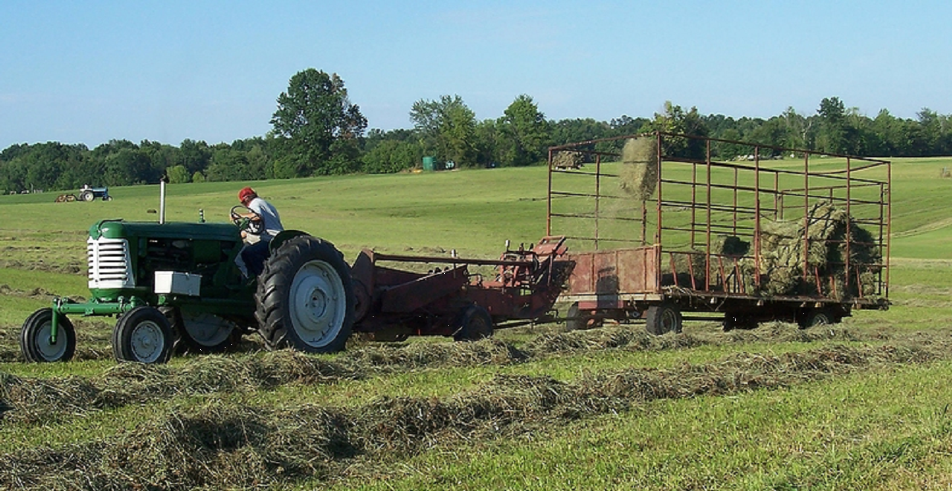
Right now, I’m sitting on my porch and watching young Beth baling(打捆)the big field on top of the hill. She’s been haying that field for over ten years. I know: I put her on the tractor when she was just twelve years old.
She picked a great day for baling. It’s not too hot, and there’s a nice breeze. On Monday, when she cut the field, it was so hot I thought the corn would start popping in the field. Didn’t stop her, though. She just stuck that big hat on her head, wrapped a wet handkerchief around her neck, and set to work. I remember when I would have done the same thing.
While I’m here sucking a lemonade, Beth is driving the “hay(干草) train,” a tractor pulling a baler and an old wagon. You’d think someone her size would never be able to see over the tractor. But somehow she manages. When she’s finished, her tracks are very straight.
The whole time she’s haying, that dog of hers is working just as hard, running along beside her like he’s afraid she’ll drive away without him. Beth sure knew what she was doing when she trained him.
The way the machine works is pure poetry. Each row is pushed into shape. When just enough hay is in a bale, it is wrapped up and fastened together. A second or so later, the bale comes flying out and into the old wagon. The person who invented that machine sure was some kind of genius.
That’s not to say it works perfectly. Every once in a while a bale misses the mark, especially when you are turning the machine at the end of a row. That means, of course, that you have to go back and pick up those bales and throw them into the wagon.
I can remember when Beth’s mother was her age. She looked an awful lot like Beth does now. Makes a man proud to see his daughter and granddaughter taking such good care of themselves.
Well, I suppose I should get up and fill this glass again. Not much fun sitting here with an empty glass.
63. We can learn from the passage that at some time in the past the author ______.
A. bought the tractor for Beth B. forced Beth to work at an early age
C. worked in the field like Beth D. trained the dog to help Beth work
64. In the eyes of the author, the sight of Beth baling hay is _______.
A. uncommon B. beautiful C. unforgettable D. changeable
65 Before thrown into the wagon, the hay must be _______.
A. tied up B. dried up C. cut up D. lined up
66. Who do you think is telling this story?
A. Beth’s mother. B. Beth’s father.
C. Beth’s grandmother. D.Beth’s grandfather.
查看习题详情和答案>>
How do you feel about watching other people work?
 Nothing is more refreshing on a warm summer day than watching someone else work.
Right now, I’m sitting on my porch and watching young Beth baling(打捆)the big field on top of the hill. She’s been haying that field for over ten years. I know: I put her on the tractor when she was just twelve years old.
She picked a great day for baling. It’s not too hot, and there’s a nice breeze. On Monday, when she cut the field, it was so hot I thought the corn would start popping in the field. Didn’t stop her, though. She just stuck that big hat on her head, wrapped a wet handkerchief around her neck, and set to work. I remember when I would have done the same thing.
While I’m here sucking a lemonade, Beth is driving the “hay(干草) train,” a tractor pulling a baler and an old wagon. You’d think someone her size would never be able to see over the tractor. But somehow she manages. When she’s finished, her tracks are very straight.
The whole time she’s haying, that dog of hers is working just as hard, running along beside her like he’s afraid she’ll drive away without him. Beth sure knew what she was doing when she trained him.
The way the machine works is pure poetry. Each row is pushed into shape. When just enough hay is in a bale, it is wrapped up and fastened together. A second or so later, the bale comes flying out and into the old wagon. The person who invented that machine sure was some kind of genius.
That’s not to say it works perfectly. Every once in a while a bale misses the mark, especially when you are turning the machine at the end of a row. That means, of course, that you have to go back and pick up those bales and throw them into the wagon.
I can remember when Beth’s mother was her age. She looked an awful lot like Beth does now. Makes a man proud to see his daughter and granddaughter taking such good care of themselves.
Well, I suppose I should get up and fill this glass again. Not much fun sitting here with an empty glass.
56. We can learn from the passage that at some time in the past the author ______.
A. bought the tractor for Beth B. forced Beth to work at an early age
C. worked in the field like Beth D. trained the dog to help Beth work
57. In the eyes of the author, the sight of Beth baling hay is _______.
A. uncommon B. beautiful C. unforgettable D. changeable
58. Before thrown into the wagon, the hay must be _______.
A. tied up B. dried up C. cut up D. lined up
59. Who do you think is telling this story?
A. Beth’s mother. B. Beth’s father. C. Beth’s grandmother. D. Beth’s grandfather.
查看习题详情和答案>>
How do you feel about watching other people work?
Nothing is more refreshing on a warm summer day than watching someone else work.
Right now, I'm sitting on my porch and watching young Beth baling (打捆) the big field on top of the hill.
She's been haying that field for over ten years. I know: I put her on the tractor when she was just twelve
years old.
She picked a great day for baling. It's not too hot, and there's a nice breeze. On Monday, when she
cut the field, it was so hot I thought the corn would start popping in the field. Didn't stop her, though. She
just stuck that big hat on her head, wrapped a wet handkerchief around her neck, and set to work. I
remember when I would have done the same thing.
While I'm here sucking a lemonade, Beth is driving the "hay (干草) train," a tractor pulling a baler and
an old wagon. You'd think someone her size would never be able to see over the tractor. But somehow
she manages. When she's finished, her tracks are very straight.
The whole time she's haying, that dog of hers is working just as hard, running along beside her like
he's afraid she'll drive away without him. Beth sure knew what she was doing when she trained him.
The way the machine works is pure poetry. Each row is pushed into shape. When just enough hay is
in a bale, it is wrapped up and fastened together. A second or so later, the bale comes flying out and into
the old wagon. The person who invented that machine sure was some kind of genius.
That's not to say it works perfectly. Every once in a while a bale misses the mark, especially when you are turning the machine at the end of a row. That means, of course, that you have to go back and pick up
those bales and throw them into the wagon.
I can remember when Beth's mother was her age. She looked an awful lot like Beth does now.
Makes a man proud to see his daughter and granddaughter taking such good care of themselves.
Well, I suppose I should get up and fill this glass again. Not much fun sitting here with an empty glass.
B. forced Beth to work at an early age
C. worked in the field like Beth
D. trained the dog to help Beth work
B. beautiful
C. unforgettable
D. changeable
B. dried up
C. cut up
D. lined up
B. Beth's father.
C. Beth's grandmother.
D. Beth's grandfather.
My mother is a geneticist, and from her I learned that despite our differences in size, shape and color, we humans are 99.9 percent the same. It is in our 36 to see differences: skin, hair and eye color, height, language. But also in our nature, way down in the DNA that 37 us human, we are almost the 38 .
I believe there is more that unites us than 39 us.
My mother came to the US from India. She is 40 enough that she got her service 41 in a diner in 1960s Dallas. My father is a white boy from Indiana whose 42 came from Germany in the mid-1800s.
It seems 43 to admit now, but I never 44 that my parents were different colors. One day, I watched my parents walk 45 the street of our church together. They were 46 in the service that day, and as they walked, I saw their hands 47 together in unison(一致地). I noticed for the first time how dark my mother was, and how white my father was. I knew them as my parents 48 I realized their skin color. I'm sorry to say that now when I see a mixed-race 49 walking down the street, I see the "mixed race" first and the "couple" second.
When my parents married in 1966, there were 50 places in this country that had laws 51 mixed marriage. 52 , my white grandfather, 53 father had been a typical racist, was not against their marriage.
Some of us are men, some are women. Some are young, some old. Some of us are short and others 54 . Some right-handed, some left-handed. We have lots of differences; we are all 55 . But deep down inside us, down in our DNA, we are 99.9 percent the same. And I believe we need to remember that.
| 【小题1】 |
|
| 【小题2】 |
|
| 【小题3】 |
|
| 【小题4】 |
|
| 【小题5】 |
|
| 【小题6】 |
|
| 【小题7】 |
|
| 【小题8】 |
|
| 【小题9】 |
|
| 【小题10】 |
|
| 【小题11】 |
|
| 【小题12】 |
|
| 【小题13】 |
|
| 【小题14】 |
|
| 【小题15】 |
|
| 【小题16】 |
|
| 【小题17】 |
|
| 【小题18】 |
|
| 【小题19】 |
|
| 【小题20】 |
|
My mother is a geneticist, and from her I learned that despite our differences in size, shape and color, we humans are 99.9 percent the same. It is in our 1 to see differences: skin, hair and eye color, height, language. But also in our nature, way down in the DNA that 2 us human, we are almost the 3.
I believe there is more that unites us than 4 us.
My mother came to the US from India. She is 5 enough that she got her service 6 in a diner in 1960s Dallas. My father is a white boy from Indiana whose 7 came from Germany in the mid-1800s.
It seems 8 to admit now, but I never 9 that my parents were different colors. One day, I watched my parents walk 10 the street of our church together. They were 11 in the service that day, and as they walked, I saw their hands 12 together in unison(一致地). I noticed for the first time how dark my mother was, and how white my father was. I knew them as my parents 13 I realized their skin color. I'm sorry to say that now when I see a mixed-race 14 walking down the street, I see the "mixed race" first and the "couple" second.
When my parents married in 1966, there were 15 places in this country that had laws 16 mixed marriage. 17, my white grandfather, 18 father had been a typical racist, was not against their marriage.
Some of us are men, some are women. Some are young, some old. Some of us are short and others 19. Some right-handed, some left-handed. We have lots of differences; we are all 20. But deep down inside us, down in our DNA, we are 99.9 percent the same. And I believe we need to remember that.
- 1.
- A.feature
- B.character
- C.nature
- D.quality
- A.
- 2.
- A.gets
- B.lets
- C.has
- D.makes
- A.
- 3.
- A.same
- B.different
- C.familiar
- D.similar
- A.
- 4.
- A.differs
- B.divides
- C.departs
- D.splits
- A.
- 5.
- A.yellow
- B.white
- C.dark
- D.brown
- A.
- 6.
- A.turned out
- B.turned down
- C.turned over
- D.turned back
- A.
- 7.
- A.ancestors
- B.parents
- C.family
- D.origin
- A.
- 8.
- A.silly
- B.wise
- C.stupid
- D.foolish
- A.
- 9.
- A.noticed
- B.looked
- C.watched
- D.observed
- A.
- 10.
- A.in
- B.up
- C.out
- D.down
- A.
- 11.
- A.entering
- B.running
- C.attending
- D.participating
- A.
- 12.
- A.rocking
- B.shaking
- C.swinging
- D.waving
- A.
- 13.
- A.unless
- B.after
- C.before
- D.until
- A.
- 14.
- A.marriage
- B.couple
- C.double
- D.twins
- A.
- 15.
- A.always
- B.also
- C.almost
- D.still
- A.
- 16.
- A.allowing
- B.preventing
- C.encouraging
- D.banning
- A.
- 17.
- A.Therefore
- B.However
- C.But
- D.Otherwise
- A.
- 18.
- A.which
- B.whose
- C.that
- D.what
- A.
- 19.
- A.long
- B.high
- C.tall
- D.kind
- A.
- 20.
- A.similar
- B.familiar
- C.unique
- D.same
- A.