网址:http://m.1010jiajiao.com/timu3_id_3082365[举报]
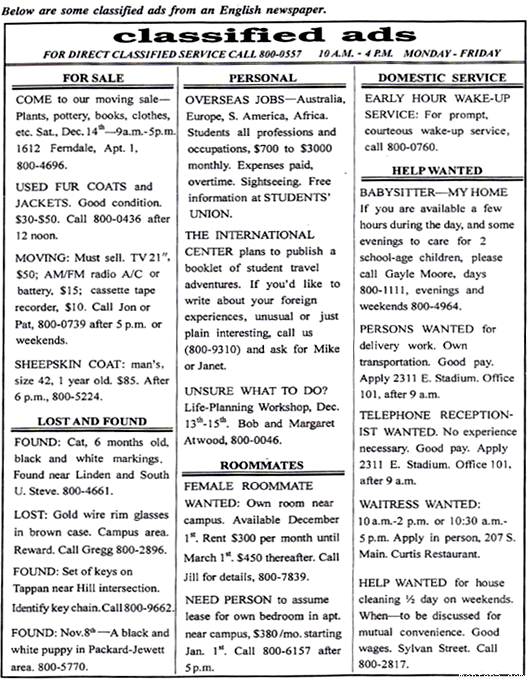
1.Where will you post a notice if you need someone to look after your children?
A. PERSONAL B. ROOMMATES
C. DOMESTIC SERVICE D. HELP WANTED
2.A second-hand jacket will probably cost you __________.
A. $60 B. $10 C. $20 D. $40
3. To have your travel notes published, you may contact __________.
A. The International Center B. Gayle Moore
C. Students’ Union D. Life Planning Workshop
4.If you want to have someone wake you up in the morning, you may call __________.
A.800-5224 B. 800-0760 C.800-7839 D. 800-5770
查看习题详情和答案>>
| |||||||||||||||||||||||||||||||||||||||||||||||||||||||||||


【小题1】Where will you post a notice if you need someone to look after your children?
| A.PERSONAL | B.ROOMMATES |
| C.DOMESTIC SERVICE | D.HELP WANTED |
| A.$60 | B.$10 | C.$20 | D.$40 |
| A.The International Center | B.Gayle Moore |
| C.Students’ Union | D.Life Planning Workshop |
| A.800-5224 | B.800-0760 | C.800-7839 | D.800-5770 |
[1] Perhaps you are an average student with average intelligence. However, you can receive better grades if you want. Yes, even students with average intelligence can be top students without additional work. Here’s how:
[2] Plan your time carefully. Make a list of your weekly tasks. Then make a schedule of your time. Be sure to set aside enough time to complete your normal reading and work assignments. Of course, studying shouldn’t occupy all of the free time on the schedule.
[3] Make good use of your time in class. Listening to what the teacher says in class means less work later. Take notes to help you remember what the teacher says.
[4] Skim before you read. Look over a passage quickly before you begin to read it more carefully. As you preview the material, you get some idea of the content and how it is organized. Later when you begin to read you will recognize less important material and you may skip some of these portions. Skimming helps double your reading speed and improve your comprehension as well.
[5] Review regularly. Go over your notes as soon as you can after class. Review important points mentioned in class as well as points you remain confused. If you know what the teacher will discuss the next day, skim and read that material, too. If you review your notes and textbook regularly, the material will become more meaningful and you will remember it longer. Regular review leads to improved performance on tests.
[6] Develop a good attitude towards tests. The purpose of a test is to show what you have learned about a subject. The world won’t end if you don’t pass a test, so don’t worry excessively about a single test.
[7] There are other techniques that might help you with your studying. Improving your studying habits will improve your grades.
71. What’s the main idea of the passage? (no more than 8 words)
__________________________________________________________________________
72. What should you do if you fail a test? (no more than 4 words)
__________________________________________________________________________
73. According to the passage, how can an average student improve his/her grades? (no more than 6 words)
__________________________________________________________________________
74. What does the word “it” (line 5, paragraph 5) probably refer to? (no more than 3 words)
__________________________________________________________________________
75. Among these suggestions, which one do you think is useful to your studies? Why? ( no more than 25 words )
____________________________________________________________________________
查看习题详情和答案>>Since many of you are planning to study at college or university in this country, you may be curious to know what you usually do in a typical week, how you can get along with your fellow students, and so on. These are the questions I want to discuss with you today.
First, let’s talk about what your weekly schedule will look like. No matter what your major may be, you can expect to spend between four and six hours a week for each class attending lectures. Lectures are usually in very large rooms because some courses such as introduction to sociology or economics often have as many as two or three hundred students, especially at large universities. In lectures, it’s very important for you to take notes on what the professor says because the information in a lecture is often different from the information in your textbooks. Also, you can expect to have exam questions based on the lectures. So it isn’t enough to just read your text books; you have to attend lectures as well. In a typical week, you will also have a couple of hours of discussion for every class you take. The discussion section is a small group meeting usually with fewer than thirty students where you can ask questions about the lectures, the reading, and the homework. In large universities, graduate students, called teaching assistants, usually direct discussion sections.
If your major is chemistry, or physics, or another science, you’ll also have to spend several hours a week in the lab, or laboratory, doing experiments. This means that science majors spend more time in the classroom than non-science majors do. On the other hand, people who major in subjects like literature or history usually have to read and write more than science majors do.
44. The main purpose of this text is ____.
A. to help the students to learn about university life
B. to persuade the students to attend lectures
C. to encourage the students to take part in discussions
D. to advise the students to choose proper majors
45. We can learn from the passage that university professors _____.
A. spend about 5 hours on lectures each week
B. must join the students in the discussion sections
C. prefer to use textbooks in their lectures
D. require the students to read beyond the textbooks
46. A discussion section does NOT include ____.
A. working under the guidance of university professors
B. talking over what the students have read about the courses
C. discussing the problems related to the students’ homework
D. raising questions about what a professor has said in a lecture
47. According to the author, science majors ____.
A. have to work harder than non-science majors
B. spend less time on their studies than non-science majors
C. consider experiments more important than discussions
D. read and write less than non-science majors
查看习题详情和答案>>