网址:http://m.1010jiajiao.com/timu3_id_3081459[举报]
For more than twenty years scientists have been searching for signs of life on other planets. Most of these searches have been done over the radio. The hope is that someone in outer space may be trying to get in touch with us. Scientists also have sent radio and television messages on spaceships traveling through space, on the chance that someone may be receptive to such messages.
Scientists are using powerful radio telescopes to listen to signals from about 1,000 stars, all within 100 light years of earth. In addition, they will scan the entire sky to “listen” for radio messages from more distant stars. Using a computer, they will be able to monitor more than eight channels at one time. Scientists are looking for any signal that stands out from the background noise.
Of the 200 billion stars in the Milky Way galaxy (银河星系), scientists find that 5% are like our sun. Perhaps half of them have a planet like earth. Such a planet would be a reasonable distance from the star for temperatures to be right for the evolution (进化) of life. Based on the inhabitable (that can be lived in) planets in our galaxy, most scientists agree that chances are likely that one or more of these planets support some life.
However, many scientists wonder whether intelligent (智能的) life exists on other planets. Some believe that twenty years of searching without any intelligible messages shows that no one is out there. They say that the evolution of intelligence comparable to ours is unlikely.
Other scientists believe that our search hasn’t been long enough to rule out the possibility that intelligent life exists in our galaxy. Although our sun family is only about five billion years old, our galaxy is about 20 billion years old. In that time, some scientists think it is likely that civilization much more advanced than ours have developed. Perhaps these civilizations send us no signals; perhaps we have not recognized the signals they have sent us. If we hope to find intelligent life, these scientists believe that we have to keep looking.
According to the passage, how many planets in our galaxy might be inhabitable?
A. 5 billion. B. 10 billion. C. 15 billion. D. 200 billion
The first paragraph in this passage is mainly about ________ .
A. how scientists are looking for signs of life on other planets
B. why scientists are looking for signs of life on other planets
C. where scientists are looking for signs of life on other planets
D. when scientists are looking for signs of life on other planets
Which of these statements is True based on the information in the passage?
A. The earth is one of the oldest planets in our galaxy.
B. Most scientists believe that there is intelligent life on other planets.
C. Scientists don’t believe that there might be life on other planets.
D. Scientists are trying different ways to find signs of life on other planets.
查看习题详情和答案>>
| |||||||||||||||||||||||||||||||||||||||||||||||||||||||||||||||||||||||||||||||||||||||||||||||||||||||||||||||||||||||||||||||||||||||||||||||||||||||||||||||||||||||||||||||||||||||||||||||||||||||||||||||||||||||||||||||||||||||||||||||||||||||||||||||||||||||||||||||||||||||||||
It is hard to say that a telephone is just a telephone anymore. Not only does it let you hear Grandma's voice from miles away clearer than ever before, but it is providing even more important information services to its users. By the year 2000, American householders will rely on the telephone system for shopping, computing, playing the stock market, making airline reservations, and watching television. The lives of heart patients may depend on telephones with on line electronic systems altering their doctors to emergencies. This is in addition to American business managers who currently rely on their telephones for sales orders, inventory control, banking, video image transmission, and many other tasks.
New technologies, such as advanced computing and fiber optics, make telecommunications services cheap and quick. In addition, since the breakup of AT&T, the competition spawned (引起) among many phone companies has emphasized price changes and introduced innovative services.
But despite the stimulus to provide commercial benefits during normal operation, one essential ingredient is missing—the incentive to design for emergency preparedness in the event of disaster. The telephone system is improving its ability to respond to some emergencies such as wartime attack, but is not prepared to handle terrorism, natural disasters, fires or accidents.
Before divestiture (解体) AT&T operated a national emergency center that coordinated all procedures during a disaster. Today, in lieu of the previous AT&T center, a government agency—the National Communications System (NCS) —operates the National Coordinating Center to address disasters related to telecommunications. In addition, the numerous phone companies and large communications suppliers have developed mechanisms of their own to respond to limited emergency situations, but massive emergencies are beyond their capabilities.
1. What does “anymore” in the first sentence of Paragraph 1 mean?
A. in any case B. at no time
C. not longer D. nowadays
2. “In Lieu of” in Paragraph 4 is used to mean
A. instead of B. because of
C. In spite of D. due to
3. The writer's main purpose is to
A. describe phenomena
B. propose a motion of the modem telecommunications sciences
C. amuse attention to the limited uses of telephone in the event of disaster
D. argue a belief of telephone
4. What would the following paragraph after Paragraph 4 more probably deal with?
A. the examples of emergencies that telephone system can not deal with
B. different opinions towards the telephone services
C. the writer's conclusion of the passage
D. the disadvantages of the National Communications System
查看习题详情和答案>>
Professor Martin's report says that children who attend a number of different schools, because their parents have to move around the country, probably make slow progress in their studies. There are also signs, says Professor Martin, that an unusually large number of such children are mentally affected.
The professor says, "It's true, my personal feeling is that children should stay in one school. However, our findings are based on research and not on any personal feelings that I or my assistants may have on the subject."
Captain Thomas James, an Army lecturer for the past 20 years and him self a father of two, said," I've never heard such rubbish. Taking me for ex ample, no harm is done to the education of my children who change schools regularly-if they keep to the same system, as in our army schools. In my experience, I've known quite a few of them-Army children are as well-adjusted(调整)as any others, if not more so. What the professor doesn't appear to appreciate is the fact that in such situations children will adapt(适应)much better than grown-ups."
When this was put to Professor Martin, he said that at no time had his team suggested that all such children were backward or mentally affected in some way, but simply that in their experience there was a clear tendency(倾向).
"Our findings show that while the very bright child can deal with regular changes without harming his or her general progress in studies, the majority of children suffer from constantly having to enter a new learning situation."
1.According to this passage, Professor Martin's personal feeling_______.
A. is the opposite of what his report has shown
B. is in a way supported by his research
C. has played a big part in his research
D. is based on his own experience as a child
2.From the passage, we can conclude that Captain James's children_________.
A. have been affected by changing schools
B. go to ordinary State schools
C. can get used to the Army school education
D. discuss their education regularly with their father
3.About children and grown-ups, Captain James says that children______.
A. are generally well-adjusted
B. are usually less experienced
C. can adapt much more easily
D. can deal with changes quickly
4.According to Professor Martin, _________ suffer from changing schools regularly.
A. Army children
B. quite a few children
C. bright children
D. few children
查看习题详情和答案>>
Taxis
Taxis are in the streets 24 hours a day.Simply raise your hand, and a taxi will appear in no time.They are usually red, and they display the price per kilometre on the window.You should check whether the cab has a business permit, and make sure you ask for a receipt.
Buses and trolleybuses
Public transport provides a cheap way to get around in Beijing.There are 20,000 buses and trolleybuses in Beijing, but they can get very crowded.It’s a good idea to avoid public transport during the rush hour(6∶30 a.m.~8∶00 a.m.and 5∶00 p.m.~6∶30 p.m.).Fares are cheap, starting at 1 yuan.Air-conditioned buses cost more.Buses numbered 1 to 100 are limited to travel within the city centre.Higher numbers have destinations in the suburbs.Tourists shouldn’t miss the 103 bus which offers one of the most impressive routes, past the Forbidden City and the White Pagoda in Beihai Park.If you get on a double-decker bus, make sure you sit upstairs.You’ll have a good view of the rapidly changing city.
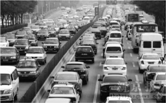
Most buses run from about 5∶00 a.m.to midnight.However, there is also a night bus service, provided by buses with a number in the 200s.
Minibuses
Minibuses with seats for 12 passengers offer an alternative to expensive taxis and crowded public transport in some areas.They run regular services and follow the same routes as large public buses.And in a minibus you always get a seat even in rush hours.
Underground
There are four underground lines in Beijing, and several lines are under construction.Trains are fast and convenient, but rush hours can be terrible.A oneway trip costs 3 yuan.Station names are marked in pinyin.The underground is open from 5∶00 a.m.to 11∶00 p.m..
Pedicabs
Tourists like these human-pedalled“tricycle taxis”, but they can be expensive.You should talk to the driver, and make sure you know the price before you begin the journey.For example, if it is per person, single or return.Tricycles are worth using if you want to explore the narrow alleys(hutong)of old Beijing.
Questions:
1.What’s the problem with buses?
2.What are the advantages of the underground?
3.What can you visit in a pedicab?