网址:http://m.1010jiajiao.com/timu3_id_3081433[举报]
以下是某个英语杂志有关专家对一些读者反映问题的建议:
A. Feel Grateful!
| You say you’re thankful, but then dismiss your mom’s investment as an “obligation”. By today’s economic standards, what she did is virtually miraculous. Tell your mom plainly, over and over again, how grateful you are. I’m sure the complaining will begin to fade. |
B. Tame the beast!
| When one boy discovers his inner caveman, he likes to initiate others into the tribe. Don’t over-worry. Boys will be boys. You and your husband should meet the boy’s parents down the street, suggesting a plan to either tame the wild beasts or limit their time together. |
C. Good effort and goodwill makes it!
| Maybe there was a reason why your buddy was out of work. He’s taking advantage of you and your employer. Remind him how to act on the job. He owes good effort and goodwill if he accepts the pay. Tell him to be quiet or get away. |
D. Calm down!
| Fast vehicles and wild people---sounds like adolescent dreams to me. As some men age, they compensate with bigger, faster toys. But he’s putting you at risk and breaking the law. In a calm moment outside the car, tell him that he is scaring you. Suggest he join a car club, one that promotes safe driving. |
E. Move your line away!
| You say you’re “in the middle”, but I’d say you’re dangerously close to slipping off the edge. There are lots of fish in the sea; why drop your line in waters your friend is still fishing? |
F. Speak out and breathe easily together!
| You are rebuilding a relationship with new trust and affection. If there’s a bad odor left from the old day, you need to clear the air. Mention the problem, and say, “I’m sorry for my part in that argument.” I’ll bet she’ll say the same. |
以下是一些读者在生活中反映的问题。请匹配问题及对应的建议。
56. Allan: My friend Jim was out of work and I helped him find a job in my company. But recently I have found he is very lazy and doesn’t do his work well. Besides, he often tells me that our employer is too bad.
57. Mary: Cathy and I were good friends. But two years ago she moved and left me because we had an argument. Now I hear she has come back to this town and lives about a mile away. I hope to visit this old friend, but I really don’t know what to do.
58. Mrs. Green: My eight-year-old son used to be obedient. But recently he’s become wild and crazy like a barbarian and doesn’t want to stay at home. My husband and I get worried. Now I find he likes to play with another boy who is also a barbarian.
59. Mike: I live with my mother, who works night and day so that she can support my schooling. I’m grateful but sometimes I get even more annoyed because she seems to be always unsatisfied with me and complains about my faults.
60. Eileen: My friend Jim is a helpful young man, and he has taken me downtown in his car several times. But every time he drove his car so crazily that I felt horrible. “I’ve got used to driving fast,” he says.
查看习题详情和答案>>Part I Listening Comprehension(30 marks)
Section A(22.5 marks)
Directions:In this section, you'll hear six conversations between two speakers.For each conversation, there are several questions, and each question is followed by three choices marked A, B and C.Listen carefully and then choose the best answer for each question.You will hear each conversation TWICE.
Conversation 1
1.How long does the woman need to work every day?
A.Three hours.
B.Four hours.
C.Five hours.
2.How much can the woman earn each day?
A.5 dollars.
B.10 dollars.
C.20 dollars.
Conversation 1
M:Do you have any work experience?
W:No, I’ve never worked in a restaurant before.
M:Do you think you can get along will with customers?
W:Yes, I think so.
M:Can you make sure to be here from four to eight in the afternoon?
W:Yes, I'm always on time.
M:Then you can start tomorrow.Monday through Friday.Five dollars an hour.
W:That's fine.
Conversation 2
3.What's the possible relationship between the speakers?
A.Boss and employee.
B.Mother and son.
C.Teacher and student.
4.When will the man come back?
A.This Monday.
B.This Wednesday.
C.This Friday.
Conversation 2
M:Mrs.Sharon, I say…, I have to …
W:What's the matter, Richard?
M:Er, I'd like to take two days off.My mother's ill.I need to stay with her.
W:I'm sorry to hear that.You mean you will be back here this Wednesday?
M:Yes, I hope I can come back earlier.
W:That's all right.By the way, don't worry about your lessons.I'll certainly help you with them.
Conversation 3
5.What can we know about Nancy and Steve?
A.They will divorce soon.
B.They have two daughters.
C.They divorced last year.
6.Who will help Nancy out in the woman's opinion?
A.Her daughter.
B.Her parents.
C.Her friends.
Conversation 3
M:Kate, Nancy and Steve are breaking up.
W:It's really a shame.I’ve heard that they quarrel, but they’ve always made up afterward.
M:Things are not working out this time.They are getting a separation soon.
W:What will happen to their daughter, Bonnie?
M:Nancy is going to take her.
W:The cost of living is so high.It will be difficult for her to take te responsibility.
M:She seems to have made up her mind.She said she would rather be a single parent than cope with an unhappy marriage.
W:Well, I hope her parents will be able to help her out.
Conversation 4
7.How often does the woman pay the tax?
A.Once a month.
B.Twice a year.
C.Once a year.
8.Why does the woman have to pay more taxes?
A.The government has raised the tax rate.
B.She didn't pay taxes last year.
C.She has got extra money.
9.What can we know about the woman?
A.She is an accountant.
B.She taught in a night school.
C.She lives upon a small income.
Conversation 4
W:Henry, our income tax is due soon.Did you call our accountant?
M:He's figuring out our taxes right now.I gave him all the records on our income and expenses last week.
W:The government has taken away taxes from our paychecks all year.I hope we get some of that money back or at least that we won't have to pay more.
M:Remember the money your aunt left us when she died, and the money you made when you taught in a night school?
W:Yes.
M:Well, that's all taxable income.That money has put us in a higher tax bracket.
W:What does that mean?
M:It means we have to pay more taxes.
W:Well, it looks like we'll have to make more money this year just to pay last year's taxes.
Conversation 5
10.What can we know about the kid from Haiti?
A.He doesn't get on well at school.
B.He is often late for school.
C.He doesn't speak much English.
11.How many countries are mentioned in the conversation?
A.Six.
B.Five.
C.Four.
12.How does the woman help the immigrant kids?
A.She has spent much time with them after class.
B.She gives them more lessons than other kids.
C.She pays more attention to them at class.
Conversation 5
M:Kate, how's the new student in your class doing?
W:The kid from Haiti? He's having a rough time communicating since he doesn't speak much English.However, the other kids seem to involve him pretty well.
M:Our students are used to new kids who don't speak much English since we have had so many new immigrant families moving into our school district.
W:Don't I know it! This year I have had a Vietnamese, an Ethiopian, a Cuban and the kid from Haiti in my class.I spend a lot of time with them after class so that they can catch up.
M:It must have been hard for you since you have to give them special attention in order to help them.
W:It has been.Nevertheless, it's really rewarding to see them progress and make friends.
Conversation 6
13.When will the speakers have the exams?
A.In one week.
B.In two weeks.
C.In three weeks.
14.What will the woman do this summer?
A.Teach English.
B.Find a job.
C.Study Chinese.
15.How did the man learn Chinese?
A.By speaking.
B.By reading.
C.By listening.
Conversation 6
M:Well, Jenny.The school year is almost over.We just have two weeks before exams.What are you going to do this summer?
W:I'm going to teach English to some immigrants in the university's community service program.
M:That sounds interesting.Don't you need to speak a foreign language for the job?
W:No.You just have to present the language simply and give the students a chance to practice speaking.
M:But that's the way I was taught to speak Chinese.But speaking Chinese didn't help me learn to read and write Chinese.
W:My students don't want to read and write English.They are more interested in speaking.
M:You sound very knowledgeable about all this.How do you know so much?
W:I took teaching English as a second language course last year when you were in China.I’ve also talked with the program administrators quite a lot.I think I would like to be an ESL teacher when I graduate.
SECTION B
Directions:In this section, you'll hear a mini-talk.Listen carefully and then fill in numbered blanks with the information you’ve got.Fill each blank with NO MORE THAN 3 WORDS.
You'll hear the mini-talk TWICE.
About friendship
Section B
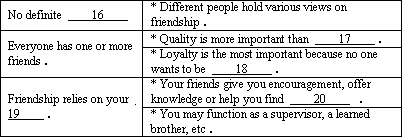
We often say, “A friend in need is a friend indeed.” But what is the exact meaning of friendship? No one can really offer a definite concept, because different people hold various views on friendship.
Everyone has his own friendship and some have a lot of friends.But in fact, quantity is not so important as quality.Loyalty is the most important for friendship.No one wants to make friends with those who will betray them.
No matter whether you are married or not, no matter where you live and work, your friends are your friends.It is not based on bloodline.It relies on your intention.To you, some friends are fun-loving, some give encouragement, some offer knowledge, and others help you to find your own identity.Before your friends, you may act as a supervisor, a learned brother, a lovely child, a gentleman or a playmate.In a word, friendship helps you to be a full person.So friendship can benefit.
Keys:
阅读下列应用文及相关信息,并按照要求匹配信息。请在答题卡上将对应的选项涂黑。
以下是某个英语杂志有关专家对一些读者反映问题的建议:
A. Feel Grateful!
You say you’re thankful, but then dismiss your mom’s investment as an “obligation”. By today’s economic standards, what she did is virtually miraculous. Tell your mom plainly, over and over again, how grateful you are. I’m sure the complaining will begin to fade. |
B. Tame the beast!
When one boy discovers his inner caveman, he likes to initiate others into the tribe. Don’t over-worry. Boys will be boys. You and your husband should meet the boy’s parents down the street, suggesting a plan to either tame the wild beasts or limit their time together. |
C. Good effort and goodwill makes it!
Maybe there was a reason why your buddy was out of work. He’s taking advantage of you and your employer. Remind him how to act on the job. He owes good effort and goodwill if he accepts the pay. Tell him to be quiet or get away. |
D. Calm down!
Fast vehicles and wild people---sounds like adolescent dreams to me. As some men age, they compensate with bigger, faster toys. But he’s putting you at risk and breaking the law. In a calm moment outside the car, tell him that he is scaring you. Suggest he join a car club, one that promotes safe driving. |
E. Move your line away!
You say you’re “in the middle”, but I’d say you’re dangerously close to slipping off the edge. There are lots of fish in the sea; why drop your line in waters your friend is still fishing? |
F. Speak out and breathe easily together!
You are rebuilding a relationship with new trust and affection. If there’s a bad odor left from the old day, you need to clear the air. Mention the problem, and say, “I’m sorry for my part in that argument.” I’ll bet she’ll say the same. |
以下是一些读者在生活中反映的问题。请匹配问题及对应的建议。
56. Allan: My friend Jim was out of work and I helped him find a job in my company. But recently I have found he is very lazy and doesn’t do his work well. Besides, he often tells me that our employer is too bad.
57. Mary: Cathy and I were good friends. But two years ago she moved and left me because we had an argument. Now I hear she has come back to this town and lives about a mile away. I hope to visit this old friend, but I really don’t know what to do.
58. Mrs. Green: My eight-year-old son used to be obedient. But recently he’s become wild and crazy like a barbarian and doesn’t want to stay at home. My husband and I get worried. Now I find he likes to play with another boy who is also a barbarian.
59. Mike: I live with my mother, who works night and day so that she can support my schooling. I’m grateful but sometimes I get even more annoyed because she seems to be always unsatisfied with me and complains about my faults.
60. Eileen: My friend Jim is a helpful young man, and he has taken me downtown in his car several times. But every time he drove his car so crazily that I felt horrible. “I’ve got used to driving fast,” he says.
查看习题详情和答案>>听力(共两节,满分30分)
第一节(共5小题;每小题1.5分,满分7.5分)
听下面5段对话。每段对话后有一道小题,从每题所给的A、B、C三个选项中选出最佳选项。听完每段对话后,你将有10秒钟的时间来回答有关小题和阅读下一小题。每段对话你将听一遍。
1.Where is the man’s bike now?
A.Under the stairs.
B.At the gate.
C.In the garden.
2.What does the man mean?
A.He doesn’t like the hotel.
B.They can’t afford to stay at the hotel.
C.They do not want to stay at a hotel.
3.What time is the woman leaving?
A.At 4∶30.
B.At 4∶00.
C.At 3∶30.
4.What does the man think of Mr.Stone’s lessons?
A.Boring.
B.Helpful.
C.Unnecessary.
5.What is the woman doing?
A.Offering suggestions.
B.Expressing dissatisfaction.
C.Asking for help.
听力原文:(Text 1)
M:I had my bike repaired.Last night I put it at the gate but can’t find it now.
W:It was in my way when I went to the garden.So I put it under the stairs.It’s still there.
(Text 2)
W:Why don’t we stay at the Grand Regency Hotel?
M:You are joking!Do you know how expensive that place is?There is no way we can afford to stay there.
(Text 3)
M:Don’t you usually leave for the airport at four o’clock?
W:Yes.I usually do.
M:Well, why are you leaving so early?
W:It’s going to snow, so I have to leave half an hour earlier.
(Text 4)
W:Mr.Stone’s lessons were a waste of time.He was always telling funny stories.
M:But he was actually covering what we should learn.
(Text 5)
M:I’d love to go to the Super Bowl next week, but I don’t think there are any more tickets.
W:Why don’t you talk to Laura?She’s a big football fan.She might be able to give you some advice on how to get a ticket.And I know she is planning to go herself, so maybe you could go with her.
第二节(共15小题;每小题1.5分,满分22.5分)
听下面5段对话或独白。每段对话或独白后有几个小题,从题中所给的A、B、C三个选项中选出最佳选项。听每段对话或独白前,你将有时间阅读各个小题,每小题5秒钟;听完后,各小题给出5秒钟的作答时间。每段对话或独白读两遍。
听第6段对话,回答第6~7题。
6.What might be the relationship between the two speakers?
A.Workmates.
B.Friends.
C.Mother and son.
7.What are they talking about?
A.The man’s major in college.
B.The man’s favorite subjects.
C.The man’s future job.
听力原文:(Text 6)
W:So what do you think you are going to do when you graduate, John?
M:I’m not sure.My dad says I should work in information technology.You know something with computers.
W:Is that what your dad does?
M:Not really.He is an engineer.
W:How about you?What are you interested in doing?
M:Well.I’m interested in medicine.I’d love to be a doctor.
W:Yeah, what subject are you good at?
M:Math is my best subject.And I’m also pretty good at science.
听第7段对话,回答第8~9题。
8.Who is the woman complaining about?
A.Her boss.
B.Her husband.
C.Her friend.
9.What is the man’s advice?
A.Finishing her job earlier.
B.Leaving the task to others.
C.Asking others for help.
听力原文:(Text 7)
W:If that man gives me any more letters to type, I’ll scream.He’s given me ten already today, and there’ll be more when I get back from coffee break.I’ll be here till midnight.
M:Calm down, Franny.He can’t make you stay after five.Finish what you can, and leave the rest for Mary.
W:But they’re important letters, Joe.They should go out tonight.
M:That’s not your worry.If they’re important, he should have given them to you earlier.
听第8段对话,回答第10~11题。
10.What happened to the woman?
A.She couldn’t cross a busy street.
B.She got into a moving taxi.
C.She got hurt by a taxi.
11.Where are the two speakers?
A.In the hospital.
B.In the street.
C.In a police station.
听力原文:(Text 8)
M:Tell me what happened.
W:Well, I wasn’t paying attention when I started to cross the street, and I stepped in front of a taxi.I didn’t realize it was still moving.
M:Can you walk?
W:Not very well.
M:Where does it hurt?
W:My side hurts when I take a step?
M:Okay, don’t try to walk anymore.Don’t worry.An ambulance is on the way.You know, you’re very lucky;you could have easily been killed in the accident.
W:Yes, I guess I could have.
M:You’ll have to fill out a form.Do you have any identification with you?
W:I have my passport.By the way, how did you get here so fast?
M:Someone dialed 911 and reported the accident.We were in the area and got a radio call.It only took a minute or so to get here.
听第9段对话,回答第12~14题。
12.What does the man want to find out?
A.The cost of taking a taxi.
B.The nearest bus stop.
C.How to get to a hotel.
13.How many possibilities does the woman suggest?
A.2.
B.3.
C.4.
14.What is the man’s final decision?
A.Checking the schedule.
B.Waiting for another bus.
C.Taking a taxi.
听力原文:(Text 9)
M:Excuse me, can you help me?
W:Of course.What can I do for you?
M:Can you tell me how I can get to the Excelsior Hotel from here?
W:The Excelsior?Let’s see, that’s in the city, right?
M:Yes, it is.On Forty-third Street, just off Eleventh Avenue.
W:Well, you can take a bus to the city.Just go out of the front door of the terminal and cross the street.There is a sign that says, “Airport-City Bus.” Otherwise, you can take a taxi.You can catch one right in front of the terminal.
M:Thank you.Oh, do you know how much the bus fare is?
W:It’s five dollars.A taxi costs about fifteen to twenty dollars.
M:I’d better take a bus then.How often does the bus run?
W:I think you just missed one.There is a schedule printed on the sign outside.I think that the buses ran every half hour or so.
M:On second thought, I’d better take a taxi.I have a lot of luggage and it’s late.Thank you!
听第10段对话,回答第15~17题。
15.Where does the conversation most probably take place?
A.On a plane.
B.On a train.
C.In a restaurant.
16.Why is the man worried?
A.This is his first time abroad.
B.He cannot arrive on time.
C.He has never seen his grandson.
17.When did the man first see Europe?
A.Recently.
B.After his wife’ s death.
C.During the Second World War.
听力原文:(Text 10)
W:Yes, Sir.You called?
M:Yes, I wonder if you could bring me another bottle of beer.
W:Certainly.Would you like anything else?
M:Well, my grandson is supposed to meet me in London at the airport.Do you think he’ll be able to find me?
W:I’m sure he will.You don’t have to worry about that.Are you going to be visiting him?
M:Yes.I’ve never seen my grandson.
W:I think you’ll have a wonderful time in London.It’s beautiful, is this your first time abroad?
M:No, I saw quite a bit of Europe before, Rome, Berlin, Paris, places like that, but I’ve never been to London.
W:Oh, then you have flown before too.
M:No, that was during the Second World War and I went to Europe on a large ship carrying soldiers.
W:Things are quite different in Europe nowadays.
M:I’m sure they are.I’m really interested to get there.
W:Well, it’s 4∶00 now and we’ll be there at 6∶00.Will you be staying long?
M:I plan to stay five weeks.I was a teacher but I have stopped working.My wife has died and so I can go wherever I want.
W:I think you’ll have a good time.I’ll go and get a beer for you.
听第11段独白,回答第18~20题。
18.What is the talk mainly about?
A.Improving our memory.
B.Taking care of our health.
C.Collecting information.
19.What should we do to remember someone’s name?
A.Write it down on a piece of paper.
B.Pay more attention to his or her first name.
C.Remember his or her last name.
20.What does the speaker suggest to us?
A.Having a rest for twenty minutes.
B.Taking some Vitamins B1 and B2.
C.Doing sports during the break.
听力原文:(Text 11)
W:There are many ways in which the memory can be improved.In fact, I believe we all have the ability to remember up to six times more than we do.
A lot of people find that visualizing information is very helpful.For example, if you are trying to remember a telephone number, imagine it written down on a piece of paper.
Remembering people’s names is a problem for a lot of people.I recommend that when you are introduced to someone you concentrate on his or her first name.It probably won’t offend anyone if you have to say, “What was your last name again, Sarah?” but Sarah might be upset if you forget her first name.
Of course, regular breaks are important and it’s better not to work for long periods without taking one, stopping for rest about every twenty minutes is best.
Finally, take care of yourself physically.Avoid substances like coffee, alcohol or drugs, because they dull the mind.And don’t forget your vitamins-B1 and B2 are particularly good for the memory.
Listening Comprehension
Section A
Conversation 1
1.What's wrong with the man?
A.He took the wrong direction.
B.He lost his way.
C.He missed the bus.
2.Which bus should the man take?
A.No.30.
B.No.2.
C.No.13.
Conversation 1
M:Excuse me.I'm going to the National Museum.Which stop should I get off at?
W:I'm afraid you're going in the wrong direction.This No.30 bus is bound for the airport.You should have caught a bus on the opposite side of the road.
M:Then which bus should I change to? Should I take bus No.2?
W:No.Just get off at the next stop, cross the road and take No.13 in the opposite direction.
Conversation 2
3.What can't the man believe?
A.That he hurt his arm.
B.That his team missed the goal.
C.That his team lost the game.
4.What's the man's attitude towards his team?
A.Confident.
B.Disappointed.
C.Surprised.
Conversation 2
W:I heard you hurt your arm in the football match last weekend.Are you OK?
M:It's nothing serious.I just can't believe that we lost to Class 2.After we scored the goal, we had a good chance to win, but we lost the game.
W:Don't take it so hard.Failure always makes us try harder next time.
M:You're right.I am confident that we will beat them next time.
Conversation 3
5.What time is it now?
A.5∶45
B.5∶55
C.7∶55
6.Where will the speakers probably go first?
A.A cinema.
B.A shopping center.
C.A restaurant.
Conversation 3
M:How about seeing a movie tonight, Helen?
W:That sounds great.I haven't been to a movie for quite a long time.
M:OK.Let me see.The movie starts at 7∶55.We still have two hours and ten minutes.Why don't we go out and have a quick dinner near the cinema?
W:Fine, but I have to stop at the shopping center first.
Conversation 4
7.What does the woman complain about?
A.The bill is not clear enough.
B.The bill is sent to a wrong address.
C.The bill she received is wrong.
8.Why do the mistakes occur?
A.The man is careless.
B.The old computer doesn't work well.
C.The man doesn't use the computer correctly.
9.What does the man promise to do finally?
A.Get a new computer.
B.No such mistake will happen again.
C.Send the presents to the woman.
Conversation 4
W:I'm afraid I have a complaint to make.
M:Please take a seat and tell me what is the matter.
W:I'm sorry to say that the bill you sent me is not right.
M:Not right, madam? That's strange.
W:Yes, I know.What's more, this isn't the first time.
M:Really? That's hard to believe.
W:It has happened five or six times in the past three months.
M:Well, I must apologize, madam.Maybe it's the old computer.
W:Well, don't you think it's about time you got it working properly? It's caused me a lot of inconvenience.
M:I agree entirely.I promise it won't happen again.
Conversation 5
10.Where does the conversation take place?
A.At home.
B.In a factory.
C.In a store.
11.What is the man so nervous?
A.He's been waiting for the call for a long time.
B.He's failed to answer the phone several times.
C.He's missed an important phone call.
12.What's the call about?
A.The man's company.
B.The man's new work.
C.The man's music.
Conversation 5
M:Linda, could you please turn down the music a little more?
W:OK.What's the matter?
M:Well, I'm expecting an important phone call, which has something to do with my new work.
W:You mean you've found a new job?
M:Yes, it's with a big company, so I don't want to miss the opportunity.
W:Don't worry.You'll be fine.
M:Was that the telephone?
W:I didn't hear anything.
M:I thought I heard it ring two or three times.
W:Sometimes when the windows are open you can hear the neighbor's phone ringing.
M:I've been waiting so long now.It's making me quite nervous.
W:Well, why not go outdoors to calm down and do what you want to do outside? I'll call you if the phone rings.
M:Thanks a lot.
Conversation 6
13.What's the man's reaction to his trip?
A.Optimistic.
B.Excited.
C.Nervous.
14.What will the man do when he checks in?
A.Examine his hand luggage.
B.Bring a boarding pass with his seat number.
C.Show his ticket and passport.
15.When should the man pay the departure tax?
A.When he checks in.
B.When he buys the ticket.
C.When he boards the plane.
Conversation 6
W:Mr.Jones, are you ready for the trip?
M:Oh, yes.I'm really excited about it, but could you tell me what I have to do at the airport? I've never flown before in my life.
W:I see.Now, as you enter, on your left you'll see a lot of check-in desks.You should go to your airline desk, okay? Actually that's very close to the entrance.
M:You mean as soon as I enter the airport, I will see the airline desk?
W:That's right.Once you are at the airline desk, show your ticket and passport to the clerk and place your luggage on the scales.
M:Is there any limit of my luggage?
W:Yes.Try not to have more than 25 kilograms altogether.Oh…and don't check in your hand luggage, as you'll bring it along with you on the plane.
M:Well.What should I do after checking in my hand luggage?
W:Then, the clerk will give you a boarding pass with your seat number printed on it.
M:A friend of mine told me something about a departure tax.What's that? Have I paid for it?
W:Don't worry.It's included in the price of your ticket.
M:Oh, thank you.
Section B
There are two types of people in the world.Although they have equal degrees of health and wealth and the other comforts of life, one becomes happy, the other becomes unhappy.This arises from the different ways in which they consider things, persons, and events, and the resulting effects upon their minds.
The people who are to be happy fix their attention on the conveniences of things, the pleasant parts of conversation, the well-prepared dishes, the goodness of the wines, and the fine weather.They enjoy all the cheerful and positive things.They are in good spirits all the time.People like to make friends with them and are happy when they are successful.It can make you popular among your classmates and strengthen the relationship with others.
Those who are to be unhappy always think and speak the negative things.So they are continually discontented.Those people tend to criticize and offend others, which makes themselves disagreeable everywhere.No one loves them and treats them as their friends.No one shows respect to them, either.They should change this bad habit, or they would not live a happier life.
