网址:http://m.1010jiajiao.com/timu3_id_3075905[举报]
After losing his job at 50, Lee had enough time and made a list of unfinished business. He was _36 through boxes of reminders that called up memories of things he 37 have done but didn’t.
For the next year, Lee travelled the country to fulfill his unfinished 38 on the list. Among his ten tasks: Pay a thank-you visit to a high school teacher; 39 out for a lonely mentally ill aunt 40 whom his whole family had lost touch over ten years ago; repay a $600 41 to a friend he hadn’t seen in decades.
“Once you start working and 42 a family, you have only so much time and energy. It’s easy to tell 43 you’ll get back to the people later.” Lee said, “At 50, I realized I had become 44 from important people and values.”
“Every 45 was just so much richer than I could have imagined. Every meeting called up a 46 experience in the people I spent time with.” The friend who had 47 his $600 had completely forgotten that debt, which 48 had grown to 6 million. But their meeting 49 memories of a brave and energetic youth, 50 Lee afterwards to climb mountains. The high school teacher was not only pleased with his former student’s visit 51 also asked questions that were challenging and inspiring as ever. Lee’s aunt, a promising pianist who hadn’t had a visit from her family in 52 , cheered up and began playing piano again; most important, she knows 53 cares.
Now Lee needs to find a new job, but he has decided to continue 54__ unfinished business. “It’s amazing 55 _ you can achieve with just a visit, a call or an email when you make efforts to reach out!”
36. A. getting B. seeing C. going D. glancing
37. A. must B. should C. might D. would
38. A. matter B. affair C. thing D. business
39. A. reach B. make C. take D. get
40. A. for B. with C. to D. of
41. A. check B. note C. budget D. debt
42 A. living B. lifting C. raising D. rising
43. A. themselves B. myself C. oneself D. yourself
44. A. disconnected B. dismissed C. disappointed D. disliked
45. A. memory B. schedule C. arrangement D. moment
46. A. similar B. same C. different D. difficult
47. A. borrowed B. lent C. sent D. kept
48. A. strangely B. effectively C. fortunately D. actually
49. A. brought back B. brought down C. brought in D. brought out
50. A. informing B. inspiring C. reminding D. taking
51. A. however B. and C. but D. yet
52. A days B. weeks C. months D. years
53. A. someone B. everyone C. no one D. any one
54. A looking after B. taking care of C. going through D. thinking over
55. A. that B. which C. what D. as
查看习题详情和答案>>
C
People think being an artist must be a wonderful way to earn one's living. Of course, there are lots of great things about working for oneself, at home alone. What I really like is that nobody tells me what time to start in the morning, what to wear; or whether I can take the afternoon off and go to a football match.
But then, I have no one to chat with when I'm bored, no one to discuss last night's match with during the lunch-hour. Sure, I can spend the afternoon doing something I enjoy like swimming, walking the dog, or even sleeping, if I choose. But the work will still be there when I do finally get back home, and it's still got to be finished in time. Unfortunately, working at home means that people can always find me, whether I’m bored or not and once I’ve answered the doorbell, it's too late——my thoughts have been interrupted. No one would dream of calling if I worked in an office, but in an office I find myself making cups of coffee and listening to friends' troubles. As they talk, my ideas disappear and I feel increasingly stressed thinking of my work waiting to be done.
66. What is the writer trying to do in the text?
A. To encourage readers to work at home.
B. To explain why he has changed his job.
C. To describe his working life.
D. To say how he would like to work.
67. What can the reader learn from the text?
A. How to start working for oneself.
B. What it's like to work at home.
C. Why the writer decided to work for himself.
D. How artists become successful?
68. What does the writer like about his life?
A. He has plenty of opportunities for sport.
B. He is his own boss.
C. He can see people when he wants to.
D. He has a comfortable place to work.
69. What does the writer imagine he might do with colleagues ( 同事 ) ?
A. Have meals in restaurants.
B. Go to the swimming pool.
C. Spend time in the countryside.
D. Talk about sport.
70. Which of these notices would be most useful for the writer to put on his door?

People think being an artist must be a wonderful way to earn one's living. Of course, there are lots of great things about working for oneself, at home alone. What I really like is that nobody tells me what time to start in the morning, what to wear; or whether I can take the afternoon off and go to a football match.
But then, I have no one to chat with when I'm bored, no one to discuss last night's match with during the lunch-hour. Sure, I can spend the afternoon doing something I enjoy like swimming, walking the dog, or even sleeping, if I choose. But the work will still be there when I do finally get back home, and it's still got to be finished in time. Unfortunately, working at home means that people can always find me, whether I’m bored or not and once I’ve answered the doorbell, it's too late——my thoughts have been interrupted. No one would dream of calling if I worked in an office, but in an office I find myself making cups of coffee and listening to friends' troubles. As they talk, my ideas disappear and I feel increasingly stressed thinking of my work waiting to be done.
61. What is the writer trying to do in the text?
A.To encourage readers to work at home. B. To explain why he has changed his job.
C.To describe his working life. D. To say how he would like to work.
62. What can the reader learn from the text?
A. How to start working for oneself. B. What it's like to work at home.
C. Why the writer decided to work for himself. D. How artists become successful?
63. What does the writer like about his life?
A. He has plenty of opportunities (机会)for sports B. He is his own boss.
C. He can see people when he wants to.
D. He has a comfortable place to work.
64. What does the writer imagine he might do with colleagues ( 同事 ) ?
A. Have meals in restaurants. B. Go to the swimming pool.
C. Spend time in the countryside. D. Talk about sport.
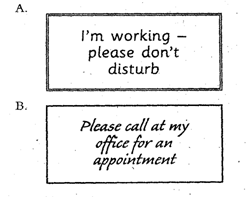
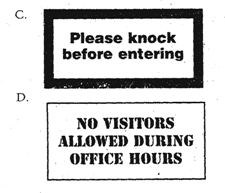
65. Which of these notices would be most useful for the writer to put on(张贴) his door?
( disturb:打扰 appointment: 约会;预约)
C
People think being an artist must be a wonderful way to earn one's living. Of course, there are lots of great things about working for oneself, at home alone. What I really like is that nobody tells me what time to start in the morning, what to wear; or whether I can take the afternoon off and go to a football match.
But then, I have no one to chat with when I'm bored, no one to discuss last night's match with during the lunch-hour. Sure, I can spend the afternoon doing something I enjoy like swimming, walking the dog, or even sleeping, if I choose. But the work will still be there when I do finally get back home, and it's still got to be finished in time. Unfortunately, working at home means that people can always find me, whether I’m bored or not and once I’ve answered the doorbell, it's too late——my thoughts have been interrupted. No one would dream of calling if I worked in an office, but in an office I find myself making cups of coffee and listening to friends' troubles. As they talk, my ideas disappear and I feel increasingly stressed thinking of my work waiting to be done.
66. What is the writer trying to do in the text?
A. To encourage readers to work at home.
B. To explain why he has changed his job.
C. To describe his working life.
D. To say how he would like to work.
67. What can the reader learn from the text?
A. How to start working for oneself.
B. What it's like to work at home.
C. Why the writer decided to work for himself.
D. How artists become successful?
68. What does the writer like about his life?
A. He has plenty of opportunities for sport.
B. He is his own boss.
C. He can see people when he wants to.
D. He has a comfortable place to work.
69. What does the writer imagine he might do with colleagues ( 同事 ) ?
A. Have meals in restaurants.
B. Go to the swimming pool.
C. Spend time in the countryside.
D. Talk about sport.
70. Which of these notices would be most useful for the writer to put on his door?


C
What is it that makes people happy? Youth, health, a good job, good looks, a flash car? None of these things, Spanish experts say.
The concept(概念) of happiness is thought to be determined by genetics, while the rest depends on childhood environment and the process(过程) of growing up. Perhaps the most surprising thing about happiness is coming under increasingly close examination in Spain.
As the nation rises to the club of the world's wealthiest countries, people are discovering that material(物质的) things do not bring happiness.
"Most people use money as a measure of human value," says Jesus Ynfante, author of a book on Spain's 300 biggest fortunes. "Expensive products are regarded as the best. The rich are admired simply for being rich," Ynfante said.
Yet psychologists(心理学家) warn that happiness as a moment of ecstatic pleasure(狂喜)--something that, by definition(定义) ,cannot last--while others speak of it as peace and acceptance of oneself. Polls(问卷调查) in different countries indicate that between 65 and 85 percent of the world's population regard themselves as reasonably happy.
Around 40 percent of a person's happiness is that it has little to do with age, health, wealth, or other values thought to be important in Western society. For most Spaniards, happiness is linked with feeling close to other people. Happy people accept their limitations and set themselves reachable goals, experts say.
There are life-style choices that favour happiness, such as exercise, eating carbohydrates and exposing oneself to sunlight. But the main secret of happiness is to take pleasure in small things.
“If you are given a choice between eternal(永久的)happiness and a cheese sandwich, take the sandwich,” advises musician Julian Hernandez.
58. Spain, as this passage tells us, __________.
A. has built more clubs than the other countries
B. has owned the largest group of experts
C. has become one of the richest countries in the world
D. has produced the most wealth in the world
59. It can be concluded that Jesus Ynfante is__________.
A. a famous expert B. a famous psychologist
C. one of the richest Spaniards D. familiar with the richest Spaniards
60. As psychologists warn in this passage, people can't feel happy even if they_________.
A. have too much money B. only care about themselves
C. don't do any homework D. have a few relations
61 Happy people, as we can find in this passage, __________.
A. are always full of feelings B. are always born in rich families
C. always enjoy every achievement they get D. always look down upon themselves