网址:http://m.1010jiajiao.com/timu3_id_3073682[举报]
B
Students’ Insurance
What Is Covered under Contents?
Under the “Contents” section your possessions---which you do not have to be listed---will be protected on “new for old” basis where items will be replaced as new---regardless of their age or condition.
“Contents” include books, radios, audio and video players, TVs, jewellery, home computers, furniture, household goods, other electrical equipment and sports equipment. They will be insured as follows:
Theft
Fire, Lighting, Explosion
Malicious(恶意)Damage
Storm, Flood and other natural disasters
But new-for-old cover does not include clothing and linen.
Where Does Cover Apply?
Anywhere in Australia whether in:
Your Living Place While at College
Your Parents’ Home or Any Temporary Residence(临时住处)---where you are staying when away from College
Your College or Students’ Union Building
College Storage during Vacations
Plus The Following Benefits Included Free
Loss or Damage to:
Gas, water and electricity meters and telephones---up to$300
TVs and videos rented in your name
Library books---up to $300
Daily things bought---up to $500 as to cover described under “Contents”
College or Landlord’s Possessions in your rooms by Fire or Theft (if you are legally responsible---up to $2,000)
Personal Money: from your room---up to $60
PLUS fraudulent(欺诈)use of your Credit Card---up to $1,000
61. If you lose an old video player, the insurance company will _____.
A. replace it with a new one B. pay you up to $30 in insurance
C. pay you nothing for it is old D. replace it with a used one
62. Which of the following statements is TRUE according to the passage?
A. Your household goods will not be insured due to natural disasters.
B. Your computer is insured when you are away from college.
C. You can be paid $2,000 for fraudulent use of your Credit Card.
D. Your rented car is completely insured if it is damaged.
63. All of the following are included in the insurance project except _____.
A. audio and video players, TV B. jewellery, library books
C. clothing, linen and cars D. furniture, home computers
64. It can be inferred from the passage that _____.
A. if you lose a radio you can get another one
B. if you have your possessions stolen outside Australia they are not insured
C. if a fire breaks out in your room you can get everything back
D. if your jewellery is stolen you will be paid as much as $300
Publishing on paper will draw up to an end in the next 30 years. That’s what some high-tech experts have said ever since computers began appearing in everyone’s workplace. If you have ever read a newspaper online, you have experienced a tiny part of what paperless future look like.
New technology will certainly continue to revolutionize written communication. But will the use of paper in our everyday lives really disappear anytime soon? Well, don’t give up on paper just yet.
Paper, an ancient Chinese invention, has dominated(主宰) written communication for centuries. Cai Lun, an official in the
Today, surprisingly, it seems the digital age has actually strengthened the importance of paper. Studies show that paper use has doubled in the last 20 years. People still like to print their longer documents and e-mails. But today’s technology is rapidly improving. And efforts toward a paperless world continue.
The Internet is clearly one giant step. Many of the publications have created Web sites that offer everything in their paper editions―and even more. Their Web sites can be continually updated as news happens. Other types of material have also fit well into the digital age. Dictionaries and other reference books actually work better in a paperless format. Information published on a Web site or CD-ROM can be kept more current.
In addition publishers have begun to produce e-book version of their best sellers. New e-book readers---a simple computer about the size of a paperback book―can store nearly a hundred books. But e-books haven’t gained a large following.
64. Which of the following is not true according to the passage?
A. The invention of paper revolutionized written communication.
B. Publishing on paper will disappear in the next decade.
C. Most books will continue in paper for now.
D. Digital books are read on a computer screen.
65. What surprises us today is that the digital age makes people realize ______________.
A. the importance of the use of paper
B. the importance of paperless workplace
C. the paperless future will come sooner or later
D. how important paper has been in the last 20 years
66. What is not included as a resource of paperless material in the passage?
A. e-books B. CD-ROM
C. a newspaper online D. dictionaries and other reference books
67. “The Internet is clearly one giant step” implies that __________.
A. It offers you an opportunity to experience a part of paperless future.
B. This new technology fits well into the digital age.
C. A substitute for paper might someday be a reality.
D. For now the world will continue to stick with what works.
查看习题详情和答案>>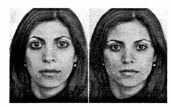
Is the woman pictured on the right more attractive than the woman on the left?
The photograph on the right was changed using a new "beauty making" computer program, which uses a mathematical formula involving 234 measurements of distances between facial features to get a theoretically more attractive version, while keeping the basic appearance of the face unchanged. Unlike changes done in fashion magazine photos, wrinkles were not smoothed and hair color was not changed.
The program is the latest attempt to combine beauty and science, a subject that has drawn increasing academic interest in the last decade.
Studies have shown there is surprising agreement among people of different cultures about what makes a face attractive. Most important is symmetry (匀称), along with youthfulness, skin smoothness and vivid eyes and hair color. Yet, like the many other scientific or mathematical attempts to define beauty, this software program raises complex and difficult questions about the understanding of beauty.
"How can they prove something is more or less beautiful?" said Lois Banner, a history professor at
After viewing "before" and "after" photographs of different people, Banner said the original faces were more attractive. "Irregular beauty is the real beauty," said Banner, adding that attempts to measure beauty are driven by the media’s efforts to define beauty and who is beautiful.
Martina Eckstut, the woman whose photo was beautified for this article, said she was struck by how different she looked. "I think the “after” picture looks great, but it doesn’t really look like me at all." She added, "I would like to keep my original face."
For centuries people have tried to define a universal ideal of beauty. "The first reaction we have to faces will be based on face symmetry." said Alexander Nehamas, a professor who has written about beauty. "But in real life we don’t just see a face. We see faces as people express their emotions and ideas, and all those aspects of the face are essential to our deciding whether a face or a person is beautiful."
46. How does the program work to beautify a face?
A. It changes the distances between facial features.
B. It smoothes the skin and softens the color of the hair.
C. It digitally repairs some obvious facial faults.
D. It replaces the original face with a similar one.
47. Banner believes that .
A. there is no such thing as beauty
B. efforts to develop a beauty measure should be encouraged
C. the media is to blame for the failure to agree on beauty standards
D. it is impossible to show that one thing is more beautiful than another
48. When seeing the "after" picture, Martina Eckstut was .
A. pleasantly surprised but thought she could look even better
B. eager to get her face changed although it didn’t look like her at all
C. amazed by the attractiveness but preferred not to have a different face
D. confused by how different she looked and had no idea what to do
49. According to the passage, which of the following statements is TRUE?
A. Beauty is mainly based on face symmetry.
B. There is no single standard or definition of beauty.
C. The program is likely to encourage people to change their appearance.
D. Mathematics should be used to help us create beauty.
50. The purpose of the passage is to .
A. oppose the attempts to create artificial beauty
B. introduce a beauty program and a discussion about beauty
C. discuss what makes a person beautiful
D. show how a beauty engine can beautify a person
查看习题详情和答案>>Is the woman pictured on the right more attractive than the woman on the left??
The photograph on the right was changed using a new "beauty making" computer program, which uses a mathematical formula involving 234 measurements of distances between facial features to get a theoretically more attractive version, while keeping the basic appearance of the face unchanged. Unlike changes done in fashion magazine photos, wrinkles were not smoothed and hair color was not changed.?
The program is the latest attempt to combine beauty and science, a subject that has drawn increasing academic interest in the last decade.?
Studies have shown there is surprising agreement among people of different cultures about what makes a face attractive. Most important is symmetry (匀称), along with youthfulness, skin smoothness and vivid eyes and hair color. Yet, like the many other scientific or mathematical attempts to define beauty, this software program raises complex and difficult questions about the understanding of beauty.?
"How can they prove something is more or less beautiful?" said Lois Banner, a history professor at Chicago University, who studies changing beauty standards. "There can never be a single standard of beauty because so much of it is culturally influenced."?
After viewing "before" and "after" photographs of different people, Banner said the original faces were more attractive. "Irregular beauty is the real beauty," said Banner, adding that attempts to measure beauty are driven by the media’s efforts to define beauty and who is beautiful.?
Martina Eckstut, the woman whose photo was beautified for this article, said she was struck by how different she looked. "I think the “after” picture looks great, but it doesn’t really look like me at all." She added, "I would like to keep my original face."?
For centuries people have tried to define a universal ideal of beauty. "The first reaction we have to faces will be based on face symmetry." said Alexander Nehamas, a professor who has written about beauty. "But in real life we don’t just see a face. We see faces as people express their emotions and ideas, and all those aspects of the face are essential to our deciding whether a face or a person is beautiful."?
1. How does the program work to beautify a face??
A. It changes the distances between facial features.?
B. It smoothes the skin and softens the color of the hair.?
C. It digitally repairs some obvious facial faults.?
D. It replaces the original face with a similar one. ?
2. Banner believes that .?
A. there is no such thing as beauty?
B. efforts to develop a beauty measure should be encouraged?
C. the media is to blame for the failure to agree on beauty standards?
D. it is impossible to show that one thing is more beautiful than another ?
3. When seeing the "after" picture, Martina Eckstut was .
A. pleasantly surprised but thought she could look even better?
B. eager to get her face changed although it didn’t look like her at all?
C. amazed by the attractiveness but preferred not to have a different face?
D. confused by how different she looked and had no idea what to do
4. According to the passage, which of the following statements is TRUE??
A. Beauty is mainly based on face symmetry.?
B. There is no single standard or definition of beauty.?
C. The program is likely to encourage people to change their appearance.?
D. Mathematics should be used to help us create beauty. ?
5. The purpose of the passage is to .?
A. oppose the attempts to create artificial beauty?
B. introduce a beauty program and a discussion about beauty?
C. discuss what makes a person beautiful?
D. show how a beauty engine can beautify a person
查看习题详情和答案>>
阅读理解
The richest man in the world is an American, Bill Gates. He started Microsoft, the company that makes computer programs and operating systems. Two years ago, Mr. Gates and his wife Melinda decided to use some of their money to improve the lives of people in developing countries. They started the Bill and Melinda Gates Foundation in Seattle, Washington. The foundation has twenty--four thousand million dollars. It is the biggest not-for-profit organization in the world. Bill and Melinda Gates started the foundation because they believed progress in medical science and information technology was not reaching people in developing countries. Their foundation finances programs aimed at improving health and education in poor countries. One of the foundation's major goals is the development of new medicines to prevent and treat tuberculosis (肺结核 ),malaria (疟疾) and AIDS. The World Health Organization reports that these three diseases kill more than five million people a year.
Another leading foundation project is an effort to reduce death rates for babies in poor countries. The foundation also supports efforts to provide necessary medicines to prevent diseases among children in seventy-four developing countries. It also supports training programs for healthy workers. Bill and Melinda Gates are also concerned about connecting people to The Internet computer system. The foundation believes men and women of all ages and races should be able to use the Interact as a tool for life-long learning. For example, the foundation gave nine million dollars to more than three hundred fifty public libraries in Chile (智利) for computers and technology training. The Gates Foundation usually provides money to developing countries in the from of a gift or a grant. However, there are conditions for receiving grants. Governments or other not-for-profit organizations working in a country must promise to provide an equal amount of money. The receiver must also meet performance goals or risk losing the money.
(1)What's not the aim of the Bill and Melinda Gates Foundation?
[ ]
A. Providing information technology for the developing countries.
B. Developing new medicines to prevent diseases.
C. Earning more money from these developing countries.
D. Helping men and women of all ages and races use the Internet.
(2)What do you think of Bill Gates from this text?
[ ]
A. Clever.
B. Rich.
C. Able.
D. Warm-hearted.
(3)What's the main idea of this passage?
[ ]
A. Bill Gates, the richest man.
B. Bill Gates set up foundation to help the people in developing countries.
C. Information technology needs popularizing.
D. The people in developing countries need to be helped.
(4)Which of the following statements is NOT true according to the text?
[ ]
A. Tuberculosis, malaria and AIDS kill many people every year.
B. A person can receive a grant as long as he lives in a developing country.
C. Gates Foundation is the largest not-for-profit organization in the world.
D. Bill Gates supported training healthy workers.
(5)What's the meaning of the underlined word “grant”?
[ ]