网址:http://m.1010jiajiao.com/timu3_id_3071834[举报]
One of the most difficult questions to answer is how much a job is worth. We naturally expect that a doctor’s salary will be higher than a bus conductor’s wages. But the question becomes much more difficult to answer when we compare a miner with an engineer, or an unskilled man working on an oil-rig(钻探平台)with a teacher in a secondary school. What the doctor, the engineer and the teacher have in common is that they have devoted several years to studying in order to obtain the necessary qualifications for their professions. We feel instinctively that these skills and these years should be rewarded. At the same time we recognize that the work of the miner and the oil-rig laborer is both hard and dangerous, and that they must be highly paid for the risks they take.
Another aspect we must take into consideration is how socially useful a man’s work is. Most people would agree that looking after the sick or teaching children is more important than, say, selling second-hand cars. Yet it is almost certain that the used-car salesman earns more than the nurse and the schoolteacher.
Indeed, this whole question of just rewards can be turned on its head. You can argue that a man who does a job which brings him personal satisfaction is already receiving part of his reward in the form of a so-called “psychic(精神的)wage”, and that it is the man with the boring, repetitive job who needs more money to make up for the soul-destroying repetitiveness of his work. It is significant that the jobs like nursing and teaching continue to be poorly paid, while others, such as those in the world of sport or entertainment, carry financial rewards out of all proportion to their social worth.
Although the amount of money that people earn is largely determined by market forces, this should not prevent us from seeking some way to decide what is the right pay for the job. A starting point would be to try to decide the ratio(比率)which ought to exist between the highest and the lowest paid. The picture is made more complicated by two factors: firstly by the welfare benefits which every citizen receives, and secondly by the taxation system which is often used as an instrument of social justice by taxing high incomes at a very high rate indeed. Most countries now regard a ratio of 7:1 as socially acceptable. If it is less, the highly-qualified people carrying heavy responsibilities will become disappointed, and might even end up by leaving for another country. If it is more, the difference between rich and poor will be so great that it will lead to social unrest.
【小题1】Why do people naturally expect that doctors should be well-paid?
| A.Their work requires greater intelligence. |
| B.They are under constant pressure at work. |
| C.They work harder than most other people. |
| D.They have studied for years to get qualified. |
| A.the talented should do more important work |
| B.unskilled jobs have less social responsibility |
| C.those with more socially useful jobs earn less |
| D.people want to pay more to important services |
| A.It’s difficult to define the social value of a job. |
| B.The market will decide what the right pay is for a job. |
| C.People should find a proper ratio between high and low pay. |
| D.Those receiving high salary should carry heavy responsibilities. |
One of the most difficult questions to answer is how much a job is worth. We naturally expect that a doctor’s salary will be higher than a bus conductor’s wages. But the question becomes much more difficult to answer when we compare a miner with an engineer, or an unskilled man working on an oil-rig(钻探平台)with a teacher in a secondary school. What the doctor, the engineer and the teacher have in common is that they have devoted several years to studying in order to obtain the necessary qualifications for their professions. We feel instinctively that these skills and these years should be rewarded. At the same time we recognize that the work of the miner and the oil-rig laborer is both hard and dangerous, and that they must be highly paid for the risks they take.
Another aspect we must take into consideration is how socially useful a man’s work is. Most people would agree that looking after the sick or teaching children is more important than, say, selling second-hand cars. Yet it is almost certain that the used-car salesman earns more than the nurse and the schoolteacher.
Indeed, this whole question of just rewards can be turned on its head. You can argue that a man who does a job which brings him personal satisfaction is already receiving part of his reward in the form of a so-called “psychic(精神的)wage”, and that it is the man with the boring, repetitive job who needs more money to make up for the soul-destroying repetitiveness of his work. It is significant that the jobs like nursing and teaching continue to be poorly paid, while others, such as those in the world of sport or entertainment, carry financial rewards out of all proportion to their social worth.
Although the amount of money that people earn is largely determined by market forces, this should not prevent us from seeking some way to decide what is the right pay for the job. A starting point would be to try to decide the ratio(比率)which ought to exist between the highest and the lowest paid. The picture is made more complicated by two factors: firstly by the welfare benefits which every citizen receives, and secondly by the taxation system which is often used as an instrument of social justice by taxing high incomes at a very high rate indeed. Most countries now regard a ratio of 7:1 as socially acceptable. If it is less, the highly-qualified people carrying heavy responsibilities will become disappointed, and might even end up by leaving for another country. If it is more, the difference between rich and poor will be so great that it will lead to social unrest.
1.Why do people naturally expect that doctors should be well-paid?
A.Their work requires greater intelligence.
B.They are under constant pressure at work.
C.They work harder than most other people.
D.They have studied for years to get qualified.
2.In Paragraph 2 and 3, the author indicates that __________.
A.the talented should do more important work
B.unskilled jobs have less social responsibility
C.those with more socially useful jobs earn less
D.people want to pay more to important services
3.Which of the following statements would the author agree?
A.It’s difficult to define the social value of a job.
B.The market will decide what the right pay is for a job.
C.People should find a proper ratio between high and low pay.
D.Those receiving high salary should carry heavy responsibilities.
查看习题详情和答案>>
听力
第一节:
听下面5段对话。每段对话后有一个小题,从题中所给的A、B、C三个选项中选出最佳选项。
1.What can we learn from the conversation?
A.They are both neighbors.
B.They are both students.
C.They are from the same school.
2.How does the man feel about his job?
A.He enjoys it.
B.He doesn’t like it at all.
C.He wants to find a new job.
3.What does the man think the building will be?
A.A market.
B.A hotel.
C.A department store.
4.What’s the most probable result of the talk?
A.The woman will accept the man’s offer.
B.The woman will go to the birthday party.
C.The woman will go to the concert with the man.
5.What’s the probable relationship between the man and the woman?
A.Taxi driver and passenger.
B.Conductor and driver.
C.Boss and driver.
第二节
听下面5段对话或独白。每段对话或独白后有几道小题,从每题所给的A、B、C三个选项中选出最佳选项。
听第6段材料,回答第6至7题。
6.Who was the original owner of the Garden Villa?
A.Jeff.
B.A boss.
C.A computer engineer.
7.Why did the man sell the house?
A.He no longer liked the house.
B.He was short of money.
C.He bought a new one.
听第7段材料,回答第8至10题。
8.How old is the girl?
A.Fifteen.
B.Sixteen.
C.Seventeen.
9.What does the girl think of the study of English?
A.Interesting.
B.Easy.
C.Hard.
10.What does the girl enjoy most?
A.Listening.
B.Writing.
C.Talking.
听第8段材料,回答第11至13题。
11.What does the woman ask the man to do?
A.To work at home.
B.To explain the word “SOHO”.
C.To learn more.
12.Which of the following is the bad result of using computers?
A.People will be much lazier than before.
B.People will be more foolish than before.
C.More people will lose their jobs.
13.What does the woman think we should do in order not to fall behind?
A.We should make more money.
B.We should learn more.
C.We should run faster.
听第9段材料,回答第14至17题。
14.Why did Jane go to New York?
A.To learn English.
B.To visit the Whites.
C.To go sightseeing.
15.When did Jane come back from the US?
A.On July 5th.
B.On August 5th.
C.On August 25th.
16.Why did Jane like to stay with the Whites?
A.They were her parents’ old friends.
B.She could speak English with them every day.
C.They treated her like their own daughter.
17.What in particular did Jane like about the American classes?
A.The teachers were kind.
B.The students had more freedom.
C.There were a lot of activities in class.
听第10段材料,回答第18至20题。
18.What’s one lifelong dream of Michelle’s?
A.Flying to Paris for baking a cake at a party.
B.Getting more attention in cooking.
C.Taking part in training courses.
19.How did Michelle get the chance to work in Paris?
A.She was chosen out of a cooking test.
B.She worked well enough to be given the chance.
C.She had already had three years of baking experience.
20.What can we know about Michelle?
A.Cakes baked by her are enjoyed by almost everyone.
B.She has strong desire for improvement.
C.She is good in the cooking school.
听力理解
第一节 听下面5段对话,每段对话后有一个小题,从题中所给的A、B、C、三个选项中选出最佳选项.听完每段对话后,你都有10秒钟的时间来回答有关小题和阅读下一小题.每段对话仅读一遍.
1.What does the Woman mean?
[ ]
A.His brother should let them use the car.
B.The subway is fine with her.
C.A car wouldn't be any faster.
2.What does the man have to do now?
[ ]
A.Complete the research.
B.Put the material in order.
C.Finish typing the paper.
3.What do you know about the woman?
[ ]
A.Perhaps she is a doctor.
B.She was badly ill.
C.She didn't like to see the film.
4.What did Jane do after the party?
[ ]
A.She had to finish her homework.
B.She went to bed.
C.She went to the teachers' office.
5.How is the man leaving?
[ ]
A.By bus.
B.By air.
C.By train.
第二节 听下面5段对话或独白.每段对话或独白后有几个小题,从题中所给的A、B、C三个选项中选出最佳选项.听每段对话或独白前,你将有时间阅读各个小题,每小题5秒钟;听完后,各小题将给出5秒钟的作答时间.每段对话或独白读两遍.
听第6段材料,回答第6~8题.
6.What time is it now?
[ ]
A.It’s 10: 10 p. m.
B.It’s 10: 30 p. m.
C.It’s 9: 50 p. m.
7.How long will it take the woman to get lo the railway station?
[ ]
A.Less than fifteen minutes.
B.More than fifteen minutes.
C.Less than fifty minutes.
8.Why did the man invite the woman to his house?
[ ]
A.They had a tea party.
B.They had a dinner party.
C.They had a dancing party.
听第7段材料,回答第9~11题.
9.Why does the man want to have a word with the waitress?
[ ]
A.Because he has been kept waiting for a long time.
B.Because he wants to complain of the food.
C.Because he wants to pay the bill.
10.What do We learn about the restaurant?
[ ]
A.It must be a new one.
B.They don’t know how to serve the people.
C.They need more waiters.
11.If the waitress had known about his opinion, what would have happened?
[ ]
A.She would have served him right away.
B.She would have let him leave the restaurant.
C.She would have turned to her boss for help.
听第8段材料,回答第12~14题.
12.What did the boy mean by asking Mary“How did you do that”?
[ ]
A.How was Mary’s holiday?
B.Why did Mary go to Denver?
C.How would Mary be away from school for such a long time?
13.What can we infer about Washington's Birthday from the dialogue?
[ ]
A.It is perhaps a national holiday.
B.It Was fine that day and nobody wanted to stay in.
C.Maybe there was a national holiday near that day
14.How did Mary go to the mountain on Washington's Birthday?
[ ]
A.By bus.
B.By car.
C.By train.
听第9段材料,回答第15~17题.
15.What did the woman learn about the job from?
[ ]
A.The newspaper.
B.The radio.
C.The TV.
16.If the woman accepts the job, how long does she have to work every day?
[ ]
A.Three hours.
B.Four hours.
C.Five hours.
17.Which of the following statements is true about the job?
[ ]
A.You can get at least 300 pounds for the job per month.
B.You need to come to work before 10 o'clock every morning.
C.No experience and qualifications (条件) are required.
听第10段材料,回答第18~20题.
18.Why does Billy do a part-time job?
[ ]
A.Because he has to make a living by himself.
B.Because he has a strong will to put himself into the society.
C.Because he has to pay for his schooling.
19.How much can Bill get by delivering newspapers in a year?
[ ]
A.About 840 dollars.
B.About 700 dollars.
C.About the money for a new bicycle.
20.How often and when does Bill collect money from his customers?
[ ]
A.Once a day at night.
B.Once a month in the afternoon.
C.Once a month at night.
第三节听下面一段独白,每段独白读三遍,第一遍听短文大意,第二遍边听边写下所缺的词或者短语,第三遍检查.
Matthew Hobbs was sixteen years old. He had been at the same school for five years, and he (1) ________. He was lazy, he fought with other students, (2) ________, and he did not (3) ________ the rules of the school. His headmaster (4) ________ to make him work and become better, (5) ________, and the worse thing was that, as Matthew grew older, he had (6) ________ .
Then at last Matthew (7) ________. He tried to find a job in a company, and the (8) ________ wrote to the headmaster to find out what he could (9) ________ about Matthew. The headmaster wanted to be (10) ________ but he also did not want to be hard. So he wrote, “If you can get Matthew to work for you, you will be very lucky. ”
查看习题详情和答案>>Part I Listening Comprehension(30 marks)
Section A(22.5 marks)
Directions:In this section, you'll hear six conversations between two speakers.For each conversation, there are several questions, and each question is followed by three choices marked A, B and C.Listen carefully and then choose the best answer for each question.You will hear each conversation TWICE.
Conversation 1
1.How long does the woman need to work every day?
A.Three hours.
B.Four hours.
C.Five hours.
2.How much can the woman earn each day?
A.5 dollars.
B.10 dollars.
C.20 dollars.
Conversation 1
M:Do you have any work experience?
W:No, I’ve never worked in a restaurant before.
M:Do you think you can get along will with customers?
W:Yes, I think so.
M:Can you make sure to be here from four to eight in the afternoon?
W:Yes, I'm always on time.
M:Then you can start tomorrow.Monday through Friday.Five dollars an hour.
W:That's fine.
Conversation 2
3.What's the possible relationship between the speakers?
A.Boss and employee.
B.Mother and son.
C.Teacher and student.
4.When will the man come back?
A.This Monday.
B.This Wednesday.
C.This Friday.
Conversation 2
M:Mrs.Sharon, I say…, I have to …
W:What's the matter, Richard?
M:Er, I'd like to take two days off.My mother's ill.I need to stay with her.
W:I'm sorry to hear that.You mean you will be back here this Wednesday?
M:Yes, I hope I can come back earlier.
W:That's all right.By the way, don't worry about your lessons.I'll certainly help you with them.
Conversation 3
5.What can we know about Nancy and Steve?
A.They will divorce soon.
B.They have two daughters.
C.They divorced last year.
6.Who will help Nancy out in the woman's opinion?
A.Her daughter.
B.Her parents.
C.Her friends.
Conversation 3
M:Kate, Nancy and Steve are breaking up.
W:It's really a shame.I’ve heard that they quarrel, but they’ve always made up afterward.
M:Things are not working out this time.They are getting a separation soon.
W:What will happen to their daughter, Bonnie?
M:Nancy is going to take her.
W:The cost of living is so high.It will be difficult for her to take te responsibility.
M:She seems to have made up her mind.She said she would rather be a single parent than cope with an unhappy marriage.
W:Well, I hope her parents will be able to help her out.
Conversation 4
7.How often does the woman pay the tax?
A.Once a month.
B.Twice a year.
C.Once a year.
8.Why does the woman have to pay more taxes?
A.The government has raised the tax rate.
B.She didn't pay taxes last year.
C.She has got extra money.
9.What can we know about the woman?
A.She is an accountant.
B.She taught in a night school.
C.She lives upon a small income.
Conversation 4
W:Henry, our income tax is due soon.Did you call our accountant?
M:He's figuring out our taxes right now.I gave him all the records on our income and expenses last week.
W:The government has taken away taxes from our paychecks all year.I hope we get some of that money back or at least that we won't have to pay more.
M:Remember the money your aunt left us when she died, and the money you made when you taught in a night school?
W:Yes.
M:Well, that's all taxable income.That money has put us in a higher tax bracket.
W:What does that mean?
M:It means we have to pay more taxes.
W:Well, it looks like we'll have to make more money this year just to pay last year's taxes.
Conversation 5
10.What can we know about the kid from Haiti?
A.He doesn't get on well at school.
B.He is often late for school.
C.He doesn't speak much English.
11.How many countries are mentioned in the conversation?
A.Six.
B.Five.
C.Four.
12.How does the woman help the immigrant kids?
A.She has spent much time with them after class.
B.She gives them more lessons than other kids.
C.She pays more attention to them at class.
Conversation 5
M:Kate, how's the new student in your class doing?
W:The kid from Haiti? He's having a rough time communicating since he doesn't speak much English.However, the other kids seem to involve him pretty well.
M:Our students are used to new kids who don't speak much English since we have had so many new immigrant families moving into our school district.
W:Don't I know it! This year I have had a Vietnamese, an Ethiopian, a Cuban and the kid from Haiti in my class.I spend a lot of time with them after class so that they can catch up.
M:It must have been hard for you since you have to give them special attention in order to help them.
W:It has been.Nevertheless, it's really rewarding to see them progress and make friends.
Conversation 6
13.When will the speakers have the exams?
A.In one week.
B.In two weeks.
C.In three weeks.
14.What will the woman do this summer?
A.Teach English.
B.Find a job.
C.Study Chinese.
15.How did the man learn Chinese?
A.By speaking.
B.By reading.
C.By listening.
Conversation 6
M:Well, Jenny.The school year is almost over.We just have two weeks before exams.What are you going to do this summer?
W:I'm going to teach English to some immigrants in the university's community service program.
M:That sounds interesting.Don't you need to speak a foreign language for the job?
W:No.You just have to present the language simply and give the students a chance to practice speaking.
M:But that's the way I was taught to speak Chinese.But speaking Chinese didn't help me learn to read and write Chinese.
W:My students don't want to read and write English.They are more interested in speaking.
M:You sound very knowledgeable about all this.How do you know so much?
W:I took teaching English as a second language course last year when you were in China.I’ve also talked with the program administrators quite a lot.I think I would like to be an ESL teacher when I graduate.
SECTION B
Directions:In this section, you'll hear a mini-talk.Listen carefully and then fill in numbered blanks with the information you’ve got.Fill each blank with NO MORE THAN 3 WORDS.
You'll hear the mini-talk TWICE.
About friendship
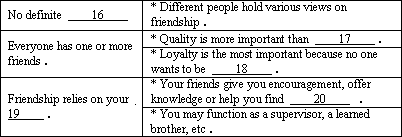
Section B
We often say, “A friend in need is a friend indeed.” But what is the exact meaning of friendship? No one can really offer a definite concept, because different people hold various views on friendship.
Everyone has his own friendship and some have a lot of friends.But in fact, quantity is not so important as quality.Loyalty is the most important for friendship.No one wants to make friends with those who will betray them.
No matter whether you are married or not, no matter where you live and work, your friends are your friends.It is not based on bloodline.It relies on your intention.To you, some friends are fun-loving, some give encouragement, some offer knowledge, and others help you to find your own identity.Before your friends, you may act as a supervisor, a learned brother, a lovely child, a gentleman or a playmate.In a word, friendship helps you to be a full person.So friendship can benefit.
Keys: