网址:http://m.1010jiajiao.com/timu3_id_3060152[举报]
听力(共两节,满分20分)
第一节(共5小题;每小题1分,满分5分)
听下面5段对话。每段对话后有一个小题,从题中所给的A、B、C三个选项中选出最佳选项。听完每段对话后,你都有10秒钟的时间来回答有关小题和阅读下一小题。每段对话仅读一遍。
1.What will the woman have?
A.Some coffee.
B.Some dessert.
C.An after-dinner drink.
2.What day is it today?
A.Saturday.
B.Sunday.
C.Monday.
3.What does the woman suggest the man do with his arm?
A.Put ice on it.
B.Put it in cold water.
C.Tie it with a bandage
4.Where are the speakers probably?
A.On a farm.
B.In a supermarket.
C.At home.
5.What season is it now?
A.Spring.
B.Autumn.
C.Winter.
第二节(共15小题;每小题1分,满分15分)
听下面5段对话或独白。每段对话或独白后有几个小题,从题中所给的A B C三个选项中选出最佳选项。听每段对话或独白前,你将有时间阅读各个小题,每小题5秒钟;听完后,各小题将给出5秒钟的作答时间。每段对话或独白读两遍。
听第6段材料,回答第6至8题。
6.When will the woman see the movie?
A.On Sunday.
B.On Saturday.
C.On Friday
7.Where will the woman’s seats be?
A.At the back.
B.In the front.
C.In the middle.
8.How much does each ticket cost?
A.$6.
B.$8.
C.$12
听第7段材料,回答第9至11题。
9.What is Greg Hunter’s phone number?
A.555-1234.
B.555-2134.
C.555-1243.
10.What does the woman mainly worry about?
A.Her age.
B.Her health.
C.The cost.
11.What does the man suggest the woman should do?
A.Walk faster.
B.Take the subway.
C.Go swimming.
听第8段材料,回答第12至14题。
12.What does the girl say about her parents?
A.They are much concerned about her.
B.They often show her off to their friends
C.They don’t allow her to do whatever she wants.
13.What do we know about the girl?
A.She gets on well with her parents.
B.She envies the boy.
C.She studies very well.
14.What does the boy say about his parents?
A.They care too much about him
B.They often argue with him.
C.They trust him completely
听第9段材料,回答第15至17题。
15.How many people does the man mention?
A.2.
B.3.
C.4.
16.What is the thief doing?
A.Stealing a picture.
B.Standing near a bank.
C.Pushing a big shopping bag.
17.What does the woman ask the man to do?
A.Arrest the thief.
B.Ask someone for help.
C.Watch out for the thief.
听第10段材料,回答第18至20题。
18.How many days does the speaker spend with her parents together a week?
A.One.
B.Two.
C.Three.
19.Why did the speaker fight with her brothers last week?
A.They didn’t do their homework.
B.They ruined her homework.
C.They stopped her doing her homework.
20.Who suggested the speaker talk with her brothers?
A.Her mother.
B.Her father.
C.Her teacher.
听力(共三节,满分
30分)第一节
(共5小题;每小题1.5分,满分7.5分)听下面
5段对话。每段对话后有一个小题,从题中所给的A、B、C三个选项中选出最佳选项。听完每段对话后,你都有10秒钟的时间来回答有关小题和阅读下一小题。每段对话仅读一遍。1.What does the woman ask the man to do?
A.Take her to the Smith Hotel.
B.Show her the way to the Smith Hotel.
C.Show her the way to the hospital.
2.What does the woman want to do?
A.Open the door.
B.Let the man in.
C.Open the window.
3.What will the woman help the man to do?
A.Carry some books.
B.Pick up some books.
C.Buy some books.
4.What do the man’s parents usually do in the evening?
A.Do some shopping.
B.Watch TV.
C.Do some reading.
5.Why couldn’t the woman get through to the man?
A.His mobile had been stolen.
B.His mobile wasn’t working.
C.His mobile was power off.
第二节
(共12小题;每小题1.5分,满分18分)听下面
4段对话,每段对话或独白后有几个小题,从题中所给的A、B、C三个选项中选出最佳选项。听每段对话前,你将有时间阅读各个小题,每小题5秒钟,听完后,各小题将给出5秒钟的作答时间,每段对话读两遍。请听第
6段材料,回答第6至7题。6.What will the two speakers do tomorrow morning?
A.Invite Mr.Green to dinner.
B.Visit Mr.Green’s new house.
C.Go to see their parents.
7.What will the man do tomorrow afternoon?
A.Do some writing.
B.Go swimming.
C.Go fishing.
请听第
7段材料,回答第8至10题。8.What does the man want to drink?
A.Water.
B.Tea.
C.Coffee.
9.What is the man doing?
A.Watching TV.
B.Writing some reports.
C.Listening to the radio.
10.When does this conversation take place?
A.Late at night.
B.In the afternoon.
C.In the morning.
请听第
8段材料,回答第11至14题。11.What is the relationship between the two speakers?
A.Manager and secretary.
B.Husband and wife.
C.Neighbours.
12.Why did the man’s classmates come to Guangzhou?
A.To attend a meeting.
B.To visit the city.
C.To see the man.
13.What did the man ask his classmates to do at first?
A.He invited them to dinner in a hotel.
B.He asked them to go shopping with him.
C.He invited them to have a chat in his office.
14.What does the woman suggest doing?
A.Preparing some more food for them.
B.Showing them around the whole city.
C.Treating the two classmates at home.
请听第
9段材料,回答第15至17题。15.How did Charles Dickens earn most of his money?
A.By writing novels.
B.By his reading tours.
C.By acting.
16.How long did his tour of America last?
A.Three weeks.
B.Three months.
C.Three years.
17.What was his last performance?
A.David Copperfield.
B.The Mystery of Edwin Drood.
C.Oliver Twist.
第三节
(共3小题;每小题1.5分,满分4.5分)听下面一段材料,将第
18至第20三个小题的信息补充完整,每空限填一个词或一个数。听材料前,你将有时间阅读各个小题,每小题5秒钟;听完后,各小题将给出5秒钟的作答时间。本段材料读两遍。听第
10段材料,回答第18至20题。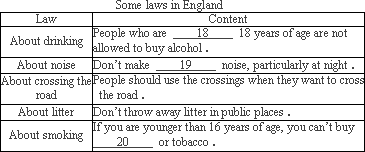
When we found him, he was a sorry sight. His clothes were torn, his hands bleeding. Before we reached him, we saw him fall. He lay a moment. Then he pulled himself to his feet, walked unsteadily a few yards through the woods and fell again.
After we got him out, we went back to find the gun that he had thrown down. His tracks showed that for two days he had circled in the forest, within 200 yards of the road. His senses were so dulled by fear and tiredness that he did not hear the cars going by or see the lights at night.
We found him just in time.
This man, like others before him, had simply been frightened when he knew he was lost. What had been a near disaster might have turned out as only a pleasant walk, if he had made a few preparations before he stepped from the highway or off a known path.
Whatever sense of direction that a man may have, it’s still largely a question of observation. A skilled woodsman always keeps an eye on his surroundings. He notes the shape of a mountain, the direction water flows through a swamp, and the way a tree leans across a path. With these in mind, he is still likely to turn around many times, but he is seldom lost.
There are exceptions, of course, and once in a while a man does come across some strange problem that puts him into the “lost” situation. A rainstorm or sudden blizzard may catch him without a compass in his pocket. Darkness may find him in a rough area, where travel is dangerous without a light.
When this happens, the normal first reaction is the fear of being laughed at as a result of his poor knowledge in the woods. He may also be concerned about the inconvenience that he will cause his friends when he doesn’t show up. This false pride may lead him to keep on the move in a false effort to find his way against all difficulties.
The person who thinks ahead is seldom in great danger. He’ll be safe if he observes carefully, thinks ahead, and remains calm.
The writer suggested that if the man had not been found, he would have ______.
A.been shot by a gun B.become confused
C.been attacked by wild animals D.been in great danger
According to the text, if a person gets lost in the forest, at the very beginning, he would _____.
A.worry about being laughed at B.push himself to find his way out
C.feel it is convenient to ask for help from his friends D.feel sorry that he didn’t study hard enough
When a person tries to find his way in the woods, ________ is the most important.
A.intelligence B.observation C.direction D.chance
The writer tells the story of the lost man as an example of people who_______.
A.go into the woods by themselves B.don’t know how to signal for help properly
C.are frightened when they think they are lost D.keep their head when they are in trouble
查看习题详情和答案>>When we found him, he was a sorry sight. His clothes were torn, his hands bleeding. Before we reached him, we saw him fall. He lay a moment. Then he pulled himself to his feet, walked unsteadily a few yards through the woods and fell again.
After we got him out, we went back to find the gun that he had thrown down. His tracks showed that for two days he had circled in the forest, within 200 yards of the road. His senses were so dulled by fear and tiredness that he did not hear the cars going by or see the lights at night.
We found him just in time.
This man, like others before him, had simply been frightened when he knew he was lost. What had been a near disaster might have turned out as only a pleasant walk, if he had made a few preparations before he stepped from the highway or off a known path.
Whatever sense of direction that a man may have, it’s still largely a question of observation. A skilled woodsman always keeps an eye on his surroundings. He notes the shape of a mountain, the direction water flows through a swamp, and the way a tree leans across a path. With these in mind, he is still likely to turn around many times, but he is seldom lost.
There are exceptions, of course, and once in a while a man does come across some strange problem that puts him into the “lost” situation. A rainstorm or sudden blizzard may catch him without a compass in his pocket. Darkness may find him in a rough area, where travel is dangerous without a light.
When this happens, the normal first reaction is the fear of being laughed at as a result of his poor knowledge in the woods. He may also be concerned about the inconvenience that he will cause his friends when he doesn’t show up. This false pride may lead him to keep on the move in a false effort to find his way against all difficulties.
The person who thinks ahead is seldom in great danger. He’ll be safe if he observes carefully, thinks ahead, and remains calm.
1.The writer suggested that if the man had not been found, he would have ______.
|
A.been shot by a gun |
B.become confused |
|
C.been attacked by wild animals |
D.been in great danger |
2.According to the text, if a person gets lost in the forest, at the very beginning, he would _____.
|
A.worry about being laughed at |
B.push himself to find his way out |
|
C.feel it is convenient to ask for help from his friends |
D.feel sorry that he didn’t study hard enough |
3.When a person tries to find his way in the woods, ________ is the most important.
|
A.intelligence |
B.observation |
C.direction |
D.chance |
4.The writer tells the story of the lost man as an example of people who_______.
|
A.go into the woods by themselves |
B.don’t know how to signal for help properly |
|
C.are frightened when they think they are lost |
D.keep their head when they are in trouble |
查看习题详情和答案>>
1970 was the World Conservation Year. The United Nations wanted everyone to know that the world is in danger. They hoped that governments would act quickly to conserve nature. Here is one example of the problems. At one time there were 1,300 different plants, trees and flowers in Holland, but now only 860 remain. The others have been destroyed by modern man and his technology. We are changing the earth, the air, the water and everything that grows and lives. We can't live without these things. If we continue like this, we shall destroy ourselves.
What will happen in the future? Perhaps it is more important to ask “What must we do now?” The people who will be living in the world of tomorrow are the young people today. A lot of them know that conservation is necessary. Many are helping to save our world. They plant trees, build bridges across rivers in forests, and so on. In a small town in the United States a large group of girls cleaned the 11-kilometre-long banks of their river. Young people may hear about conservation through a record called “No One's Going to Change Our World”. It was made by the Scatles, Cliff Richard and other singers. The money from it will help to conserve wild animals.
(1) There are fewer plants, trees and flowers in Holland now because ________.
[ ]
A.there has been a lot of conservation in Holland
B.Holland does not need so many plants, trees and flowers
C.many plants, trees and flowers do not grow there any longer
D.some plants, trees and flowers are dangerous
(2) We shall destroy ourselves if we change ________.
[ ]
(3) What is the most important thing for us to do to save our world?
[ ]
A.We should plant more trees and flowers.
B.We should clean the banks of our rivers.
C.We should know what will happen in the future.
D.We should know what we must do and begin to do it now.
(4) “No One's Going to Change Our World” was ________.
[ ]
A.an important book published in 1970
B.an idea that nobody would accept
C.a record calling on people to conserve nature
D.a rule worked out by the United States
(5) What's the main idea of the passage?
[ ]
A.1970 was the World Conservation Year.
B.The United Nations wanted everyone to know that the world is in danger.
C.Conservation is necessary.
D.It is the young people who are helping to save our world.
查看习题详情和答案>>