网址:http://m.1010jiajiao.com/timu3_id_3054390[举报]
We have so many first days in our lives. First days are milestones(里程碑) in our lives. They 36 the beginning of a new experience or journey and they are also filled with 37 feelings. They can be a little frightening as we step into the unknown, but they can also inspire us as they give us fresh 38 for the future.
I want to share a 39 that perfectly shows this point. Trisha was told that 40 is the key to knowledge. She watched her older brother 41 he read his schoolbooks and could hardly 42 the day when she would learn to read.
But after Trisha 43 started school, she found that she was not able to understand words like the other boys and girls. However hard she 44 , she saw only confusion. Trisha 45 , the teacher and the other children laughing at her, and she began to believe that she was not 46 .
By the time Trisha entered the fifth grade, she had lost the 47 in herself. That was the year when she met Mr. Falker. He was 48 . He praised Trisha’s talents, and he wouldn’t tolerate the other children laughing at her. After some time, Mr. Falker 49 that Trisha didn’t know how to read, but he knew she could 50 some help.
He found an expert, and together they 51 with Trisha after school. They 52 her to understand words 53 one day Mr. Falker handed her a book and she could read it all by herself. She didn’t even notice the tears in his eyes.
This is a true story. The little girl is Patricia Polacco, a famous 54 , and Thank you Mr. Falker is the twenty-sixth book that she has written. Mr. Falker gave her a fresh new 55 and made a difference in her life.
【小题1】A. cause B. mark C. describe D. show
【小题2】A. absurd B. strange C. mixed D. strong
【小题3】A. blood B. evidence C. hope D. air
【小题4】A. belief B. story C. view D. concern
【小题5】A. reading B. speaking C. listening D. thinking
【小题6】A. before B. since C. as D. though
【小题7】A. look for B. wait for C. ask for D. wish for
【小题8】A. gradually B. mostly C. finally D. firmly
【小题9】A. breathed B. tried C. managed D. pressed
【小题10】A. took off B. stayed up C. kept on D. fell behind
【小题11】A. smart B. hard-working C. healthy D. easy-going
【小题12】A. memory B. balance C. chance D. confidence
【小题13】A. shy B. proud C. different D. strict
【小题14】A. doubted B. witnessed C. represented D. realized
【小题15】A. with B. besides C. including D. within
【小题16】A. sang B. worked C. danced D. chatted
【小题17】A. helped B. forced C. begged D. allowed
【小题18】A. when B. once C. until D. whether
【小题19】A. teacher B. writer C. expert D. guide
【小题20】A. school B. start C. home D. attention
查看习题详情和答案>>
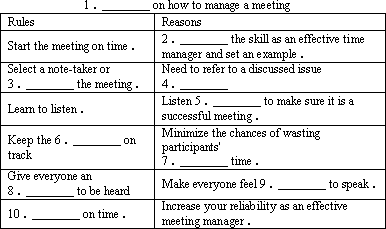
阅读下面短文,根据所读内容在表格中的空白处填入恰当的单词。注意:每个空格只填一个单词.
If you are asked to chair a meeting, remember the following six golden rules for meeting management.
1.Always start the meeting on time.If you begin on time, group members who show up late will realize the value of time.Beginning on time reflects the skill as an effective time manager and sets an example for others to follow.
2.Select a note-taker or arrange to have the meeting audio-taped.You may need to refer back to an issue that was discussed during the meeting at a later date.Good record-keeping is a sign of a good meeting manager as well.
3.Learn to listen.So many times we think we are going to say and, in the process, block out important points that other group members may be contributing.Additionally, we often hear only what we want to hear, rather than really listen to other people.Meetings that are characterized by effective listening are successful meetings.
4.Keep the discussion on track.Many times important issues can get sidetracked in a meeting, especially when everyone has a different opinion about the topic.If an unexpected conflict develops once the meeting is in progress, either appoint a subcommittee to look into the problem, or ask the participants involved in the conflict to meet with you after the meeting.Doing so will help keep the discussion on track and minimize(减少)the chances of wasting participants' time of great value.
5.Give everyone an opportunity to be heard.Some people tend to control meetings, whereas others wait to be asked their opinions.As the leader of the meeting, you need to keep an open mind and make sure everyone feels welcome to contribute and express ideas without criticism.
6.End on time.If you said the meeting would last no longer than one hour, make sure the meeting lasts for only one hour.Running late with a meeting makes members late for other appointments, increases the chances that the members will mentally leave the meeting and reduces your reliability as an effective meeting manager.
Despite all the reports of Internet security attacks over the years, including the recent ones on Google’s e-mail service, many people have reacted to the break-ins with a shrug(耸肩).
Mr. Shulman and his company examined a list of 32 million passwords that an unknown hacker stole last month from RockYou, a company that makes software for users of social networking sites like Facebook and MySpace. The list was briefly posted on the Web, and hackers and security researchers downloaded it.
The list provided an unusually detailed window into computer users’ password habits. Typically, only government agencies like the F.B.I. or the National Security Agency have had access to such a large password list.
Some Web sites try to keep back the attackers by freezing an account for a certain period of time if too many incorrect passwords are typed. But experts say that the hackers simply learn to trick the system, by making guesses at an acceptable rate, for instance.
To improve security, some Web sites are forcing users to mix letters, numbers and even symbols in their passwords. Others, like Twitter, prevent people from picking common passwords.
Still, researchers say, social networking and entertainment Web sites often try to make life simpler for their users and are reluctant to put too many controls in place.
Even commercial sites like eBay must weigh the consequences of freezing accounts, since a hacker could, say, try to win an auction(拍卖) by freezing the accounts of other potential buyers.
But owing to the reality of our overcrowded brains, the experts suggest that everyone choose at least two different passwords — a complex one for Web sites where security is vital, such as banks and e-mail, and a simpler one for less risky places, such as social networking and entertainment sites.
Mr. Moss relies on passwords at least 12 characters long, figuring that those make him a more difficult target than the millions of people who choose five- and six-character passwords.
“It’s like the joke where the hikers run into a bear in the forest, and the hiker that survives is the one who outruns his companions,” Mr. Moss said. “You just want to run that bit faster.
59. The underlined sentence “Many people have reacted to the break-ins with a shrug” shows that many people ______.
don’t take seriously the hacker’s break-ins
are worried and frightened at the hacker’s break-ins
don’t know what to do with the hacker’s attacks
are eager to get helps from the experts
60. According to the passage, which of the following web sites needs a more complex password?
A social web site.
An entertainment web site.
A commercial web site.
A government web site.
61. The Internet users are advised to______ in order to keep back the hackers.
mix letters, numbers and symbols as well
choose passwords with at least 12 characters
choose passwords with 5 or 6 characters
choose at least two different passwords
62. Which would be the best title for the passage?
Password, Simple or Complex?
Popular Passwords, High Risk!
Clever Hackers, Stupid Netizens.
Hacker, the Enemy of Internet Security.
Each child has his individual(个人的)pattern of social, as well as physical, development. Some of it depends on his home life and his relationships with the people who love him. Children in large families learn how to get along with others through normal brother- sister play and tussles (打斗). An only child, on the other hand , may have to learn his lessons in social living through hard experiences on the playground or in the classroom. Twins who always have one another to lean on may be slow in responding to others because they do not need anyone else.
A child who is constantly scolded and made to feel he does everything wrong may have a difficult time developing socially. He may be so afraid of displeasing the adults around him that he keeps to himself (where he can’t get into trouble)or he may take the opposite route and go out of his way to create trouble. Like the deserted child, he too may return to infantile (幼稚的)pleasures, developing habits that will satisfy him, but create barriers(障碍)toward social contact.
1.Which of the following may have effect on children’s paten of social development?
|
A.Age. |
B.Education |
C.Home life. |
D.Gender(性别) |
2.The passage implies that which of the following may have the earliest time learning to get along with others?
|
A.An only child |
|
B.A child from a large family |
|
C.Twins |
|
D.Children who are continually scolded |
3.Which of the following is implied by the passage?
|
A.Too much scolding of children may make their social development difficult. |
|
B.All children developed in the same ways. |
|
C.Children who are constantly scolded may learn to get along with others quickly. |
|
D.Deserted children often exhibit quicker social development. |
4.We can inferred from the passage that ________.
|
A.continual scolding is not harmful to the child. |
|
B.continual scolding holds back healthy social development. |
|
C.continual scolding has no effect on obeying orders. |
|
D.continual scolding has no effect on physical development |
5.Where does the passage say the only child learns his social lessons?
|
A.School and home |
B.Home and playground |
|
C.Classroom and playground |
D.All of the above |
查看习题详情和答案>>
In the very early 1800’ s, a young boy about 14 years old named John lived in an orphanage (孤儿院) in Old England along with several other children. Orphan meant unwanted and unloved.
Christmas was the one day of the year when the children didn’t work and received a gift, an orange. Usually they tried to taste and preserve it for so long that it often rotted before they ever peeled(剥开)it to enjoy the sweet juice. Many thought were expressed as Christmas time approached. The children would say, “I will keep mine the longest.” John usually slept with his next to his pillow. This year John was overjoyed by the Christmas season. He was becoming a man and stronger and soon he would be old enough to leave. He would save his orange until his birthday in July.
Christmas day finally came. The children were so excited as they entered the big dining hall. Immediately the master shouted, “John, leave the hall and there will be no orange for you this year.” John’s heart broke violently wide open. He turned and went swiftly back to the cold room. Then he heard the door open and each of the children entered. Little Elizabeth with her hair falling over her shoulders, a smile on her face, and tears in her eyes held out a piece of rag to John. “Here John,” she said, “this is for you.” As he lifted back the edges of the rag he saw a big juicy orange all peeled and quartered and then he realized what they had done.
John never forgot the sharing, love and personal sacrifice his friends had shown him that Christmas day. In memory of that day every year he would send oranges all over the world to children everywhere.
1. The first paragraph is mainly to tell us that ______.
A. John lived in the early 1800’ s B. John’s parents had died
C. John lived a hard life in an orphanage D. John lived with several other children
2. These children would be happiest when ______.
A. they got the special gift B. they preserved it very long
C. they finally enjoyed the sweet juice D. they entered the dining hall
3. What would overjoy John most the next year according to the second paragraph?
A. He placed his orange next to his pillow.
B. He would eat his orange on his birthday.
C. He wouldn’t get his special gift.
D. He would stay in the orphanage for another year
4. According to the text, where did John’s orange come from this year?
A. It was made up of what these children donated.
B. His master gave him a whole one again.
C. These children bought him one.
D. Little Elizabeth donated hers to John.
5. What can be inferred from the text?
A. John had expected he wouldn’t get the gift this year.
B. John knew why he didn’t get the gift this year.
C. John felt ashamed for not getting the special gift.
D. The story teaches us to learn to share with others.
查看习题详情和答案>>