网址:http://m.1010jiajiao.com/timu3_id_3013389[举报]
听力
第一节 听下面5段对话。每段对话后有一个小题,从题中所给的A、B、C三个选项中选出最佳选项。听完每段对话后,你都有10秒钟的时间来回答有关小题和阅读下一小题。每段对话仅读一遍。
1.What does the man mean?
A.He is willing to answer the question.
B.He is not interested in answering the question.
C.He refuses to answer the question.
2.Where does this conversation most probably take place?
A.In an operating room.
B.In a doctor’s office.
C.In a professor’s office.
3.What does the man mean?
A.He doesn’t know how to begin to write a play.
B.He isn’t sure what the first part is about.
C.He doesn’t understand the play at all.
4.What does the man say about the sandwiches?
A.He hasn’t eaten any sandwiches yet.
B.He thinks the first sandwich is better.
C.He’s too full to eat another sandwich.
5.What can we know about Judy?
A.She came to the party.
B.She planned to come but changed her mind ?later?.
C.She hasn’t appeared yet.
第二节
听下面5段对话或独白。每段对话或独白后有几个小题,从题中所给的A、B、C三个选项中选出最佳选项。听每段对话或独白前,你将有时间阅读各个小题,每小题5秒钟;听完后,各个小题将给出5秒钟的作答时间。每段对话或独白读两遍。
听第6段材料,回答第6~8题。
6.Where does the conversation take place?
A.At the man’s house.
B.At a hotel.
C.At a restaurant.
7.How long will the man stay there?
A.2 nights.
B.3 nights.
C.4 nights.
8.How much does the man have to pay?
A.$30.
B.$60.
C.$90.
听第7段材料,回答第9~11题。
9.What’s the girl’s trouble?
A.She can’t find a suitable job.
B.She can’t decide whether to go to university or get a job.
C.She wants to go to college but her parents don’t agree.
10.What do her parents want her to do?
A.To start working at once.
B.To wait until a proper time.
C.To study economics(经济学)at a university.
11.What might the girl do in the end?
A.Go to university.
B.Look for a job.
C.Study at home and depend on her parents.
听第8段材料,回答第12~14题。
12.Why was the man kept in hospital?
A.His left leg was broken.
B.He was seriously ill.
C.He had a car accident.
13.How did the accident happen?
A.Someone knocked into the back of his car.
B.He had drunk too much and lost his control.
C.He drove too fast.
14.Where was the man going that day?
A.The passage doesn’t tell us.
B.He was going home.
C.He was going to a party.
听第9段材料,回答第15~17题。
15.Why does Steven look unhappy?
A.He isn’t very well.
B.He has some trouble in his study.
C.He feels lonely in Britain.
16.What advice does his friend give him?
A.He should go out to parties.
B.He should go out to different places to speak to English people.
C.He should stay at home and practise a lot.
17.What can we learn from the dialogue?
A.Steven is a student, coming to Britain to study.
B.It is difficult to make friends with English people.
C.Steven is not interested in spoken English.
听第10段材料,回答第18~20题。
18.Why does the writer want to move away?
A.The area he lives in is too crowded and noisy.
B.His neighbors are too noisy at night.
C.His house is not big and new enough.
19.How long has he been looking for a new flat?
A.For seven years.
B.For more than a year.
C.For several months.
20.What does he think of the last flat the agent recommends(介绍)to him?
A.It is peaceful and quiet, just right for him.
B.He is not pleased with it at all.
C.It is still too noisy with a busy road on one side.
LISTENING COMPREHENSION(30 marks)
SECTION A(22.5 marks)
Directions:In this section, you "I1 hear six conversations between two speakers.For each conversation, there are several questions and each question is followed by three choices marked A, B and C.Listen carefully and then choose the best answer for each question.
You will hear each conversation TWICE.
Conversation 1
1.What is the probable relationship between the two speakers'?
A.Employer and employee.
B.Classmates.
C.Mother and son.
2.What can we know about the man?
A.He will graduate.
B.He will take an exam.
C.He will study in another school.
Conversation 2
3.Why was the woman worried when she first spoke English to a foreigner?
A.She thought her pronunciation was bad.
B.She thought she couldn't express herself clearly.
C.She thought she might make many mistakes.
4.Why did the foreigner not say anything at first when the woman talked with him'?
A.The foreigner was too worried.
B.The foreigner knew little English.
C.The foreigner was very patient.
Conversation 3
5.What can we learn from the conversation?
A.Jean earns much money.
B.Jean's husband is very fat.
C.Jean loves money so much.
6.What does the man speaker think of the woman speaker?
A.He thinks the woman works hard.
B.He thinks the woman will be very rich.
C.He thinks the woman is different from Jean.
Conversation 4
7.Where is Jack now?
A.In the prison.
B.In the hospital.
C.In the car.
8.What can we learn from the conversation?
A.Jack will be fined $ 500 for drunk driving.
B, The new law for drunk driving is tougher than before.
C.Jack knows little about the new law on drunk driving.
9.For how long can't Jack drive?
A.12 months
B.6 months.
C.8 months.
Conversation 5
10.What exercise does the boy do every morning?
A.Walking.
B.Playing bowling.
C.Running.
11.Where does the conversation probably take place?
A.In the classroom.
B.In the subway.
C.In the gym.
12.What does the girl advise the boy to do?
A.To do exercise every day.
B.To set his alarm for an earlier time.
C.To make a better plan for exercise.
Conversation 6
13.What's the weather like in the Caribbean?
A.Hot.
B.Warm.
C.Cool.
14.What problem did the woman meet when she was traveling in the Caribbean?
A.She had some language problems.
B.The clothes were expensive.
C.It was difficult to find a hotel.
15.Which of the following is cheap in the Caribbean?
A.Clothes.
B.Gold jewellery.
C.Toys.
SECTION B(7.5 marks)
Directions:In this section, you will hear a short passage.Listen carefully and then fill in the numbered blanks with the information you have heard.Fill in each blank with NO MORE THAN THREE WORDS.
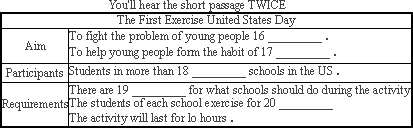
听力(共两节,满分20分)
第一节(共5小题;每小题1分,满分5分)
听下面5段对话。每段对话后有一个小题,从题中所给的A,B,C三个选项中选出最佳选项。听完每段对话后,你都有10秒钟的时间来回答有关小题和阅读下一小题。每段对话仅读一遍。
1.When does the conversation probably take place?
A.At 10:20
B.At 10:30
C.At 10:10
2.Where are the two speakers?
A.In a cinema
B.In a zoo
C.In a restaurant
3.When will the speakers meet?
A.Next Monday
B.On Sunday
C.Tomorrow
4.What happened to the woman?
A.A thief broke into her garden
B.One of her windows was broken
C.Some of her money was stolen.
5.Why is the man worried?
A.He doesn’t have a lot of money.
B.He doesn’t like to take bus.
C.He doesn’t have any small change.
第二节(共15小题;每小题1分,满分15分)
听下面5段对话或独白。每段对话或独白后有几个小题,从题中所给的A、B、C三个选项中选出最佳选项。听每段对话或独白前,你将有时间阅读各个小题,每小题5秒钟;听完后,每小题将给出5秒钟的作答时间。每段对话或独白读两遍。
听第6段材料,回答第6至8题。
6.Why was the woman unhappy?
A.She was sick
B.She had no time to write her composition.
C.She couldn’t think of a topic for her composition.
7.What did the man suggest to the woman?
A.Taking a trip.
B.Writing about her trip.
C.Trying to take some pictures.
8.How did the woman think about writing the composition after she heard the man’s suggestion?
A.Still very difficult.
B.All the same.
C.Easy.
听第7段材料,回答第9至11题。
9.Why does the Jack’s family plan to move?
A.His father has got a new job.
B.Their house is too small.
C.His school is far away from his home.
10.What do you know about Jack?
A.He is happy on hearing the news.
B.He doesn’t like a bigger house.
C.He doesn’t have his own bedroom.
11.Which of the following is TRUE?
A.They haven’t decided to move yet.
B.They have decided to move.
C.The have decided not to move.
听第8段材料,回答第12至14题。
12.Who caught the biggest fish?
A.Ben
B.Ben’s mother
C.Kathy
13.Why doesn’t Ben want fish for dinner?
A.He is not hungry.
B.He ate too much fish on his holiday.
C.His mother doesn’t want him to eat fish.
14.What does Ben the most interesting thing during the holiday/
A.Friday
B.Swimming
C.Eating
听第9段材料,回答第15至17题。
15.Why can the woman get the a job in China?
A.Because she speaks Chinese very well?
B.Because English is her mother tongue.
C.Because China is her motherland.
16.How many languages are spoken at the Olympics?
A.About 8.
B.About 18.
C.About 80
17.What job will the woman be able to do in China?
A.Announcer
B.Teacher
C.Translator.
听第10段材料,回答第18至20题。
18.How can you sometimes learn more about a person?
A.By talking with him.
B.By listening to him.
C.By watching him.
19.When is a person interested in listening to you?
A.When his eyes ayes are moving around.
B.When he is standing still.
C.When he is tapping his foot.
20.What can we learn from what the speaker said?
A.Signs can help you follow a speaker along.
B.A fast speaker often uses body language.
C.Signs are usually used on TV.
听力测试
听下面5段材料。每段材料后有几个小题,从题中所给的A、B、C三个选项中选出最佳选项。听每段材料前,你将有时间阅读各个小题,每小题5秒钟;听完后,各个小题将给出5秒钟的作答时间。每段材料读两遍。
听第1段材料,回答第1~3题。
W:Don’t you have any good news?
M:No.Yesterday, I had to stay after school, because I was talking during my biology teacher’s class.
W:You’d better keep quiet during class.
M:Sometimes I do.The day before yesterday, I was very quiet during my history teacher’s class and I still had to stay after class.
W:I don’t understand.
M:Because I fell asleep during his class, but it wasn’t my fault.The lesson was very dull.
W:I advise you to take school more seriously.If you don’t pass your exam, you’ll have to go out and work as a result.
M:I don’t see that it makes much difference.If I have a job, I have to do dull work every day, but if I’m in school I must listen to dull teachers every day.
1.What is the possible relationship between the man and woman?
A.Good friends.
B.Mother and son.
C.Teacher and student.
2.What did the boy often do at school?
A.He was often late for school.
B.He often fell asleep in class.
C.He often stayed after class.
3.Which of the following statements is true?
A.The boy prefers to go out and work.
B.The boy has neither interest in school nor in work.
C.The boy is discouraged because he hasn’t passed the exam.
听第2段材料,回答第4~6题。
M:How long have you been studying English?
W:For about six years.I started when I was ten.My teacher was from America.He was a very good teacher.I enjoyed studying English with him.
M:Are you still studying English?
W:Yes, I go to an evening school now.
M:How often do you have classes?
W:Twice a week usually.
M:Do you find English difficult?
W:Yes, it’s rather difficult, I think.Do I make many mistakes?
M:No, your English is very good.Do you often listen to the radio?
W:Yes, I listen to the radio every night.
M:Do you enjoy reading English books?
W:Yes, I read a lot of English books.But I prefer conversation.I like talking to foreigners.
4.How old is the girl?
A.Fifteen.
B.Sixteen.
C.Seventeen.
5.What does the woman think of the study of English?
A.Interesting.
B.Easy.
C.Hard.
6.What did the woman enjoy most?
A.Listening.
B.Writing.
C.Talking.
听第3段材料,回答第7~9题。
M:You look worried.Is anything the matter?
W:It’s my son.He hasn’t come home yet.I can’t understand him being so late.
M:Where’s he gone?
W:To visit a friend.I didn’t want him to go.I don’t like him going out at night.
M:Well, it isn’t very late.
W:It’s nine o’clock.I expected him to be back about eight.And it’s already dark.
M:Well…
W:I can just imagine him losing his way.Or falling off his bicycle.
M:Er…how old is your son?
W:Thirty-five.
7.Why does the woman look worried?
A.Her son has lost his way.
B.Her son hasn’t come back yet.
C.Her son has gone out at night.
8.Where has her son gone?
A.To school.
B.For a ride.
C.To visit a friend.
9.What do you think has happened to the woman’s son?
A.He has got lost.
B.He has fallen off his bicycle.
C.We don’t know.
听第4段材料,回答第10~12题。
W:We’re thinking about putting on a show this spring.
M:Do you think you’ll be able to make some money?
W:Oh, no, we just want to do it for the fun of it.You know there are a lot of us who like to get up a stage and perform.
M:What kind of show?
W:A musical play.
M:Have you decided who to do it?
W:We have three in mind, and of course we’ve been thinking about you.
M:Me? Why me?
W:You sing, don’t you? Everyone says you have a wonderful voice.
M:Well, I have sung a little, but I’ve never really appeared on a stage.
W:I thought you sang in church every Sunday.
M:That’s different.There are so many others singing too.
W:Then here’s your chance to find out how good you are.And not just to sing but to act and dance too.
M:Oh, it might be exciting.
10.What will they put on a show for?
A.For money.
B.For fun.
C.For others.
11.What can we conclude from the dialogue?
A.They want to put on three shows in all.
B.Three people will appear in the play.
C.They will sing three songs in the play.
12.What can we learn about the man?
A.He’ll sing and dance in the show.
B.He often gets up a stage.
C.He sings pop songs for money.
听第5段材料,回答第13~15题。
Now back to the news.
Ten people died yesterday morning when a boat sank off the Gold Sand Coast.Eight were able to swim to the shore and were saved by the coast guard.The boat was on its way to Beill Island.
Police are looking for a man and a woman in their early twenties who broke into a bank in the early hours this morning.This was reported by people working in the shop opposite who heard the breaking of glass.Two people were seen running away.The man is said to be very well-built, with dark hair which is very long.The woman with him is said to be small with short hair cut very close to her head.She was wearing blue trousers and a brown jacket.Anyone who has any information please gives further details to the police.
13.What were the eight people doing after the boat sank?
A.Saving the others.
B.Swimming to the shore.
C.Helping the captain.
14.When did the robbers break into the bank?
A.In the afternoon.
B.At midnight.
C.Early in the morning.
15.What was said about the man?
A.Tall and strong.
B.Strong with long hair.
C.Fat and well built.
听力(共两节、满分30分)
第一节(共5小题,每小题1.5分,满分7.5分)
听下面5段对话,每段对话后有一个小题,从题中所给的A、B、C三个选项中选出最佳选项。听完每段对话后,你都有10秒钟的时间来回答有关小题和阅读下一小题。每段对话仅读一遍。
1.Who is the shortest of the three?
A.Sam
B.Jack
C.Steve
2.How soon will the man’s cousin get to the station?
A.In five minutes.
B.In fifteen minutes.
C.In twenty minutes.
3.Why does the woman hate sea-journey?
A.Because she prefers flying.
B.Because she gets seasick.
C.Because she is not good at sailor.
4.What time does the man think they should leave?
A.7∶25
B.7∶35
C.7∶37
5.Where are the two speakers possibly?
A.In an English class.
B.In a bookstore.
C.In a library.
第二节(共15小题:每小题1.5分,满分22.5分)
听下面5段对话或独白。每段对话或独白后有几个小题,从题中所给的A、B、C三个选项中选出最佳选项。听每段对话或独白前,你将有时间阅读各个小题,每小题5秒钟,听完后,各小题将给出5秒钟的作答时间。每段对话或独白读两遍。
听第6段材料,回答第6至7题。
6.What does David think of Emma’s neighborhood?
A.It is safe, but boring.
B.It is quiet and clean.
C.It is exciting, but dangerous.
7.What can we learn from the conversation?
A.Emma likes her neighborhood very much.
B.There is no crime in David’s neighborhood.
C.Emma lives in the neighborhood where all her friends live.
听第7段材料,回答第8至19题。
8.Why didn’t the woman want to go to the movies?
A.She had to review her lessons.
B.She had seen the movie before.
C.She didn’t want to see that movie.
9.Why did the woman feel nervous?
A.She never studied hard.
B.She needed more time to prepare.
C.This exam would be very difficult for her.
听第8段材料,回答第10至12题。
10.What’s the relationship between the two speakers?
A.They are close friends.
B.They are shop assistant and customer.
C.They are strangers.
11.Why did the man talk to the woman?
A.He wanted to buy a house.
B.He wanted to get a job.
C.He wanted to rent a flat.
12.How much will the man pay for the biggest one each year?
A.2,400 dollars.
B.3,000 dollars.
C.3,600 dollars.
听第9段材料,回答第13至16题
13.How did the woman keep in touch with her family?
A.By letters.
B.By computer.
C.By telephone.
14.What does the man suggest the woman do?
A.Learning how to use Internet.
B.Talking with people on line.
C.Making friends in the discussion group.
15.What is the man most interested in?
A.Discussing problems
B.Music.
C.Word processing
16.What is the woman going to do?
A.Ask the man to teach her how to use the computer.
B.Go and buy a computer.
C.Learn by herself how to use Internet.
听第10段材料,回答第17至20题。
17.How many kinds of pollution have been mentioned in this monologue(独白)?
A.Two
B.Three
C.Four
18.Which is the most serious pollution in today’s life?
A.Water pollution.
B.Noise pollution
C.Air pollution
19.Why must factories clean their water before it is drained away?
A.Because it will pollute our rivers and lakes.
B.Because it will give out unpleasant smell.
C.Because it can be used.
20.What have you learned from the passage?
A.We should eat less fish.
B.We should build fewer factories and make fewer cars.
C.We should help to fight pollution.