网址:http://m.1010jiajiao.com/timu3_id_3010609[举报]
A strong wind can be a dangerous thing — sometimes it is powerful enough to knock you off your feet. But to plants, the wind is a source of new life, carrying them or their spores (孢子) thousands of miles.
A NASA satellite called QuikSCAT has discovered highways of wind over the Earth's oceans. Scientists believe these invisible roads may explain why many nonflowering plants, such as mosses (苔) and lichens (地衣), grow where they do.
The satellite is able to send microwaves (微波) from space to the surface of the ocean. The pattern of signals that come back shows which way the winds are blowing.
Using this data, the scientists studied a group of islands in the southern hemisphere (半球), near Antarctica.Winds tend to blow anticlockwise (逆时针) in this region, but there are lots of local differences.
When the researchers compared these local patterns to botanical (植物学) data, they found that the wind had an important effect on where species of mosses, lichens, and other nonflowering plants grow.
For example, Bouvet Island and Heard Island, share 30 per cent of their moss species, 29 per cent of liverworts (叶苔), and 32 per cent of lichens — even though they are 4,430 kilometers apart. In contrast, Gough Island and Bouvet Island, separated by just 1,860 kilometers of sea, share only 16 per cent of mosses and 17 per cent of liverworts. They have no lichens in common.
Ferns (蕨类植物) and flowering plants don't travel as well in the wind, so they don't show the same kinds of distribution (分布) patterns.
This story is about _____.
A.the discovery of wind highways B.how wind travels
C.how wind affects different plants D. one function of the wind
The underlined word "data" in the fourth paragraph means _____.
A.signal B.pattern C.information D. research
Which of the following is wrong?
A.Bouvet Island, Heard Island and Gough Island are all in the southern hemisphere.
B.Winds in the researched area blow anti-clockwise.
C.The scientists shouldn't base this research on how winds affect where ferns grow.
D. Without the discovery of QuikSCAT, the research wouldn't have made sense.
Which of the following diagrams shows the correct position of the islands?
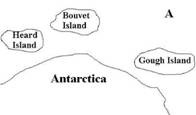
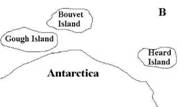
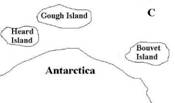
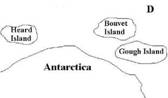
A strong wind can be a dangerous thing-sometimes it is powerful enough to knock you off your feet.But to plants,the wind is a source of new life,carrying them or their spores(孢子)thousands of miles.
A NASA satellite called QuikSCAT has discovered highways of wind over the Earth's oceans.Scientists believe these invisible roads may explain why many nonflowering plants,such as mosses(苔藓)and lichens(地衣),grow where they do.
The satellite is able to send microwaves(微波)from space to the surface of the ocean.The pattern of signals that come back shows which way the winds are blowing.
Using this data, the scientists studied a group of islands in the southern hemisphere(半球),near Antarctica.Winds tend to blow anticlockwise(逆时针)in this region,but there are lots of local differences.
When the researchers compared these local patterns to botanical(植物学)data,they found that the wind had an important effect on where species of mosses,lichens,and other nonflowering plants grow.
For example,Bouvet Island and Heard Island,share 30 percent of their moss species,29 percent of liverworts(叶苔),and 32 percent of lichens-even though they are 4,430 kilometers apart.In contrast,Gough Island and Bouvet Island,separated by just 1,860 kilometers of sea,share only 16 percent of mosses and 17 percent of liverworts.They have no lichens in common.
Ferns(蕨类植物)and flowering plants don't travel as well in the wind,so they don't show the same kinds of distribution(分布)patterns.
67.This story is about .
A.the discovery of wind highways B.how wind travels
C.how wind affects different plants D.one of the wind
68.The underlined word “data” in the fourth paragraph means .
A.signal B.pattern C.information D.research
69.Which of the following is WRONG?
A.Bouvet Island,Heard Island and Gough Island are all in the southern hemisphere.
B.Winds in the researched areas blow anticlockwise.
C.The scientists needn't base this research on how winds affect where ferns grow.
D.Without the QuikSCAT,the research wouldn't have made sense.
70.Which of the following diagrams shows the correct position of the islands?

查看习题详情和答案>>
Foreign visitors are often puzzled in Japan because most streets there don’t have names. In Japan, people use landmarks in their directions instead of street names. For example, the Japanese will say to travelers, “Go straight down to the corner. Turn left at the big hotel and go pass a fruit market. The post office is across from the bus stop.”
In the countryside of the American Midwest, usually there are not many landmarks. There are no mountains, so the land is very flat(平坦的). In many places there are no towns or buildings within miles. Instead of landmarks, people will tell you directions and distance. In Kansas or Iowa, for example, people will say, “Go north two miles. Turn east, and then go another mile.”
People in Los Angeles, California, have no idea of distance on the map: They measure(测量) distance by means of time, not miles. “How far away is the post office?” you ask. “Oh,” they answer, “It’s about five minutes from here.” you say, “Yes, but how many miles away is it?” They don’t know.
People in Greece sometimes do not even try to give directions because visitors seldom(很少) understand the Greek language. Instead of giving you the direction, a Greek will often say, “Follow me.” Then he’ll lead you through the streets of the city to the post office.
Sometimes a person doesn’t know the answer to your question. What happens in this situation(情形)? A New Yorker might say, “Sorry, I have no idea.”But in Yucatan, Mexico, no one answers, “I don’t know.”People in Yucatan think that “I don’t know” is impolite. They usually give an answer, often a wrong one. A visitor can get very, very lost in Yucatan!
One thing will help you everywhere—in Japan, in the United States, in Greece, in Mexico, or in any other place. You might not understand a person’s words, by maybe you can understand his body language. He or she will usually turn and then point in the correct direction. Go in that direction, and you may find the post office!
1. The passage mainly tells us that __________.
A. never carry a map for travel
B. there are not many landmarks in the American Midwest
C. there are different ways to give directions in different parts of the world
D. New Yorkers often say, “I have no idea,” but people in Yucatan, Mexico, never say this
2.The passage says, “In Japan, people use landmarks in their directions.” The word “landmarks” means __________.
A. building names
B. street names
C. hotels, markets and bus stops
D. buildings or places which are easily recognized
3. In which place do people tell distance by means of time?
A. Japan.
B. American Midwest.
C. Los Angeles, California.
D. Greece.
4. In the passage, __________ countries are mentioned by the writer.
A. seven B. four C. eight D. five
5. Which of the following is wrong?
A. Travelers can learn about people’s customs by asking questions about directions.
B. A person’s body language can help you understand directions.
C. People in some places give directions in miles, but people in other places give directions by means of time.
D. People in different places always give directions in the same way: They use street names.
查看习题详情和答案>>
I have a rule for travel: Never carry a map. I prefer to ask for directions(方向).
Foreign visitors are often puzzled in Japan because most streets there don’t have names. In Japan, people use landmarks in their directions instead of street names. For example, the Japanese will say to travelers, “Go straight down to the corner. Turn left at the big hotel and go pass a fruit market. The post office is across from the bus stop.”
In the countryside of the American Midwest, usually there are not many landmarks. There are no mountains, so the land is very flat(平坦的). In many places there are no towns or buildings within miles. Instead of landmarks, people will tell you directions and distance. In Kansas or Iowa, for example, people will say, “Go north two miles. Turn east, and then go another mile.”
People in Los Angeles, California, have no idea of distance on the map: They measure(测量) distance by means of time, not miles. “How far away is the post office?” you ask. “Oh,” they answer, “It’s about five minutes from here.” you say, “Yes, but how many miles away is it?” They don’t know.
People in Greece sometimes do not even try to give directions because visitors seldom(很少) understand the Greek language. Instead of giving you the direction, a Greek will often say, “Follow me.” Then he’ll lead you through the streets of the city to the post office.
Sometimes a person doesn’t know the answer to your question. What happens in this situation(情形)? A New Yorker might say, “Sorry, I have no idea.”But in Yucatan, Mexico, no one answers, “I don’t know.”People in Yucatan think that “I don’t know” is impolite. They usually give an answer, often a wrong one. A visitor can get very, very lost in Yucatan!
One thing will help you everywhere—in Japan, in the United States, in Greece, in Mexico, or in any other place. You might not understand a person’s words, by maybe you can understand his body language. He or she will usually turn and then point in the correct direction. Go in that direction, and you may find the post office!
1. The passage mainly tells us that __________.
A. never carry a map for travel
B. there are not many landmarks in the American Midwest
C. there are different ways to give directions in different parts of the world
D. New Yorkers often say, “I have no idea,” but people in Yucatan, Mexico, never say this
2.The passage says, “In Japan, people use landmarks in their directions.” The word “landmarks” means __________.
A. building names
B. street names
C. hotels, markets and bus stops
D. buildings or places which are easily recognized
3. In which place do people tell distance by means of time?
A. Japan.
B. American Midwest.
C. Los Angeles, California.
D. Greece.
4. In the passage, __________ countries are mentioned by the writer.
A. seven B. four C. eight D. five
5. Which of the following is wrong?
A. Travelers can learn about people’s customs by asking questions about directions.
B. A person’s body language can help you understand directions.
C. People in some places give directions in miles, but people in other places give directions by means of time.
D. People in different places always give directions in the same way: They use street names.
查看习题详情和答案>>
Can you believe your eyes? A recent experiment suggests that the answer to that question may depend on your age.
Martin Doherty, a psychologist at the University of Stirling in Scotland, led the team of scientists. In this experiment, Doherty and his team tested the perception(观察力) of some people, using pictures of some orange circles. The researchers showed the same pictures to two groups of people. The first group included 151 children aged 4 to 10, and the second group included 24 adults aged 18 to 25.
The first group of pictures showed two circles alone on a white background. One of the circles was larger than the other, and these people were asked to identify the larger one. Four-year-olds identified the correct circle 79 percent of the time. Adults identified the correct circle 95 percent of the time.
Next, both groups were shown a picture where the orange circles, again of different sizes, were surrounded by gray circles. Here’s where the trick lies in. In some of the pictures, the smaller orange circle was surrounded by even smaller gray circles — making the orange circle appear larger than the other orange circle, which was the real larger one. And the larger orange circle was surrounded by even bigger gray circles — so it appeared to be smaller than the real smaller orange circle.
When young children aged 4 to 6 looked at these tricky pictures, they weren’t fooled — they were still able to find the bigger circle with roughly the same accuracy as before. Older children and adults, on the other hand, did not do as well. Older children often identified the smaller circle as the larger one, and adults got it wrong most of the time.
As children get older, Doherty said, their brains may develop the ability to identify visual context. In other words, they will begin to process the whole picture at once: the tricky gray circles, as well as the orange circle in the middle. As a result, they’re more likely to fall for this kind of visual trick.
Doherty and his team of scientists did an experiment to evaluate .
A.children’s and adults’ eye-sight
B.people’s ability to see accurately
C.children’s and adults’ brains
D.the influence of people’s age
When asked to find the larger circle, .
A.children at 6 got it wrong 79 % of the time with no gray ones around
B.only adults over 18 got it right 95% of the time with gray ones around
C.children at 4 got it right about 79 % of the time with gray ones around
D.adults got it right most of the time with gray ones around
According to the passage, we can know that .
A.a smaller orange circle appears bigger on a white background
B.an orange circle appears bigger than a gray one of the same size
C.a circle surrounded by other circles looks bigger than its real size
D.a circle surrounded by bigger ones looks smaller than its real size
Visual context may work when children get older than .
A.4 B.6 C.10 D.18
Why are younger children not fooled?
A.Because they are smarter than older children and adults.
B.Because older people are influenced by their experience.
C.Because people’s eyes become weaker as they grow older.
D.Because their brain can hardly notice related things together.
查看习题详情和答案>>