网址:http://m.1010jiajiao.com/timu3_id_3006812[举报]
One day a very wealthy father took his son on a trip to the country with the firm purpose of showing his son how poor people can be.
They spent a couple of days and nights on the farm of 36 would be considered a very poor family. On their return from their 37 , the father asked his son, “How was the trip?”
“It was 38 , Dad.”
“Did you see how poor people can be?” the father asked.
“Oh yeah?” said the son.
“So what did you 39 from the trip?” asked the father.
The son answered, “I saw that we have one dog 40 they have four. We have a pool that 41 to the middle of our garden and they have a river that has 42 end. We have imported lanterns in our garden and they have the 43 at night. Our patio (露台) reaches to the front yard and they have the 44 horizon(地平线). We have a small piece of land to live on and they have fields that go 45 our sight. We have servants who serve us, but they serve 46 . We buy our food, but they grow theirs. We have 47 around our property to protect us but they have friends to protect them.”
With this the boy’s father was 48 .
Then his son added, “Dad, thank you for showing me how 49 we are.”
Too many times we 50 what we have and concentrate on what we don’t have. What is one person’s 51 object is another’s prize possession(财产). It is all 52 on one’s opinion. Think about what would happen if we all gave 53 for what we have, 54 worrying about what we don’t have.
Be thankful for every single thing in your life, exactly as it is now – and 55 your friends. Be sure to take the time to express your appreciation and gratitude for the people whom you are closed with.
36. A. which B. that C. what D. how
37. A. trip B. town C. house D. friend
38. A. shameful B. disappointing C. excited D. great
39. A. suffer B. regret C. keep D. learn
40. A. because B. and C. so D. when
41. A. reaches B. gets C. arrives D. flows
42. A. much B. no C. some D. other
43. A. lights B. darkness C. stars D. nothing
44. A. smooth B. full C. all D. whole
45. A. through B. within C. beyond D. at
46. A. themselves B. employers C. customers D. us
47. A. dogs B. walls C. soldiers D. servants
48. A. discouraged B. satisfied C. delighted D. speechless
49. A. poor B. wealthy C. sorry D. moved
50. A. miss B. forget C. remember D. consider
51. A. valuable B. useful C. priceless D. worthless
52. A. based B. concentrated C. looked D. laid
53. A. love B. regret C. thanks D. interests
54. A. more than B. or else C. instead of D. nothing but
55. A. especially B. besides C. specially D. except
查看习题详情和答案>>
One day an American friend invited me to a party. It wasn’t a real party, it was some kind of informal get-together. Since it was summer time, he had a cookout where most of his American friends and relatives were known to me, but there were others I had never met before.
It was the most embarrassing (令人尴尬) party for me when I noticed that everybody was wearing jeans and simple T-shirts for the day, while I arrived in proper dress with my shoes and my hair all fixed for a fancy party. It was hard to explain my embarrassment to other guests. When one of them turned around and said, “What nice clothes! What’s the occasion?” I felt my face burning hot with embarrassment. I did not answer at all. If she knew how bad I already felt, she wouldn’t have come near me. But she did. Maybe she didn’t ask intentionally to make me feel bad or uncomfortable, but my reaction had to do with the way I already felt. I could have told her I had to go to another party afterwards, but I did not want to continue the conversation.
Many times I thought about going home and changing, but I knew that they would notice. It would be even worse for me, because I knew they would quickly think that I felt out of place. So I wanted to pretend that I was okay…
I had already realized their customs were different from mine; but after I talked to my friend, I was more convinced that people here are more casual (休闲的,随意的). They care less about formality, unless it is a special occasion, like a wedding or a very formal invitation.
In contrast, my culture is totally the opposite. For instance, in
After all, I think that my problem at the party wasn’t that I wasn’t accepted by the Americans; but my feeling was so bad that I couldn’t fit in the group even if nobody noticed, because I was the one who discovered the difference in the first place. It doesn’t matter if people dress differently, but I was the only one different in the group. I felt I was the one who should adjust to their customs. After that, I decided to learn more about American culture, so now I don’t have as many problems as I’ve had in the past.
61.Which of these statements describes the cookout in the story?
A. It was very formal. B. People wore casual clothing.
C. It took place in a restaurant. D. People care more about formality.
62.This story is mainly about _________.
A. culture differences B. living in the
C. what to do at a cookout D. how to get prepared for a cookout
63.It can be inferred from the story that the author _________.
A. left the cookout early B. probably didn’t enjoy the cookout
C. never wears blue jeans D. will never go to a cookout
64.Which of the following can replace the underlined word “intentionally” in the second paragraph?
A. Patiently. B. Willingly. C. Carefully. D. On purpose.
查看习题详情和答案>>One day an American friend invited me to a party. It wasn’t a real party, it was some kind of informal get-together. Since it was summer time, he had a cookout where most of his American friends and relatives were known to me, but there were others I had never met before.
It was the most embarrassing (令人尴尬) party for me when I noticed that everybody was wearing jeans and simple T-shirts for the day, while I arrived in proper dress with my shoes and my hair all fixed for a fancy party.It was hard to explain my embarrassment to other guests.When one of them turned around and said, “What nice clothes! What’s the occasion?” I felt my face burning hot with embarrassment. I did not answer at all. If she knew how bad I already felt, she wouldn’t have come near me.But she did. Maybe she didn’t ask intentionally to make me feel bad or uncomfortable, but my reaction had to do with the way I already felt.I could have told her I had to go to another party afterwards, but I did not want to continue the conversation.
Many times I thought about going home and changing, but I knew that they would notice.It would be even worse for me, because I knew they would quickly think that I felt out of place.So I wanted to pretend that I was okay…
I had already realized their customs were different from mine; but after I talked to my friend, I was more convinced that people here are more casual (休闲的,随意的).They care less about formality, unless it is a special occasion, like a wedding or a very formal invitation.
In contrast, my culture is totally the opposite.For instance, in Cape Verdean culture, if a friend invited me to his house on a special day, even if it is not a real party, one should appear well dressed or otherwise the host will be annoyed thinking you are disrespectful to him or the other guests.We do dress casually for going on picnic or on ordinary days, but not normally to go over to a friend’s when invited, especially if other people will be there.
After all, I think that my problem at the party wasn’t that I wasn’t accepted by the Americans; but my feeling was so bad that I couldn’t fit in the group even if nobody noticed, because I was the one who discovered the difference in the first place.It doesn’t matter if people dress differently, but I was the only one different in the group.I felt I was the one who should adjust to their customs.After that, I decided to learn more about American culture, so now I don’t have as many problems as I’ve had in the past.
1.Which of these statements describes the cookout in the story?
A.It was very formal. B.People wore casual clothing.
C.It took place in a restaurant. D.People care more about formality.
2.This story is mainly about _________.
A.culture differences B.living in the United States
C.what to do at a cookout D.how to get prepared for a cookout
3.It can be inferred from the story that the author _________.
A.left the cookout early B.probably didn’t enjoy the cookout
C.never wears blue jeans D.will never go to a cookout
4.Which of the following can replace the underlined word “intentionally” in the second paragraph?
A.Patiently. B.Willingly. C.Carefully. D.On purpose.
查看习题详情和答案>>One day an American friend invited me to a party. It wasn’t a real party, it was some kind of informal get-together. Since it was summer time, he had a cookout where most of his American friends and relatives were known to me, but there were others I had never met before.
It was the most embarrassing (令人尴尬) party for me when I noticed that everybody was wearing jeans and simple T-shirts for the day, while I arrived in proper dress with my shoes and my hair all fixed for a fancy party. It was hard to explain my embarrassment to other guests. When one of them turned around and said, “What nice clothes! What’s the occasion?” I felt my face burning hot with embarrassment. I did not answer at all. If she knew how bad I already felt, she wouldn’t have come near me. But she did. Maybe she didn’t ask intentionally to make me feel bad or uncomfortable, but my reaction had to do with the way I already felt. I could have told her I had to go to another party afterwards, but I did not want to continue the conversation.
Many times I thought about going home and changing, but I knew that they would notice. It would be even worse for me, because I knew they would quickly think that I felt out of place. So I wanted to pretend that I was okay…
I had already realized their customs were different from mine; but after I talked to my friend, I was more convinced that people here are more casual (休闲的,随意的). They care less about formality, unless it is a special occasion, like a wedding or a very formal invitation.
In contrast, my culture is totally the opposite. For instance, in Cape Verdean culture, if a friend invited me to his house on a special day, even if it is not a real party, one should appear well dressed or otherwise the host will be annoyed thinking you are disrespectful to him or the other guests. We do dress casually for going on picnic or on ordinary days, but not normally to go over to a friend’s when invited, especially if other people will be there.
After all, I think that my problem at the party wasn’t that I wasn’t accepted by the Americans; but my feeling was so bad that I couldn’t fit in the group even if nobody noticed, because I was the one who discovered the difference in the first place. It doesn’t matter if people dress differently, but I was the only one different in the group. I felt I was the one who should adjust to their customs. After that, I decided to learn more about American culture, so now I don’t have as many problems as I’ve had in the past.
1.Which of these statements describes the cookout in the story?
A.It was very formal. B.People wore casual clothing.
C.It took place in a restaurant. D.People care more about formality.
2.This story is mainly about _________.
A.culture differences B.living in the United States
C.what to do at a cookout D.how to get prepared for a cookout
3.It can be inferred from the story that the author _________.
A.left the cookout early B.probably didn’t enjoy the cookout
C.never wears blue jeans D.will never go to a cookout
4.Which of the following can replace the underlined word “intentionally” in the second paragraph?
A.Patiently. B.Willingly. C.Carefully. D.On purpose.
查看习题详情和答案>> 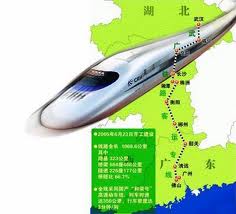
 Imagine, one day,getting out of bed in Beijing and being at your office in Shanghai in only a couple of hours,and then,after a full day of work,going back home to Beijing and having dinner there.
Sounds unusual,doesn't it? But it's not that unrealistic,with the development of China’s high-speed railway system.And that’s not all.China has an even greater high-speed railway plan — to connect the country with Southeast Asia,and eventually Eastern Europe.
China is negotiating to extend its own high-speed railway network to up to 17 countries in 10 to 15 years,eventually reaching London and Singapore.
China has proposed three such projects.The first would possibly connect Kunming with Singapore via Vietnam and Malaysia.Another could start in Urumqi and go through Kazakhstan and Uzbekistan,and possibly to Germany.The third would start in the northeast and go north through Russia and then into Western Europe.
If China’s plan for the high-speed railway goes forward,people could zip over from London to Beijing in under two days.
The new system would still follow China’s high-speed railway standard.And the trains would be able to go 346 kilometers an hour,almost as fast as some airplanes.
China’s bullet train(高速客车),the one connecting Wuhan to Guangzhou,already has the World’s fastest average speed.It covers 1,069 kilometers in about three hours.
Of course,there are some technical challenges to overcome.There are so many issues that need to be settled,such as safety,rail gauge(轨距),maintenance of railway tracks.So,it’s important to pay attention to every detail.
But the key issue is really money.China is already spending hundreds of billions of yuan on domestic railway expansion.
China prefers that the other countries pay in natural resources rather than with capital investment.Resources from those countries could stream into China to sustain development.
It’ll be a win-win project.For other countries,the railway network will definitely create more opportunities for business,tourism and so on,not to mention the better communication among those countries.
For China,such a project would not only connect it with the rest of Asia and bring some much-needed resources,but would also help develop China’s far west.We foresee that in the coming decades,millions of people will migrate to the western regions,where the land is empty and resources unused.With high-speed trains,people will set up factories and business centers in the west once and for all.And they’ll trade with Central Asian and Eastern European countries.
China’s new high-speed railway plan will be a win-win project because ________.
A.China will get much-needed resources and develop its western regions
B.China and the countries involved will benefit from the project in various ways
C.China will develop its railway system and communication with other countries
D.the foreign countries involved will develop their railway transportation, business and tourism
According to the passage,the greatest challenge to the new high-speed railway plan is ________.
A.technical issues B.safety of the system
C.financial problems D.maintenance of railway tracks
Which of the following words best describes the author’s attitude towards China’s high-speed railway plan?
A.Critical. B.Reserved. C.Doubtful. D.Positive.
Which of the following might be the best title for the passage?
A.New Railway Standards. B.Big Railway Dreams.
C.High-speed Bullet Trains. D.International Railway Network
查看习题详情和答案>>