网址:http://m.1010jiajiao.com/timu3_id_3002871[举报]
| |||||||||||||||||||||||||||||||||||||||||||||||||

| |||||||||||||||||||||||||||||||||||||||||||||||||

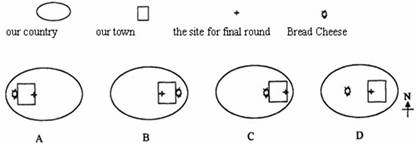
Our town is in the eastern part of our country.Once a year, we elect a girl to show how beautiful and great our town is.All the girls are eager to get this position in an effort to become popular.
It was not an easy choice this year, since there were eight girls to choose from.The elder judge finally decided that either Sara or May would get the position.Both girls were beautiful with extraordinary appearance.Besides, they had a good education and cared about how pollution had a bad effect on the earth.Most important, both girls got up early to eat eggs at their breakfast.Eggs were important to people of the east of our town because the economy here depended mainly on the production of eggs.
“Either girl will win,” my father said, “But someone will cry in the end.”
“Either will be fine,” I said, “They are both great girls.”
The final round was held at the east edge of our town.Sara lived nearby so she did not need to get up early to arrive.However, she was the first person there.“You know what they say about the early bird. ”she said with a smile.
However, May arrived fifteen minutes late to the competition.“It’s the taxi driver’s fault,” she said.“I told him to head east, but he was in one ear and thought I said Bread Cheese.You know, Bread Cheese is the name of our neighboring town.”
I thought May would certainly lose because she was late, but to my surprise, she turned out to be this year’s winner. The judges liked her answer to their last question, “If you could have anything in the world, what would it be?” Sara replied, “World peace.” May, on the other hand, said, “Better market to have our eggs sell well”.
1. Why was it difficult to make a choice this year?
A. Because the girls just looked alike.
B. Because people had to choose from eight girls.
C. Because all the girls liked eggs.
D. Because all the girls had a good education.
2. What does the underlined sentence “You know what they say about the early bird.” mean?
A. she liked the early bird very much.
B. she was sure that she would succeed.
C. she lived nearby, so she should get there early.
D. she wanted to show off her good language knowledge.
3. Why was May chosen in the end?
A. Because she arrived late and gave enough explanation.
B. Because she gave a different answer from Sara’s.
C. Because she looked more beautiful than Sara.
D. Because her answer was more practical than Sara’s.
4. According to the passage, which of the following maps is correct?
Dr Rajendra Pachauri, chair of the United Nations Intergovernmental Panel on Climate Change, said that people should then go on to reduce their meat consumption even further.
Pachauri, who was re-elected the panel’s chairman for a second six-year term last week, said diet change was important because of the huge greenhouse gas emissions (排放) and other environmental problems associated with raising cattle and other animals. “It was relatively easy to change eating habits compared to changing means of transport,” he said.
The UN’s Food and Agriculture Organisation has estimated that meat production accounts for nearly a fifth of global greenhouse gas emissions. These are produced during the production. For example, ruminants (反刍动物), particularly cows, give off a gas called methane, which is 23 times more effective as a global warming agent than CO2.
Pachauri can expect some opposite responses from the food industry to his advice, though last night he was given unexpected support by Masterchef presenter and restaurateur John Torode. “I have a little bit and enjoy it,” said Torode. “Too much for any person is bad. But there’s a bigger issue here: where the meat comes from. If we all bought British and stopped buying imported food, we’d save a huge amount of carbon emissions.”
Professor Robert Watson, the chief scientific adviser for the Department for Environment Food and Rural Affairs, said government could help educate people about the benefits of eating less meat, but it should not regulate. “Eating less meat would help, there’s no question about that,” Watson said.
However, Chris Lamb, head of marketing for pig industry group BPEX, said the meat industry had been unfairly targeted and was working hard to find out which activities had the biggest environmental impact and reduce them. “Some ideas were contradictory,” he said. “For example, one solution to emissions from cattle and other animals was to keep them indoors, but this would damage animal welfare. Climate change is a very young science and our view is there are a lot of simple solutions being proposed.”
- 1.
What is directly related to global warming?
- A.Consumption of meat.
- B.Growth of cattle.
- C.Methane from ruminants.
- D.Processing of meat.
- A.
- 2.
Who holds a view opposite to the others’ in the passage?
- A.Rajendra Pachauri.
- B.John Torode.
- C.Robert Watson.
- D.Chris Lamb.
- A.
- 3.
It is implied in the passage that _____.
- A.we should try to keep away from cattle
- B.ruminants should not be left outdoors
- C.the meat industry will soon close down
- D.we must do our duty to save the earth
- A.
- 4.
Which of the following might be the best title for the passage?
- A.Less meat, slower global warming
- B.More animals, more greenhouse gas
- C.Less imported food, better our environment
- D.Greater diet change, smaller climate change
- A.
“People should have one meat-free day a week if they want to make a personal and effective sacrifice that would help deal with climate change,” the world’s leading authority on global warming has told The Observer.
Dr Rajendra Pachauri, chair of the United Nations Intergovernmental Panel on Climate Change, said that people should then go on to reduce their meat consumption even further.
Pachauri, who was re-elected the panel’s chairman for a second six-year term last week, said diet change was important because of the huge greenhouse gas emissions (排放) and other environmental problems associated with raising cattle and other animals. “It was relatively easy to change eating habits compared to changing means of transport,” he said.
The UN’s Food and Agriculture Organisation has estimated that meat production accounts for nearly a fifth of global greenhouse gas emissions. These are produced during the production. For example, ruminants (反刍动物), particularly cows, give off a gas called methane, which is 23 times more effective as a global warming agent than CO2.
Pachauri can expect some opposite responses from the food industry to his advice, though last night he was given unexpected support by Masterchef presenter and restaurateur John Torode. “I have a little bit and enjoy it,” said Torode. “Too much for any person is bad. But there’s a bigger issue here: where the meat comes from. If we all bought British and stopped buying imported food, we’d save a huge amount of carbon emissions.”
Professor Robert Watson, the chief scientific adviser for the Department for Environment Food and Rural Affairs, said government could help educate people about the benefits of eating less meat, but it should not regulate. “Eating less meat would help, there’s no question about that,” Watson said.
However, Chris Lamb, head of marketing for pig industry group BPEX, said the meat industry had been unfairly targeted and was working hard to find out which activities had the biggest environmental impact and reduce them. “Some ideas were contradictory,” he said. “For example, one solution to emissions from cattle and other animals was to keep them indoors, but this would damage animal welfare. Climate change is a very young science and our view is there are a lot of simple solutions being proposed.”
【小题1】What is directly related to global warming?
| A.Consumption of meat. | B.Growth of cattle. |
| C.Methane from ruminants. | D.Processing of meat. |
| A.Rajendra Pachauri. | B.John Torode. | C.Robert Watson. | D.Chris Lamb. |
| A.we should try to keep away from cattle | B.ruminants should not be left outdoors |
| C.the meat industry will soon close down | D.we must do our duty to save the earth |
| A.Less meat, slower global warming |
| B.More animals, more greenhouse gas |
| C.Less imported food, better our environment |
| D.Greater diet change, smaller climate change |