网址:http://m.1010jiajiao.com/timu3_id_3001137[举报]
The Three Gorges Dam
“Walls of stone to hold back clouds and rain”
Mao Zedong wrote a poem in which he (梦想) “walls of stone to (阻止) clouds and rain till a (光滑的,平坦的) lake (上升) in the narrow gorges”. Now his dream has (实现). The (水力) of the Yangtze River, which is the world’s third longest river, has been (利用) by the Three Gorges Dam.
The Three Gorges Dam, which is the biggest (建筑工程)in China since the building of the Great Wall and the Grand Canal, has been built (控制泛滥)and
hydro-electric power (为……提供)the central region of China. The dam is nearly 200 metres (高)and 1.5 kilometres (宽). It is the largest (水力发电站)
and dam in the world and has cost more than any other construction project in history.
Sun Yat-sen, who was the leader of the 1911 Revolution, first (建议,提出)the idea of a dam across the Yangtze River in 1919. Three quarters of China’s energy is (产生)by burning coal. In 1993, China used 1.2 billion tons of coal for heating and (发电). Unfortunately, burning coal (导致,引起) serious air pollution and increases (全球变暖). The dam will generate electricity (相当于)about 40 million tons of coal without causing so much air pollution.
The reservoir has (淹没)2 cities, 11 counties, 140 towns and more than 4,000 villages. More than a million people who lived in the region have moved from their homes. Now they’re (过着幸福的新生活)in different areas.
The Three Gorges area is one of the most beautiful areas of China and the project has flooded some of China’s most famous (历史遗迹), (包括)the Qu Yuan Temple, the Han Watchtower and the Moya Cliff carvings. About 800 historical relics have been (淹没). Some of them are being (迁移)and some are being put into museums.
查看习题详情和答案>>书面表达
某英文杂志设有一个反映学生心声的电子信箱。请根据一份某些中学生在校现状调查列出的部分信息,以高三学生李平的名义给负责信箱的Mr.Helper写一封电子邮件。
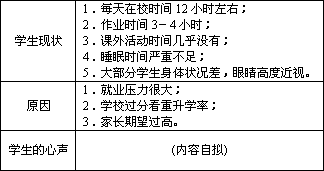
注意:
1.对所给要点不要简单翻译,要有适当发挥;
2.词数:150左右。短文中已写好了的部分,不计入总词数;
3.参考词汇:升学率:enrollment quotas;近视:nearsighted(adj.)
Dear Mr.Helper,
I am writing to tell you about the great pressure among us senior three students.We need your help badly because we can hardly bear the pressure.
________________________________________________
But actually, we teenagers are eager to _________________
____________________________________________________
We’d like to share our pressure and concern with you and we are looking forward to your advice.
Yours sincerely,
Li Ping
请根据下列提示写出相应内容。
1.arrow n.________
2.pan n.________
3.pancake n.________
4.平坦的adj.________→(使)变平vt.&vi.________→公寓n.________
5.指路;指挥vt.→________方向n.→________→直接的adj.________→直接地;一……就……________
书面表达
任务型写作
阅读下面的短文,然后按照要求写一篇150词左右的英语短文。
Here are some comments on Li Hua from his classmates.
Lily said, "Li Hua is the smartest student in our class and usually scores the highest marks in the English and mathematics exams.His homework and assignments are always done to a very high standard so our teachers ask us to follow his example.We all admire his intelligence."
Kate said, "Li Hua is really a hard-working student.He spends at least four hours everyday reviewing his lessons and his homework is never late.As the exams get closer he becomes even more diligent and works into the early hours of the morning, making sure he has gone over all of the information covered in our classes."
John said, "Li Hua is the kind of person who is easy to co-operate with.Although he's very clever he is still willing to listen to others' opinions and take their suggestions.When we do group work in class we all want to be in his group because he always does his share of the work and is easy to get along with."
Tim said, "Li Hua is the class monitor and the most helpful student in our class.He always makes sure the classroom is kept clean and assists the teacher in handing out and collecting the students' books and homework.When a student is absent from school he will call and tell them what they have missed."
[写作内容]假设你叫李平,你的同学李华拟申请到美国某大学学习。申请材料需包括同伴的推荐信。李华邀请你为他写一封推荐信。上文是其他同学对李华的一些评价,请根据这些评价和你自己对李华的看法,写一封推荐信。(信的开头和结尾已经为你写好):
1.以约30个词概括同学们眼中李华的特点和优点;
2.以约120个词表达你对李华的看法,并包括如下要点:
(1)你对同学们评价意见的看法;
(2)以你和李华之间的经历来说明其中的一点看法。
[写作要求]作文中可使用自己的亲身经历或虚构的故事,也可以参照阅读材料的内容但不得直接引用原文中的句子;
[评分标准]概括准确,语言规范,内容合适,篇章连贯。
| |||||||||||||||||||||||||||||||||||||||||||||||||||||||||||