网址:http://m.1010jiajiao.com/timu3_id_2999740[举报]
The common cold is the world's most widespread illness, which is plagues (瘟疫) that flesh receives. The most widespread fallacy (谬误) of all is that colds are caused by cold. They are not. They are caused by viruses passing on from person to person. You catch a cold by coming into contact, directly or indirectly, with someone who already has one.
If cold causes colds, it would be reasonable to expect the Eskimos to suffer from them forever. But they do not. And in isolated arctic regions explorers have reported being free from colds until coming into contact again with infected people from the outside world by way of packages and mail dropped from airplanes.
During the First World War soldiers who spent long periods in the trenches (战壕) cold and wet, showed no increased tendency to catch colds. In the Second World War prisoners at the notorious Auschwitz concentration camp (奥斯维辛集中营), naked and starving, were astonished to find that they seldom had colds.
At the Common Cold Research Unit in England, volunteers took part in experiments in which they gave themselves to the discomforts of being cold and wet for long stretches of time. After taking hot baths, they put on bathing suits, allowed themselves to be dipped with cold water, and then stood about dripping wet in drafty room. Some wore wet socks all day while others exercised in the rain until close to exhaustion. Not one of the volunteers came down with a cold unless a cold virus was actually dropped in his nose.
If, then, cold and wet have nothing to do with catching colds, why are they more frequent in the winter? Despite the most pains-taking research, no one has yet found the answer. One explanation offered by scientists is that people tend to stay together indoors more in cold weather than at other times, and this makes it easier for cold viruses to be passed on.
No one has yet found a cure for the cold. There are drugs and pain-killer pills such as aspirin, but all they do is relieve the symptoms.
1.How many examples are offered by the writer to support his argument?
|
A.4 |
B.5 |
C.6 |
D.3 |
2.Which of the following does not agree with the chosen passage?
|
A.The Eskimos do not suffer from colds all the time. |
|
B.Colds are not caused by cold. |
|
C.People suffer from colds just because they like to stay indoors. |
|
D.A person may catch a cold by touching someone who already has one. |
3.Arctic explorers may catch colds when _______.
|
A.they are working in the isolated arctic regions |
|
B.they are writing reports in terribly cold weather |
|
C.they are free from work in the isolated arctic regions |
|
D.they are coming into touch again with the outside world |
4.Volunteers taking part in the experiments in the Common Cold Research Unit _______.
|
A.suffered a lot |
B.never caught colds |
|
C.often caught colds |
D.became very strong |
5.The passage mainly discusses _______.
|
A.the experiments on the common colds |
|
B.the fallacy about the common cold |
|
C.the reason and the way people catch colds |
|
D.the continued spread of common colds |
查看习题详情和答案>>
| |||||||||||||||||||||||||||||||||||||||||||||||||||||||||||
| |||||||||||||||||||||||||||||||||||||||||||||||||||||||||||||||||||||||||||||||||||||||||||||||||||||||||||||||||||||||||||||||||||||||||||||||||||||||||||||||||||||||||||||||||||||||||||||||||||||||||||||||||||||
In modern society there is a great deal of argument about competition. Some value it highly,believing that it is responsible for social progress and prosperity. Others say that competition is bad;that it sets one person against another;that it leads to unfriendly relationship between people.
I have taught many children who held the belief that their self worth relied (依赖)on how well they performed at tennis and other skills. For them,playing well and winning are often life and death affairs. In their single minded pursuit(追求)of success,the development,of many other human qualities is sadly forgotten.?
However,while sonic seem to be lost in die desire to succeed,others take an opposite attitude. In a culture which values only die winner and pays no attention to the ordinary players,they strongly blame competition. Among the most vocal are youngsters who have suffered under competitive pressures from their parents or society. Teaching these young people,I often observe in them a desire to fail. They seem to seek failure by not trying to win or achieve success. By not trying,they always have an excuse:“I may have lost,but it doesn’t matter because I really didn’t try.” What is not usually admitted by themselves is the belief that if they had really tried and lost,that would mean a lot. Such a loss would be a measure of their worth. Clearly,this belief is the same as that of the true competitors who try to prove themselves. Both are based on the mistaken belief that one’s self respect relies on how well one performs in comparison with others. Both are afraid of not being valued. Only as this basic and often troublesome fear begins to dissolve(缓解) can we discover a new meaning in competition.
1. What does this passage mainly talk about? ?
A. Competition helps to set up self-respect.?
B. Opinions about competition are different among people.?
C. Competition is harmful to personal quality development.?
D. Failures are necessary experiences in competition.?
2. Why do some people favor competition according to the passage? ?
A. It pushes society forward.
B. It builds up a sense of duty.?
C. It improves personal abilities.
D. It encourages individual efforts.?
3. The underlined phrase “the most vocal” in Paragraph 3 means .
A. those who try their best to win ?
B. those who value competition most highly ?
C. those who are against competition most strongly ?
D. those who rely on others most for success?
4. What is the similar belief of the true competitors and those with a “desire to fail”?
A. One’s worth lies in his performance compared with others.?
B. One’s success in competition needs great efforts.?
C. One’s achievement is determined by his particular skills.?
D. One’s success is based on how hard he has tried.
5. Which point of view may the author agree to? ?
A. Every effort should be paid back.?
B. Competition should be encouraged.?
C. Winning should be a life-and-death matter.?
D. Fear of failure should be removed in competition.?
查看习题详情和答案>>
He lived his whole life as a poor man He suffered from a mental illness that led him to cut off part of his left ear in 1888 and to shoot himself two years later. But after his death, he achieved the world fame.
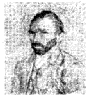
* And the Van Gogh Museum in Amsterdam, home to the biggest collection of his masterpieces, is marking the anniversary with exhibitions throughout the year.
“He is a big fame like Einstein and Beethoven. He is such a great figure. We are always amazed by how popular he is and his popularity seems to be growing.” said Andreas Bluehm, the museum's head of exhibitions.
Van Gogh was the son of a pastor. He left school when he was just 15. By the age of 27, he had already tried many jobs including an art gallery salesman and a French teacher. Finally in 1880, he decided to begin his studies in art.
“Instead of trying to reproduce exactly what I have before my eyes. I use colour more freely, in order to express myself more forcibly,” he wrote in a letter to his brother, Theo, in 1888.
Van Gogh sold only one painting during his short life. But now his works are sold for millions of dollars. His “Portrait of Dr. Gachet” was sold for US  89.5 million in 1990. It is the highest price ever paid for a painting.
1.The second paragraph mainly tells us that ________.
[ ]
A.the Van Gogh Museum is located in Amsterdam
B.the Van Gogh Museum has the biggest collection of Van Gogh'smasterpieces
C.exhibitions will be held in honor of Van Gogh
D.the Van Gogh Museum will hold exhibitions the whole year through for Van Gogh
2.The underlined word “figure” in the third paragraph means “________”.
[ ]
3.The writer cited a part of a letter written by Van Gogh to show Van Gogh's ________.
[ ]
4.Choose the right order of the given events.
a.He worked as a French teacher.
b.He achieved the world fame.
c.He left school. d. He cut off his left ear.
e.He shot himself. f. He began studies in art.
[ ]