网址:http://m.1010jiajiao.com/timu3_id_2975219[举报]
In 1891, a man named James Naismith was teaching physical education at a school in Springfield. One long, cold winter, he had to create a game for 18 young men to play indoors. So the Canadian-born Naismith wrote some rules.
Rule number one: “The ball may be thrown in any direction with one or both hands.” Two: “The ball may be batted in any direction with one or both hands (never with the fist).”
In all, there were 13 rules— the original rules of basketball. James Naismith is recognized as the inventor of basketball.
The National Association of Basketball Coaches established the Naismith Memorial Basketball Hall of Fame in Springfield, Massachusetts, in the northeastern United States in 1949. It opened in 1968 at Springfield College. A new, larger building opened in 1985. And, four years ago, the Hall of Fame moved into a newer building, just south of its former home. The new building increased the size by almost one hundred percent.
Honors ring in Basketball Hall of Fame.
The Basketball Hall of Fame is a museum and entertainment center. It combines history with technology. And it tries to capture the energy and excitement of the game. In the Center Court area, for example, visitors can play interactive games of basketball and take part in skill competitions.
The Hall of Fame explores basketball at every level of the game. Visitors learn about professional basketball in the United States and other countries. They learn about women’s teams and how the game is played at the college level. They also learn about basketball for disabled people.
The Hall of Fame honors the best players, teams, coaches and officials in basketball. Earlier this month, six more honorees joined the more than 250 people in the Hall of Fame. The six new members are Geno Auriemma, Charles Barkley, Joe Dumars, Sandro Gamba, David Gavitt and Dominique Wilkins.
40. James Naismith is considered to be the forerunner of basketball mainly because ____.
A. he discovered the first basketball
B. he created the earliest basketball games
C. he set up the Basketball Hall of Fame
D. he organized the earliest basketball games
41. From the passage, we can infer that ____.
A. the Hall of Fame only honors the best basketball players
B. James Naismith was employed as a coach in the Hall of Fame
C. visitors can compete with the professional players in the hall
D. a variety of basketball games are developed by the Hall of Fame
42. James Naismith made some rules in order to ____.
A. organize an indoor basketball game
B. improve physical education at school
C. train his students for the Hall of Fame
D. invent the game of basketball for the young
43. The passage talks mainly about ____.
A. the Basketball Hall of Fame B. the first basketball games
C. the original 13 basketball rules D. the players in the Hall of Fame
查看习题详情和答案>>
Most Chinese people these days know what it is like to have an “English teacher”, since almost all pupils study English from their third year. Usually that first English teacher will be a young and lovely lady in primary school. But my first English teacher is no other than my father. Looking back, I can see that, when I was only a little girl, he created an English environment by providing me with flashcards,fun English- language toys and even dolls which can sing English songs! My interest in English had certainly been awakened (唤起) when I began to learn English at school. Just imagine, he went a step further and asked me to learn New Concept English by myself! I was puzzled and even angry. I could not understand why a father could be so strict with his little girl. All the same, he never gave up and he gently insisted that I follow through with his idea. At first, I read stories with tears and I actually hated them because they were too difficult for me. In the end, I came to love the funny stories and, to be honest, my father was always there with a helping hand. I am sure that my English would never have got so far without his support. And that’s why my father is not only my first English teacher but also my lifelong teacher. He is one who awoke my interest, and who gave me much confidence .
【小题1】Most pupils in China begin to learn English________.
| A.in primary school | B.from parents | C.at three years old | D.at home |
| A.like my father | B.not my father | C.my father himself | D.not only my father |
| A.the girl preferred playing to learning English |
| B.the girl hates her father because he was strict |
| C.the girl is very thankful to her father |
| D.the father gave up after knowing his daughter could not understand |
| A.The girl’s father is her first English teacher. |
| B.The girl had been interested in English before going to school. |
| C.The girl’s father was always ready to help her with her English. |
| D.The girl could have learned English well by herself without her father. |
| A.How I learned English at school |
| B.My father---my first and lifelong English teacher |
| C.The relationship between my father and me |
| D.I’ve made progress in English learning |
Dave Bruno works as an online marketing manager. Several years ago, one weekend Bruno and his family did a major house cleanup and then donated several bags of unneeded items to the local Goodwill store. “After all were done, I looked around and realized that I still had too much stuff”, says Bruno, “It occurred to me that maybe I wanted to lead a simple life but in reality I behaved differently.” That realization prompted the 39-year-old father of three to try an experiment, “The 100Thing Challenge”.
With the goal of breaking free of what he calls a “bad habit of consumerism(消费主义), Bruno was determined to live for one year with just 100 personal items. He cut down his possessions to 94 items, including a Bible, laptop, guitar, wedding ring, car and clothes. He created some guidelines for the experiment since his wife and daughters did not participate, familyshared and household items did not count as personal items. He also grouped together some basic things such as underwear and socks. Bruno began blogging about his new lifestyle and eventually wrote a book, The 100 Thing Challenge: How I Got Rid of Almost Everything, Remade My Life, and Regained My Soul.
Since completing the experiment, Bruno has continued to live by the motto: reduce, refuse, and rearrange and maintains just 110 personal things. “ Nearly three years of living with a minimal amount of personal possessions, I’m no longer in the habit of consuming for the sake of consumption (消费),” he wrote in his blog last week, “That has freed me up for all sorts of better endeavors (活动) than shopping—like spending time with family and writing a book and planning for business opportunities.”
Bruno’s project has also inspired others to live minimally, many of whom post their own 100 Thing Challenge updates on YouTube. “The reality is that the 100 Thing Challenge is surprisinglyeasy”, says Bruno, “I’m not saying there were no challenges or disappointments. I miss some things, but not that much. Frankly, it’s far easier to live with less stuff than with excessive trash.”
【小题1】What does the underlined sentence mean in Paragraph 1?
| A.Bruno regretted to have an easy life. |
| B.Bruno had a special behavior in reality, |
| C.Bruno and his family led a happy life. |
| D.Bruno would have liked a life with fewer items. |
| A.socks | B.a Bible | C.cookers | D.a wedding ring |
| A.Live with 100 Things |
| B.Defeat 100 Challenges in Life |
| C.Survive by Your Motto |
| D.Consume for Consumption’s Sake |
Thomas Alva Edison was an American inventor, scientist and businessman who invented many things that greatly influenced life around the world, such as the phonograph, the motion picture camera, and a long-lasting, practical electric light bulb. Edison has been recognized as the creator of the first industrial research laboratory. It is he who came up with the concept of providing electricity for home. His first power station was on Manhattan Island, New York.
Edison was born in Milan, Ohio, and grew up in Port Huron, Michigan. He was the seventh and last child of his family. When he was young, Edison stayed at home and was taught by his mother. Edison recalled later, “My mother was the making of me. She was so true, so sure of me; and I felt I had someone to live for, someone I must not disappoint.” During his childhood, he suffered from scarlet fever which affected his hearing.
Young Edison sold candy and newspapers on trains running from Port Huron to Detroit, and he sold vegetables to supplement his income. These jobs, though insignificant, inspired him greatly. He realized that he had a talent for business. These talents eventually made him founder of 14 companies, including General Electric, which is still in existence and is the largest publicly traded company in the world.
Edison started as a telegraph operator and this was the field in which he came up with the first invention. The invention which first gained him fame was the phonograph in 1877. The invention seemed magical, as nothing similar had ever been thought of before. Funded by the successful sale of the telegraph at a price of $10,000, Edison built his own research laboratory in Menlo Park, New Jersey.
The laboratory expanded rapidly over the decade. In 1892, it was confirmed that Edison was the official inventor of the carbon microphones, which was used in all telephones. Although he attempted to make use of X-rays to take radiographs, he quit the project and admitted his fear of X-rays in public.
Thomas Edison died of diabetes at his home in New Jersey, on October 18, 1931 and in honor of his contributions, Life magazine (USA), in a special double issue in 1997, placed Edison first in the list of the “100 Most Important People in the Last 1000 Years”, noting that the light bulb he promoted “lit up the world”.
Title: Thomas Edison—an influential person in the American history
|
Edison’s __71__ to society |
◆ He invented many things that greatly influenced life around the world, _72__ the phonograph, the motion picture camera, a long-lasting, practical electric light bulb and the carbon microphone. ◆ He set up the first industrial _73__ laboratory. ◆ He put __74__ the concept of providing electricity for home. ◆ He __75__ 14 companies, including General Electric, which is still in existence and is the largest publicly traded company in the world. |
|
The life experience of Edison |
◆ He was born in Milan and was the youngest of seven children in his family. ◆ _76_ of receiving schooling, Edison was taught by his mother at home. ◆ The scarlet fever he suffered _77_ to hearing loss. ◆ To earn a living, Edison sold newspapers, candy and vegetables, which __78__ him and helped him discover his talent for business. ◆ Later, he worked in the field of telecommunication as an telegraph operator, where he invented phonograph in 1877, which gained him great fame. ◆ After he created his research laboratory, he __79__ up the project of making use of X-rays to take radiographs due to his fear of radiation. ◆ He died of diabetes at his home in New Jersey in 1931. |
|
The honor given to Edison |
◆ He was placed first in the list of the “100 Most __80__ People in the Last 1000 Years”, noting that the light bulb he promoted “lit up the world”. |
查看习题详情和答案>>
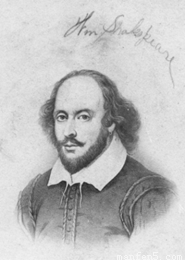
Today, we complete our story about the influential English writer William Shakespeare. He wrote plays and poems during the late fifteenth and early sixteenth centuries, which remain very popular today.
During earlier times, people would probably have learned several ancient Roman and Greek plays. It was not unusual for writers to produce more current versions of these works. For example, in Shakespeare’s play “The Comedy of Errors”, Shakespeare borrowed certain details from the ancient Roman writer Plautus. For his play “Macbeth”, Shakespeare most likely used a work on Scottish history by Raphael Holinshed for information. Shakespeare might have borrowed from other writers, but the intensity(强度)of his imagination and language made the plays his own. While many plays by other writers of his time have been forgotten, Shakespeare and his art live on.
Shakespeare was also influenced by the world around him. He described the sights and sounds of London in his plays. His works include observations about political struggles, the fear of diseases, and the popular language of the city’s tradesmen. Shakespeare’s knowledge of the English countryside is also clear. His works include descriptions of deep forests, local flowers, and the ancient popular traditions of rural people.
It would be impossible to list all of the ways in which Shakespeare’s works have influenced the world culture. But the first and greatest example would be his great influence on the English language. During his time, the English language was changing. Many new words from other languages were being added. Shakespeare used his sharp mind and poetic inventiveness to create hundreds of new words and rework old ones. For example, he created the noun forms of “critic”, “mountaineer” and “eyeball”. Many common expressions in English come from his plays, including “pomp and circumstance(装腔作势)” from “Othello”, “full circle(绕圈子地)” from “King Lear”, etc. The list of cultural creations influenced by Shakespeare is almost endless. From paintings to television to music and dance, Shakespeare was well represented. Shakespeare’s plays have been translated into every major language in the world.
Shakespeare became a wellknown writer during a golden age of theater. His years of hard work paid off.
1. From the passage, we can see that ________.
A. Shakespeare was hardworking when he was a student
B. many of Shakespeare’s works were influenced by earlier writings
C. the experience of living in London had no effect on Shakespeare’s works
D. Shakespeare became rich later because of the popularity of his works
2. Why could Shakespeare’s works survive his time?
A. Because there were so few people writing plays in his time.
B. Because he produced too many works that nobody else could do.
C. Because his works were rich in imagination and language.
D. Because he was a rich and influential person of his time.
3.Shakespeare’s greatest influence should be on .
A. paintings B. television
C. the English language D. music and dance
4.The passage is mainly about .
A. an introduction to Shakespeare’s life and his works
B. the main features and styles of Shakespeare’s plays
C. Shakespeare’s greatest influence on the world culture.
D. how culture influenced Shakespeare and he influenced culture.
查看习题详情和答案>>